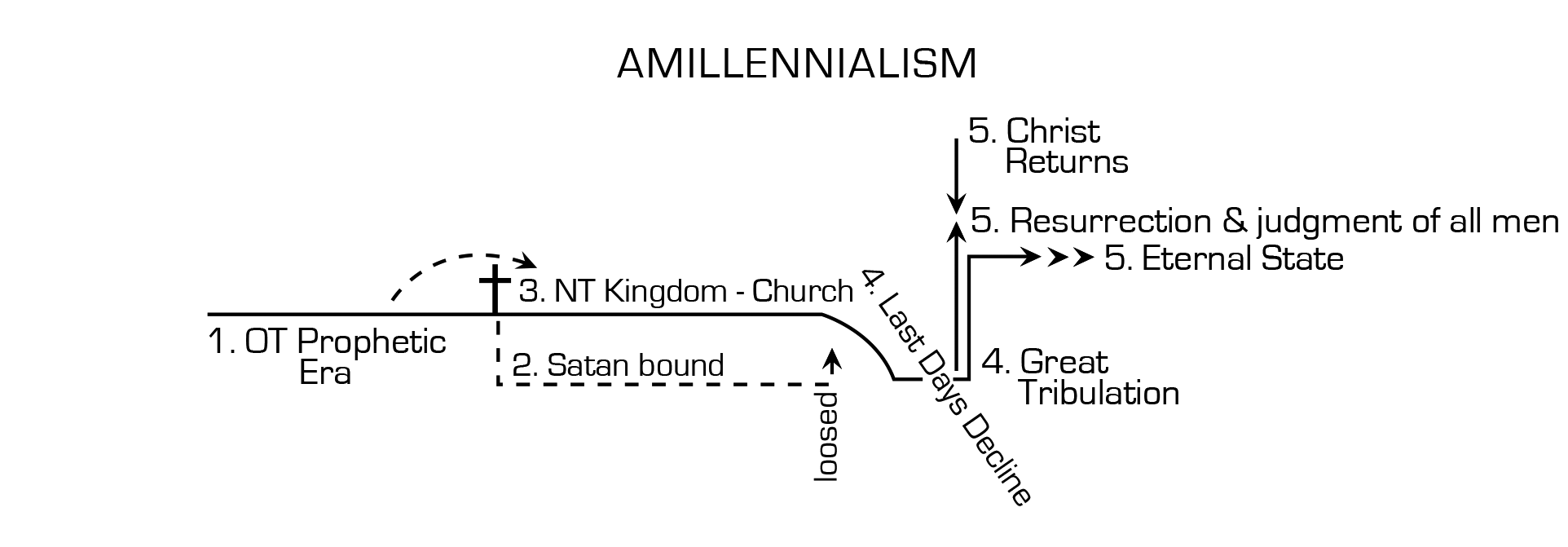
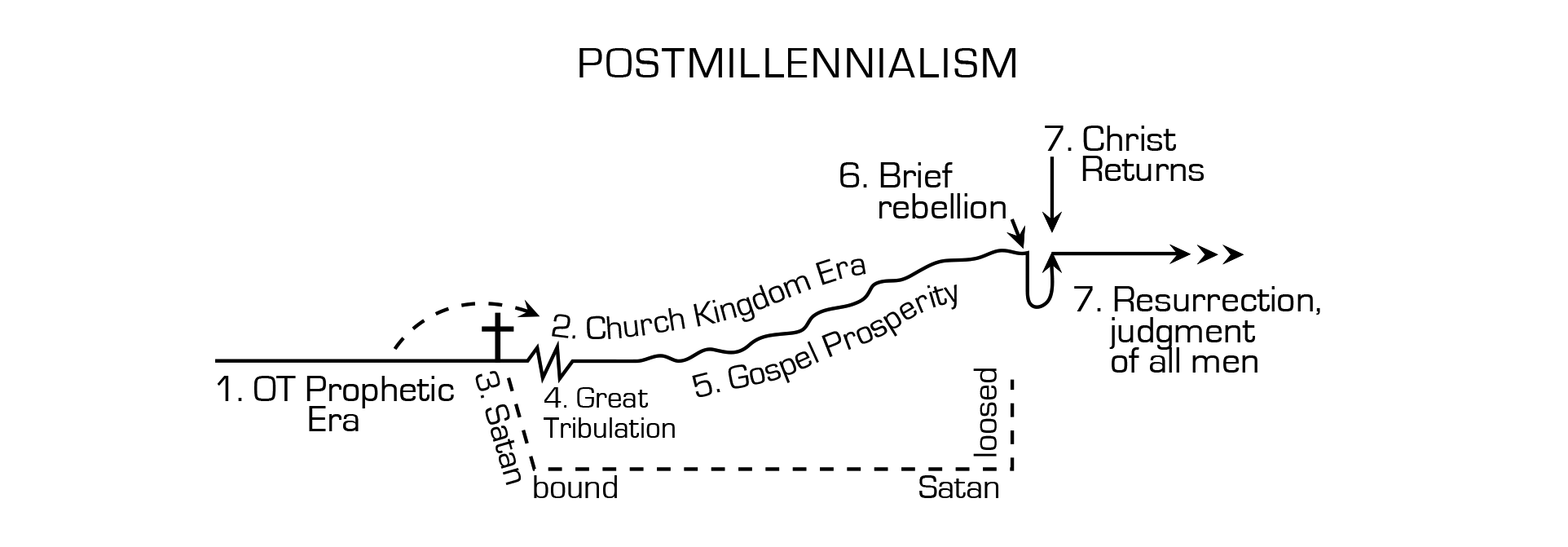
As I was preparing for tomorrow’s sunday school lesson, I thought it might be helpful to post up a few charts of the four predominant views on the millennium. I have to thank the folks at Postmillennialism.com for their work on these (I’m not endorsing everything on their site, but these charts were helpful).
Sunday Class Notes
Introduction to Revelation: Part 4
The Kingdom of God & the Already Not Yet
Often it is very easy to get caught up in viewpoints about the millennium, and I do not want to detract from the importance of the millennium. For even though the millennium – the 1,000 year reign of Christ mentioned in the first few verses of chapter 20 – takes up a very short space in terms of the book itself, its importance is seen in how we interpret what its saying.
But before we discuss these things specifically, I believe we need to begin our study of this book by briefly examining the nature of the kingdom of God. For when we speak of the “millennium” we’re talking about the Kingdom of God, and specifically the reign of His Christ.
Tom Schreiner says, “Those who participate in the first resurrection will reign with Christ for a thousand years (Revelation 20:6), although the nature of this reign is intensely debated, and scholars differ on whether it refers to the reign of saints in the heaven during the time between the resurrection and the return of Christ or to a reign of the saints on earth before the inauguration of the new heavens and new earth.”[ix]
We can see the importance of this idea of the reign of Christ in how it manages to seep into how pastors and theologians comprehend the overarching theme(s) of this book. For instance, Warren Wiersebe, a Premillennialist, says, “The overriding theme of the book of Revelation is the return of Jesus Christ to defeat all evil and to establish His reign.” Note how he uses the word “establish” in lieu of the word “consummate” which is the term an amillennialist would use because of the emphasis on Christ’s current reign.
The amillennialist would remind us of verses like we find at the end of Mark’s gospel, “So then the Lord Jesus, after he had spoken to them, was taken up into heaven and sat down at the right hand of God” (Mark 16:19 – also see Ephesians 1:20-23)[i]
Now, most theologians believe that Christ is reigning now, but what is the nature of that reign? I think the difference lies in whether or not one believes that His current reign is somewhat lesser or mostly spiritual (i.e. in the hearts of his people).
Dispensationalist John MacArthur puts it this way:
So God rules spiritually now over the hearts of those who know Him by faith. And that’s been the case since His saving work began. There is a spiritual element of the Kingdom that has existed since God started redeeming men. But this is not that spiritual Kingdom of which we read here, but rather that earthly literal Kingdom which comes at the culmination of human history.[ii]
However, I think that this emphasis on the future nature of Christ’s kingdom does injustice to His victory at Calvary, and does not fully comprehend the fullness of Christ’s current reign.
You can now see the rub, can you not? How we think about the kingdom of God shapes how we view the book of Revelation, and perhaps the millennium question in particular.
The Already/Not Yet
I believe the critical hermeneutical principle which will help us most is called the “already/not yet” principle. In order to understand most of the NT – especially the words of Jesus and the book of Revelation – we need to understand this important principle.
For our purposes, I believe that we need to get our heads around two truths about the nature of God’s kingdom. The first is that it has been inaugurated by Jesus Christ, and will be consummated upon his return. The second is that God is working dynamically in history to bring about the expansion of His kingdom and its final consummation.
Regarding the first truth, it is worth quoting R.C. Sproul at this point at length:
Many professing evangelicals today believe the kingdom of God is strictly in the future, although there is no biblical foundation for that. This view robs the church of important teachings concerning the kingdom that are clearly set forth in the New Testament. In fact, the New Testament opens with John the Baptist’s announcement of the kingdom: “Repent, for the kingdom of heaven is at hand” (Matthew 3:2).
Another time the Pharisees asked Him when the kingdom of God would come, and Jesus replied, “Behold, the kingdom of God is in the midst of you” (Luke 17:21). The kingdom was in their midst became (sic – because) the King was there. In another occasion, He said, “But if it is by the finger of God that I cast out demons, then the kingdom of God has come upon you” (Luke 11:20).
So John came first with his warning of the radical nearness of the kingdom. Then Jesus came announcing the presence of the kingdom. This was followed by the acme of His redemptive work in the ascension, when He left earth to go to His coronation, where God declared Him King. As Jesus stood on the Mount of Olives, read to depart, His disciples asked him, “Lord will you at this time restore the kingdom to Israel?” (Acts 1:6). They had been waiting for Jesus to make His move, to drive out the Romans and establish the kingdom, but Jesus replied, “It is not for you to know times or seasons that the Father has fixed by his own authority. But you will receive power when the Holy Spirit has come upon you, and you will be my witnesses in Jerusalem and in all Judea and Samaria, and to the end of the earth” (Acts 1:7-8).
In answer to their question about the kingdom, Jesus gave the fundamental mission of the church. Men would be blind to His kingship, so His disciples were given the task of making it visible. The fundamental task of the church is to bear witness to the kingdom of God. Our King reigns now, so for us to put the kingdom of God entirely in the future is to miss one of the most significant points of the New Testament. Our King has come and has inaugurated the kingdom of God. The future aspect of the kingdom is its final consummation.[iii]
When Jesus returns it will not be to establish a kingdom, but rather to consummate a kingdom which has been established from before the foundation of the world, and which He reigns over at this very moment.
Indeed the book of Revelation, as we mentioned earlier, was written to assure Christians that He is in control over all things – He is the Lord of history.
Interestingly, Beale thinks that John wrote Revelation with the book of Daniel in mind – especially important in Daniel is the already/not yet function of his literature. Some things were occurring right away for Daniel during his time, while others he saw as distant and far away. Those things which Daniel saw as far away, John saw as fulfilled at least partially in the death, burial and resurrection of the Lord Jesus and the inauguration of his kingdom.
Beale puts it this way:
John probably views the death and resurrection of Christ as inaugurating the long-awaited kingdom of the end times predicted by Daniel, which will now continue throughout the church age.
Side note: for those more advanced in prophetic study or curious about these things, one of the things Beale and other see in Revelation is that at the beginning of some of the major sections/division there is a reference or allusion to something from Daniel chapter two (1:1, 4:1, and 22:6) Beale says that a pattern definitely emerges, “John is employing the same allusion as a literary device to give structure to his whole book.”
This also has ramifications for how we understand the millennium.
Douglass Kelly says, “The exercise of this heavenly authority over all lesser powers is the main thing that is happening in this age between the two comings of the Lord; which, as we shall seek to demonstrate, is the prime meaning of the millennium. The millennium is not a literal period of only one thousand years that will occur much later; rather it is that period of victorious outreach of the Gospel to the nations: a time that last from Jesus’ first coming to his last.”[iv]
All of this can be comprehended by identifying how the Bible speaks about the kingdom of God and the reign of His Christ in other places, and how we are to understand this in light of what we read in chapter 20. Is Jesus’ reign something future, or is it now and to be seen with our eyes in the future? How should we think of, and describe his reign?
This is what R.C. Sproul was speaking of earlier when he said that Christ’s kingdom was “inaugurated” but not yet “consummated.” There are some promises, and some realities that are presently being realized in the church age, yet will not come to their full glory until Christ returns. Our very salvation is like this, for we are saved NOW, yet we have not yet fully realized that salvation. We have the down payment of this reality in the giving of the Spirit, yet not the consummation of this reality in the presence of our Lord and Savior.
The second principle is tied to the first, and it is this: The kingdom of God is “dynamic.” That is to say it is more than just this idea of God separately reigning in heaven, He is working out His will in and amongst us in time and space. He is ruling here – He is involved in our lives – His rule is not detached.
John Frame quotes Geerhardus Vos for us on this matter:
To him (Jesus) the kingdom exists there, where not merely God is supreme, for that is true at all times and under all circumstances, but where God supernaturally carries through his supremacy against all opposing powers and brings men to the willing recognition of the same.
Then Frame says, “On this definition, the kingdom is dynamic, indeed dramatic. It is a world-historical movement, following the fall of Adam, in which God works to defeat Satan and bring human beings to acknowledge Christ as Lord. It is, preeminently, the history of salvation.”[v]
Anthony Hoekema puts it this way:
The kingdom of God, therefore, is to be understood as the reign of God dynamically active in human history through Jesus Christ, the purpose of which is the redemption of God’s people from sin and from demonic powers, and the final establishment of the new heavens and the new earth. It means the great drama of the history of salvation has been inaugurated, and that the new age has been ushered in. The kingdom must not be understood as merely the salvation of certain individuals or even as the reign of God in the hearts of his people; it means nothing less that the reign of God over his entire created universe. “The kingdom of God means that God is King and acts in history to bring history to a divinely directed goal. (quoting Ladd)”[vi]
He goes on to say, “The Kingdom of God involves two great moments: fulfillment within history, and consummation at the end of history.”[vii]
Now given what we know of these two principles, we know that God is both reigning supreme over all, but also dynamically working in and through His creation to bring about His purposes. This points to the linear nature of history – God is working toward something.[viii] What He is doing now in and through us by His Spirit and His Lordship over all history and creation is a shadow of what will be upon the consummation of His purposes.
Christ inaugurated a kingdom (the already) and with that inauguration has brought forth fruit first by His cross work, and now by His Spirit’s powerful work here on earth through the spread of the gospel. One day He will return to consummate His kingdom (the not yet) and upon that return will usher in the visible reality of his reign (the already).
While futurists await a future “literal earthly” kingdom (which we all look for), the way in which we speak about and think about God’s exercise of power and authority over the world, and the souls of lost people is important. I believe its crucial that we understand God as working even now dynamically, personally, powerfully in history and in the lives of men all across the globe to expand his kingdom – a real kingdom of real people.
So you can see how these perspectives function to shape our viewpoint of the book itself and the millennium. But they also shape how we live our lives as Christians – especially what kind of mindset we take toward events here on earth and circumstances in our personal lives.
NOTE: Some of the dispensationalists might argue that God rules “spiritually in the hearts” of men, but not physically here on earth, and does not rule them in any way other than in their hearts. To me this is a false dilemma. The postmillennialist has it right in the respect that when God saves a man, there is fruit and evidence of change not only in that man’s heart, but in his life and in the society in which he lives. To argue a distant futurist reign of Christ is to argue the opposite of how the Bible describes the efficacy of Christ’s work on the cross. He truly is Lord of all and he exercises that Lordship full now, though it is unseen (as Sproul mentions above). I’m not saying that the Postmillennial view is perfect, but their mindset on the nature of the kingdom certainly seems to make more sense and align more Biblically to me.
The Millennium
With this cursory understanding of the kingdom of God under our belts, let us examine the four major views on the reign of Christ in the millennium.
Amillennialism
The Amillennial view (Amil) is probably the simplest of the four major viewpoints on the millennial question.
Wayne Grudem says, “Those who are said to be reigning with Christ for the thousand years are Christians who have died and are already reigning with Christ in heaven…This view is called ‘Amillennialism’ because it maintains that there is no future millennium yet to come.”[x]
John Frame describes it:
The Amil believe that the millennium is now, the whole period from Jesus’ ascension to his return. He emphasizes that the resurrection and ascension of Jesus ushered in a new era of world history. Jesus has now achieved a great victory over Satan, sin, and death…The Amil says that Satan no longer deceives the nations (20:3) as he did before the coming of Christ. Before Jesus came, believers in the truth God existed mainly in Israel. The other nations were deceived by Satan into worship idols. But after the resurrection, the Christian church received power to reach people of all nations with the message of the gospel. And God will continue to empower this mission until the last day, until there are believers from every kingdom, tongue, tribe and nation.[xi]
R.C. Sproul adds…
The Amillennial position, which holds some points in common with both of the premillennial positions, believes that the church age is the kingdom age prophesied in the Old Testament. The New Testament church has become the Israel of God. Amillennialists believe that the binding of Satan took place during Jesus’ earthly ministry; Satan was restrained while the gospel was preached to the world, and this restraint continues today.[xii]
The verses that come to my mind as typically cited in terms of the defeat of Satan are as follows:
The seventy-two returned with joy, saying, “Lord, even the demons are subject to us in your name!” And he said to them, “I saw Satan fall like lightning from heaven. Behold, I have given you authority to tread on serpents and scorpions, and over all the power of the enemy, and nothing shall hurt you. Nevertheless, do not rejoice in this, that the spirits are subject to you, but rejoice that your names are written in heaven.” (Luke 10:17-20)
He disarmed the rulers and authorities and put them to open shame, by triumphing over them in him. (Colossians 2:15)
Frame describes how the Amil views the future…
Amils affirm that toward the end of this era Satan will be released briefly, as Revelation 20:3 indicates (also verses 7-8). He will then deceive the nations again, presumably achieving some measure of his old power. But he will be frustrated and defeated by the return of Christ and the judgment that will result in his final destruction.[xiii]
Amils believe that the first resurrection is simply that spiritual resurrection that has taken place and realized during the intermediate state. The second resurrection is the physical resurrection of the body preceding the judgment when Christ returns. Frame says, “Similarly, the first death is the physical death of human being; the second death is the condemnation of the wicked, a death that believers do not experience.”[xiv]
Postmillennialism
Most folks who are of the post-mil persuasion also believe that the millennium period of 1,000 years is NOW just like the Amils believe. John Frame notes that some older literature reveals that there are a few Post-mills who have said that is a part of this time now, but more will reside in the future. Post-mills also agree with Amils on the binding of Satan during Christ’s ministry and his release for a short time before Jesus’ return.
John Frame describes the difference between Amils and Post-mills:
Well, although the postmil agrees with the amil that our age is a time of persecution for the church, he also thinks that during this time Christians will come to have more and more influence in general culture. Believers will indeed gain wealth, influence, and even dominance.[xv]
Sproul describes this unique part of Post-millennialism:
What distinguishes postmillennialists from amillennialists and premillennialists is the belief that Scripture teaches the success of the Great Commission in the age of the church.[xvi]
Grudem says, “ The primary characteristic of postmillennialism is that it is very optimistic about the power of the gospel to change lives and bring about much good in the world.”
I must admit that when I study the history of the world since the spread of the gospel, I do not see a uniform trajectory upward toward a world of people who are united in morals and standards. Certainly I believe that since Christ the world has been changed in huge part by the Gospel of Jesus Christ. There is no doubt that the world was in darkness before He came – so much so that every other nation worshiped idols except Israel. Can you imagine if we looked around the world today and every other nation except one the size of Rhode Island worshiped wooden blocks and golden statues? So certainly the gospel has transformed our world.
However, the post-millennial viewpoint was really made popular and caught on prior to the 20th century. It was perhaps at its height at the end of the 19th century when medical cures were being found, the industrial revolution was in full swing, and great revivals had swept across the world many times over the course of the past several hundred years. Then came World War I. The gruesome bloodshed and seemingly worthless outcome was more than conservative theologians could swallow in their assessments of world events and the human situation on earth.
However, not all theologians and pastors had to wait until the bloody events of the 20th century to object to Postmillennialism’s optimistic theology. J.C. Ryle, the great 19th century contemporary of Spurgeon, wrote hinting about this way of thinking:
Let us dismiss from our minds the vain idea that nations will ever give up wars entirely, before Jesus Christ comes again. So long as the devil is the prince of this world, and the hearts of the many are unconverted, so long there must be strife and fighting. There will be no universal peace before the second advent of the Prince of peace. Then, and then only, men shall “learn war no more” (Isaiah 2:4).
Let us cease to expect that missionaries and ministers will ever convert the world, and teach all mankind to love one another. They will do nothing of the kind. They were never intended to do it. They will call out a witnessing people who shall serve Christ in every land, but they will do no more. The bulk of mankind will always refuse to obey the Gospel. The nations will always go on quarreling, wrangling, and fighting. The last days of the earth shall be its worst days. The last war shall be the most fearful and terrible war that ever desolated the earth.[xvii]
The theology fell out of style, yet there are some very smart theologians whom I respect who still hold this theology today. John Frame[xviii] and Keith Mathison both consider themselves Post-Millennial.
I say all that because, while I do not consider myself Postmillennial, I really respect those who take that view, and their arguments are generally very scriptural. They point to many times, both in Scripture and in the time since Christ, when Christian influence has changed the world for the good. They remind us that when Jesus changes someone’s head and heart, those changes lead to changes in our actions which affect the society in which we live.
NEXT TIME…..Premillenialism…..
FOOTNOTES
[i] Ligonier has a devotional published about the kingdom of God which cites these verses in Ephesians: http://www.ligonier.org/learn/devotionals/seated-at-gods-right-hand/
[ii] John MacArthur sermon on Revelation 20 (Part 1): http://www.gty.org/resources/print/sermons/66-73
[iii] Sproul, Everyone’s a Theologian, Pg. 307.
[iv] Kelly, Pg. 11
[v] John M. Frame, ‘Systematic Theology: An Introduction to Christian Belief’, Pg. 87
[vi] Hoekema, The Bible and the Future, Pg. 45
[vii] Anthony Hoekema, ‘The Bible and the Future’, Pg. 51
[viii] For more on the linear nature of history, see Anthony Hoekema’s ‘Created in God’s Image’
[ix] Tom Schreiner, New Testament Biblical Theology, Pg. 846-847.
[x] Wayne Grudem, Systematic Theology, Pg. 1110.
[xi] John Frame, Systematic Theology, Pg. 1087-1088
[xii] R.C. Sproul, Everyone’s a Theologian, Pg. 313.
[xiii] John Frame, Systematic Theology, Pg. 1088
[xiv] John Frame, Systematic Theology, Pg. 1088
[xv] Frame, Systematic Theology, Pg. 1088.
[xvi] Sproul, Everyone’s a Theologian, Pg. 314.
[xvii] J.C. Ryle, Expository Thoughts on the Gospels, Luke 21:10-19. Here Ryle is discussing the Olivet Discourse and particularly, “Christ’s predictions concerning the nations and the world.” That this important, and sound, theologian and pastor would raise such a warning flag against the post-mil mindset while its popularity was at its zenith is (to me) a very important note.
[xviii] Frame, Systematic Theology, Pg. 1094
Introduction to Revelation: Part 3
Welcome to part three of my introduction to Revelation. On Sunday morning we covered the nature of symbolism in Revelation as well as the four main overarching viewpoints of the book. I hope you enjoy this post!
PJW
Symbolism in Revelation
It has occurred to me after studying many of the viewpoints of the pre-trib rapture folks that understanding proper hermeneutics is really fundamental to understanding Revelation. Of course, I’ve mention his before in this study and also in other books I’ve taught through. But I think that when it comes to Revelation, getting the symbols right is important – in fact, just understanding that symbols are, well, symbolic is important!
I bring up the pre-trip rapture folks because as I read through the work of one such seminary professor’s work this evening, I began to really be impressed with his knowledge of Scripture, and his desire to bring Scripture to bear in the forming of his opinions. As I read through his Scripture references, I began to see where he was coming from, but it didn’t make complete sense until I read that, in his view, Revelation 4-18 contained no mention of the church. Of course this is a major point in the pre-trib rapture argument. These folks believe that the church must have been raptured prior to chapter 4. Furthermore, they assume the book works chronologically, and not simply a series of visions describing the inter-advental period.
Now, I disagree with their chronological assumption, and I will address that later. But let me just hone in on this major issue of not seeing the church mentioned anywhere between chapters 4 and 19. This particular professor held a similar belief of many pre-trib folks who say that the “elect” and “Israel” are mentioned, but not the church. Of course, just a simple understanding of the meaning of “the elect” tells us that he doesn’t understand that the elect ARE the church. But again, we will set aside this equally stupefying misunderstanding and just realize that these people come to the conclusion that “the church” is not mentioned in these chapters because they are not reading the book symbolically.
I spent all that time laying that example out so you can see that hermeneutics have consequences. If we ignore the obvious symbolic nature of Revelation and instead choose to take every image we possibly can as literal, then we will never understand this great book.
The question is really not whether we should interpret the book symbolically, but rather how do we go about understanding the symbols? I have given Johnson’s 7 ways to “see” Revelation above, and now I want to just overlay that with some thoughts from Hendriksen who has just 3 different things for us to consider:[i]
1. There is a need to concentrate on the central theme
Just like in Jesus’ parables, each symbol usually has just one main theme or message its trying to convey. You might find other truths associated with the symbols, but that doesn’t take away from the one or two driving principle thoughts/themes.
2. There is a need to distinguish between the principle and the detail
Hendriksen puts it this way:
One must not begin to press the details. One must not ask, in the symbol of the locusts that came out of the abyss (9:1-11), what is the separate meaning of their hair, teeth, breast-plates, etc.” We must not pluck the symbol apart and lose the unity. These details belong to the picture, just as the mule, wine, oil, etc. belong to the parable of the Good Samaritan. One should ask, first, what is the picture taken as a whole? Second, what is the one central meaning of this picture?
As a rule the details belong to the picture, to the symbol. We must not try to give a ‘deeper’ interpretation to the details, unless the interpretation of these details is necessary in order to bring out the full meaning of the central idea of the symbol. Thus, in the symbol of the new Jerusalem (chapters 21, 22), the central idea is perfect fellowship with God. The details – wall, foundations, gates, river etc. – describe the glorious character of this fellowship. What we are after is the total impression, the central idea, of each complete symbol. As in the parables, so here, the context helps to explain the meaning of the picture, and a thorough study of all the details is also necessary in order to determine what is the central thought.
- Learning what the symbols mean
Hendriksen says that there are really two kinds of symbols. The first are those “symbols which describe the beginning or the end of the course of the new dispensation…for example, the radiant woman who is delivered of a Son, a Man-child, refers to the Church bringing forth the Christ, His human nature (12:1-5)” or “…the twofold harvest (14:15) refers to the final judgment, to that one great event.” These are big events at the beginning of the first advent or the end of the age etc.
The second type of symbol is that which fills the majority of the book and could be people, tribulations, place etc. happening in time between the first and second advent of Christ. These symbols are such as the lamp stands, the bowls, the trumpets, seals etc. The question is, do these symbols represent particular people or specific events – single happenings – in history or in the future? Hendriksen, Baucham and many others say “no”, and I agree with them. This probably puts them (and me) in some sort of fashion under the “idealist” view of the book – which we will discuss momentarily!
The reason for these symbols not representing specific one-time events or people in most cases is evident for numerous reasons. First if they did, how would we ever know which events or people in history? Everyone would have their own “interpretation”! Who would be the final judge? We’d have to give up and say that this book isn’t able to be interpreted. But we don’t do that because we believe that this book was indeed given to “reveal” to us God’s purpose, and to edify the church.
Furthermore, these symbols operate in a sphere (to paraphrase Hendriksen) that is very extensive. Large swaths of the earth are involved in the descriptions of the effects of these seals, bowls, trumpets and so forth. “This could hardly be true if each seal, trumpet or bowl had reference to just one single event in history, an event that takes place at a certain specific date in a definite locality…again, these symbols affect not just one very limited group of people, but a multitude that cannot be counted.”
Hendriksen also points out that most of the symbols operate in groups of seven – not a coincidence I think. “This number seven indicates completeness. It harmonizes very well with the idea that the symbols refer to principles in human conduct and of divine government that are always operative, especially throughout this entire dispensation.”
Hendriksen sums up the viewpoint I take on most of these symbols:
Yet we do not believe that this is a closed book. We fully believe that it is a revelation, an unveiling. So we must look for some other rule of interpretation (other than that of specific symbols representing specific one-time events or people).
…It is on the basis of the symbols themselves, as described in the Apocalypse, that we arrive at this very significant conclusion, namely, that the seals, trumpets, bowls, and similar pictures, refer not to specific events or details of history, but to principles that are operating throughout the history of the world, especially throughout the new dispensation.
And…
We should constantly bear in mind that the purpose of God and of the seer is to make men wise unto salvation. The book has an ethical and spiritual purpose. For if these symbols merely indicate and predict isolated, future events, it may satisfy some people’s curiosity, but it can hardly be said that people, in general, are edified. On the other hand, if we believe that the book reveals the principles of divine moral government which are constantly operating, so that, whatever age we happen to live in, we can see God’s hand in history, and His mighty arm protecting us and giving us the victory through our Lord Jesus Christ, then, and only then, are we edified and comforted.
Which leads us to our next topic…
But first… a NOTE: As I personally work through the book of Revelation, I will be leaning heavily on those who have closely examined the symbolic nature of the book. While Hendriksen provides a wonderful layman’s outline of how to think of these symbols in broad terms of interpretation, Beale agrees with these and adds another level of study. Beale’s work is very thorough and while he agrees with Hendriksen on OT background, and immediate context, he also explains in-depth the way to both discover when one is seeing a symbolic reference, as well as how and when to approach each symbol to a degree of study that others simply haven’t touched. Beale relies on Sweet, Caird and others as well as his own language and grammar expertise. Much of this is found throughout the commentary, but on pages 50-69 he spends time diving into the grammar and contextual matters involved in this book, and what grammatical/literary and logical rules we must apply when thinking through this book. I just mention this as an aside because for me to go through each of his points in my own notes and teaching would fall beyond the scope and patience level of most people, yet I want those who I’m teaching to understand where I’m deriving my frame of reference for these grammar and literary rules. Indeed I want to assure those in my care that such careful consideration has been taken in these points so that my teaching might be clear, yet without subjecting those reading and listening the tediousness of combing through grammar and literary matters on a Sunday morning.
The Overarching Viewpoints
In the approach to this book there have been several perspectives. There are mainly four overarching perspectives with several modified versions of each. The main four are: Historist, Idealist, Futurist, and Preterist. Let me give a brief overview of each one.
Historist
The Historist view is very interesting. They see Revelation as dealing with the big events in Christian history from Christ’s ministry until this day. Beale describes this view:
The majority of these (Historist) commentators have understood the seals, trumpets, and bowls as unfolding successive events in history in general chronological order. Christ’s final coming is usually seen as very imminent. Typically this view identifies parts of the Apocalypse as prophecies of the invasions of the Christianized Roman Empire by the Goths and the Muslims. Further, the corruption of the medieval papacy, the reign of Charlemagne, the Protestant Reformation, and the destruction wrought by Napoleon and Hitler have been seen as predicted by John.[ii]
Issues with this view include its exclusion of non-western church events as important to world history, and also there’s the problem that different people who’ve held this view at different points in history have not agreed with each other on the particulars of each major historical movement. Beale also points out that, “such a projection of future history would have had little relevance to the first-century readers of Revelation.”
Preterist
The Preterist view has two main iterations. The destruction of Jerusalem by Titus’ armies in 70 A.D. figure prominently in both views. The first believes that the entire book of Revelation is really a prediction about the fall of Jerusalem in 70 A.D. (of course this necessitates an early dating to the book). These folks believe that “Babylon” represents Israel “who aids Rome in oppressing Christians.”[iii] Israel is therefore being judged, and their temple’s destruction is the climax of all the judgment prophecy in Revelation (not to mention Daniel 2 and 7). There are several problems with this, not the least of which is that Daniel 2 and 7 – which are integral to Revelation’s judgments – indicate a worldwide/universal judgment of nations, whereas Preterists see these judgments as exclusive to Israel.
The second main form of Preterism indicates that what Revelation talks about was fulfilled in the fall of Jerusalem in 70 A.D. but that “Babylon the Great” refers to Rome, and not to Israel. This makes a little more sense, but still encounters the difficulties mentioned above.
Now there is a view called “Partial Preterism”, which R.C. Sproul describes as follows:
Partial Preterism holds that many of the prophecies of the future were fulfilled in the first century – chiefly in the events surrounding the destructions of Jerusalem in AD 70. Most Partial Preterists say that the first twenty chapters of Revelation have taken place while the last two chapters have yet to be fulfilled. Partial Preterists tend to be postmillennial in their thinking, holding that the millennium (not a literal one thousand years) began with the first advent of Christ.[iv]
There are other forms of preterism which are really nothing more than heresy. One says that John prophesied worldwide destruction, but was mistaken. Another is similar to the first form I mentioned only goes so far as to say that Jesus came back in 70 A.D., judged Israel, and went back to heaven. In this view there will be no second coming of Christ, for He has already come.
John Frame wisely remarks, “It is also significant that the early church fathers of the generation following the apostles never speak of a return of Christ that occurred in A.D. 70. If this were the momentous event that preterists make it out to be, one would think that the fathers would have made that one of the main themes of their writings. But in fact, they never even mention it.”
Futurist
There are two forms of the Futurist viewpoint and (as Beale notes) both see John’s vision from Chapter 4 – 22:5 as referring to the future time that will come immediately prior to the end of history.
The dispensational version of Futurism is complicated, so I will quote Beale’s summary here as it is helpful:
…Dispensational Futurism , which interprets very literally and generally sees the order of the visions as representing the historical order of future events: (1) the restoration of ethnic Israel to its land (apparently beginning directly prior to the events depicted in 4:1-22:5), (2) the church’s rapture into heaven, (3) a seven-year tribulation, (4) the antichrist’s reign, (5) the assembly of evil nations to fight over Jerusalem, (6) Christ’s second coming, when he defeats the evil nations, (7) his millennial reign, (8) Satan’s final rebellion at the end of the millennium, which he gathers together unbelievers from throughout the world to fight against Christ and the saints, and (9) Christ’s eternal reign together with the saints in a new heaven and new earth. 1:19 is often seen as the outline of the book: “Therefore, write what you have seen” represents the past, which is described in ch. 1; “and what is” represents the present, which is described in chs. 2-3; “and what things are about to come to pass after these things” represents the future, which is described in 4:1-22:5.[v]
The second form of futurism doesn’t interpret events in the book as literally as the dispensationalists do, and it doesn’t “hold as strictly that the visions represent the chronological sequence of future history.” Beale says that, “In particular, this version can affirm that the church is true Israel and that there will be no ‘pretribulational rapture.’”[vi]
There are several issues with these views, we will deal with them as we get into the book, but Beale is right to state that, “The futurist position especially encounters the difficulty that the book would have had no significant relevance for a first-century readership.”
Idealist
The Idealist perspective sees Revelation as symbolic and portrays the general conflict between good and evil. There are some versions of this viewpoint which doesn’t see any real historical fulfillment in what John predicted, but rather see it as just lessons to be learned and a depiction of the overall battle between God and Satan.
Beale says, “The problem with this alternative is that it holds that Revelation does not depict any final consummation to history, whether in God’s final victory or in a last judgment of the realm of evil.”
That being said, Beale, Hendriksen, Johnson, and Baucham and others hold to a modified version of idealism. Beale calls his view “Eclecticism” and I really appreciate his viewpoint. He takes the best of idealism and the other views and tosses out those views which have obvious difficulties.
One of the things that we ought to benefit from as Christians living in the 21st century is that men and women have been thinking about these issues for thousands of years. When one view becomes popular, but has holes/issues, then we ought to give it serious consideration and ask ourselves whether our assumptions are wrong. This is why I like Beale’s approach.
Because Beale is one of the most respected scholars on this book, we will be referring to his work a great deal, therefore it may be helpful to give you his own summary of the approach he advocates taking:
A more viable, modified version of the idealist perspective would acknowledge a final consummation in salvation and judgment. Perhaps it would be best to call this fifth view “eclecticism.” Accordingly, no specific prophesied historical events are discerned in the book, except for the final coming of Christ to deliver and judge and to establish he final form of the kingdom in a consummated new creation – though there are a few exceptions to this rule. The Apocalypse symbolically portrays events throughout history, which is understood to be under the sovereignty of the Lamb as a result of his death and resurrection. He will guide the events depicted until they finally issue in the last judgment and the definitive establishment of his kingdom. This means that specific events throughout the age extending from Christ’s first coming to his second may be identified with one narrative or symbol. We may call this age inaugurated by Christ’s first coming and concluded by his final appearance “the church age,” “the interadventual age.” Or “the latter days.” The majority of the symbols in the book are transtemporal in the sense that they are applicable to events throughout the “church age.”
Therefore, the Historicists may sometimes be right in their precise historical identifications, but wrong in limiting the identification only to one historical reality. The same verdict may be passed on the Preterist school of thought, especially the Roman version. And certainly there are prophecies of the future in Revelation. The crucial yet problematic task of the interpreter is to identify through careful exegesis and against the original historical background those texts which pertain respectively to past, present, and future.
FOOTNOTES…
[i] Hendriksen, Pg.’s 37-43
[ii] Beale, Pg. 46.
[iii] Beale, Pg. 44
[iv] R.C. Sproul, Everyone’s a Theologian, Pg. 314.
[v] Beale, Pg. 47.
[vi] Beale, Pg. 47
Revelation: An Introduction Part 2
This morning I taught the second part of our intro to Revelation. This is part two, of what will likely be a 4-6 part introduction. I hope you enjoy!
The Importance of Hermeneutics (continued from last week)
It is so important that before we begin our study in this book that we have an understanding of how to interpret what we’re reading. The book of Revelation is classified as what theologians call “apocalyptic literature”, which means that the genre of this writing is not poetry, historical narrative, or epistolary – though it has some elements of the latter form.
R.C. Sproul explains this very well, and its worth quoting him at length here:
The basic principle of biblical interpretation established by the Reformers was literal interpretation, sensus literalis, which means that responsible interpreters of Scripture always interpret the Bible in the sense in which it was written. Poetic literature should be interpreted as poetry, didactic literature should be interpreted as didactic, and so on. A verb remains a verb, a noun remains a noun, a simile is a simile, and a metaphor is a metaphor.
Conversely, the style of interpretation called “literalism” involves applying a wooden interpretation, which does not work well for poetic literature. For example, when the psalmist says that the rivers clap their hands (98:8), we do not take that to mean that rivers somehow grow hands and begin clapping. We do not interpret such poetic images in an overly literalistic way.
When it comes to interpreting prophetic literature, the question is whether the language is figurative or ordinary prose, and there is widespread disagreement about that. Some believe that we must interpret the prophecies of the future literally in order to be faithful to the Bible, but that can lead us in circles.[i]
Revelation is a book will need to be interpreted differently than, say, the book of Genesis. We will encounter all manner of symbols, numbers, and visual descriptions that will leave us in awe – and perhaps a little confused, especially if we take the wrong approach to the book. Dennis Johnson rightly says, “The strength of symbolism is vividness, for often a picture is worth a thousand words. The challenge of symbolism, however, is its ambiguity.”[ii]
Johnson says there are 7 “strategies for seeing”[iii] the book of Revelation correctly. From those 7 I have listed my favorite quotes and points below because I have found his outline very helpful:
- Revelation is given to reveal. It makes its central message so clear that even those who hear it can take it to heart and receive the blessings it promises.
Johnson also says, “Our starting point should be confidence that God has given this book not to confuse, terrify, or divide his people but to give us light, to reveal to us the invisible forces and the secrets of his invincible plan that make sense of the visible events and movements experienced by his church in the world.”[iv]
- Revelation is a book to be seen, a book of symbols in motion. Because the appearance of individuals and institutions in every day experience often masks their true identity. Revelation is given in visions full of symbols that paradoxically picture the true identify of the church, its enemies, and its Champion.
Johnson mentions earlier that, “One of the key themes of the book is that things are not what they seem…Paradox is central to the symbolism. Not only are the things not what they appear to be in history, but also typically their true identities as portrayed in the visions are the opposite of their appearance in the world.”[v]
Hendriksen says, “The theme (of the book) is the victory of Christ and of His Church over the dragon (Satan) and his helpers. The Apocalypse is meant to show us that things are not what they seem. The beast that comes up out of the abyss seems to be victorious…But his rejoicing is premature. In reality it is the believer who triumphs.”[vi]
“If we are to follow an interpretive rule of thumb in reading Revelation, it should be that we take what John sees as symbolic where possible”, says Johnson. This reality is one that is the opposite of many in popular theology who says that we should take a “literal approach whenever possible.” Our hermeneutic shouldn’t be determined by our presuppositions, but rather by the kind of literature, the context etc. that we are reading.
This is a very important point – probably one of the most important things to keep in mind as we go through the book. Dispensationalists disagree with this viewpoint. John MacArthur represents that viewpoint and makes the case that we should take a literal view because that’s the most obvious one to take – he does not even address the different kinds of literature and how a genre affects our reading of it.[vii]
- Revelation makes sense only in light of the Old Testament. Not only the visions of such prophets as Ezekiel, Daniel, and Zechariah but also historical events such as creation, the fall, and the exodus provide the symbolic vocabulary for John’s visions.
Kelly agrees with this, “These images must be understood in terms of how they were originally used in the Old Testament prophecies, such as Isaiah, Ezekiel, and Daniel. There, they do not mean the literal falling of the stars to earth, but rather the down-falling of governmental powers (such as Joseph’s dream of the sun and the moon, and the twelve stars bowing before him, meaning his parents and brothers). Not to take this into account makes it hard properly to interpret Revelation.”[viii]
- Numbers count in Revelation. Since numbers are used symbolically in Revelation, we must discern the meaning they convey rather than trying to pull them as numbers directly into our experience, measured by calendars and odometers.
When speaking about the number “666” Beale says, “The other numbers in Revelation are probably used figuratively without specific reference to one historical reality at one particularly point in history.”[ix]
Johnson explains that the numbers mean different things. Seven is the number of completeness/fullness, ten is significant and frequently is used in multiples to symbolize vast numbers of years or people (1,000 year, 144,000 people, 12,000 stadia etc.), twelve is the number of the people of God and so forth.
Johnson concludes, “The symbolic use of numbers in Revelation is flexible. Readers un-accustomed to this flexibility are perplexed…When we recognize the symbolic significance of numbers and the flexibility of numerical symbolism in Revelation, we will get the message that the numbers are intended to convey without pressing for a literal connection between the numerical measurements in the visions and the temporal, spatial, or demographic dimensions of their referents.”[x]
- Revelation is for a church under attack. Its purpose is to awaken us to the dimensions of the battle and the strategies of the enemy, so that we will respond to the attacks with faithful perseverance and purity, overcoming by the blood of the Lamb.
Johnson says of Revelation that, “It’s purpose, to reveal ‘things which must soon take place,’ is not to satisfy idle eschatological curiosity or feed a hunger for revenge but to fortify Jesus’ followers in steadfast hope and holy living.” [xi]
Therefore, “our interpretation of Revelation must be driven by the difference God intends it to make in the life of his people.”[xii]
- Revelation concerns “what must soon take place.” We must seek an understanding that touches the experience of our brothers and sisters in seven first-century congregations scattered in the cities of western Asia Minor. Revelation is not about events and hostile forces remote from their struggle.
“Revelation gave first-century Christians insight into the purposes of God in their time. We can at least conclude, therefore, that interpretations of the visions that lie completely beyond the original reader’s frame of reference are suspect. If we begin our inquiry with the assumption that God intended first-century believers to get the message of Revelation, we read its visions against the backdrop of Old Testament imagery rather than forcing them into the template of twenty-first century technologies or politics.”[xiii]
Hendriksen agrees, saying, “A sound interpretration of the Apocolypse must take as its starting point the position that the book was intended for believers living in John’s day and age. The book owes its origin, at least in part, to contemporary conditions. It is God’s answer to the prayer and tears of severely persecuted Christians scattered about in the cities of Asia Minor.”[xiv]
But Hendriksen doesn’t stop there. He also sees that the book was written for us as well, and gives four reasons for supporting this position – reasons I believe are not only sound, but helpful as we frame our thoughts for the study. I will quote him at length for your benefit here:
First, the affliction to which the Church was subjected in the days of the Apostle John is typical of the persecution which true believers must endure throughout this entire dispensation (2 Timothy 3:12) and especially just before Christ’s second coming (Matthew 24:29-30).
Secondly, many of the predictions in which the book abounds (example, the seals, trumpets, and bowls) concerns principles and happenings which are so broad in their scope that they cannot be confined to one definite year or period of years but span the centuries reaching out to the great consummation.
Thirdly, the letters in chapters 2 and 3 are addressed to the 7 churches. Seven is the number which symbolizes completeness, its use here indicates that the church as a whole is mind and that the admonitions and consolations of this book were meant for Christian believers throughout the centuries.
Finally, all those who read and study this book in any age are called blessed (1:3) as at the beginning, so also at the close of the book, the author addressed himself not merely to one group of men living in one decade but to every man who hears the prophecy of this book (22:18).[xv]
- The victory belongs to God and to his Christ. Revelation is pervaded with worship songs and scenes because its pervasive theme – despite its gruesome portrait of evil’s powers – is the triumph of God through the Lamb. We read this book to hear the King’s call to courage and to fall down in adoring worship before him.
FOOTNOTES
A note about “footnotes”: I have footnotes here not because this is an academic exercise (you’ll see this in the loose way in which I write those footnotes!), but so that I will remember where I got these quotes for future reference, and so you can look them up yourself if you’d like. It will also show you extended thoughts on a matter that may be a little bit of a rabbit trail I didn’t want to address in class or in the main body of my text.
[i] R.C. Sproul, ‘Everyone’s A Theologian;, Pg.’s 310-311
[ii] Johnson’s commentary on Revelation is called, ‘Triumph of the Lamb’ and this quote is found on page 10.
[iii] Johnson, Pg.’s 22-23
[iv] Johnson, Pg. 6.
[v] Johnson, Pg. 9.
[vi] Hendriksen, Pg. 8
[vii] John MacArthur says this, “If you just take all of that literally you come up with a premillennial view. And one of the compelling reasons to take it all literally is because there’s no other way to interpret the Bible because as soon as you say you don’t have to interpret the Bible literally, then what in the Bible don’t you have to interpret literally? I mean, how do you…how can you just say, ‘Well we don’t interpret prophecy literally, but we interpret everything else literally,’ on the basis of what? We maintain a literal, historical, grammatical contextual hermeneutic of interpretation because that’s the only way that we can understand the Bible, to take it at its historical, contextual, linguistic face value. And when you do that, you find you’re drawn to be a premillennialist because that’s the literal aspect.” But in his ardency to read the Bible “literally”, he discards simple logic and other standard interpretive rules. Sensus Literalis is thrown out the door. The approach to how we’d read any kind of literature, be that poetic, prophetic, didactic etc., are not considered. Additionally, and much to my consternation, I’ve found that dispensationalists generally make arguments about their hermeneutic that are disingenuous. 1. They use language about “literal” and “face value” interpretations to smack down discerning theologians who see spiritual or symbolic interpretations. Then, they interpret passages which they view as symbolic as such because it suits them in the situation. They do this because they are convinced that one must approach any literature with a literal interpretation first, and then only symbolically if the literal doesn’t work – often they refuse to interpret the literature symbolically at all therefore forcing the passage at hand into a future occurrence (since nothing like a talking “beast” lives among us today!) This is a wrong-headed way to approach Scripture. 2. They regularly write about other views in a condescending manner, while continually stressing how theirs must be correct (far from the humble approach of those who hold other views, and this is found throughout Walvoord, MacArthur, and Ryrie). 3. They use terms like “replacement theology” for the views of other’s which is inaccurate. 4. They seem to completely ignore historic premillenialism – often not even mentioning it as an option. In a sermon on the millennial views MacArthur says there are only “three” major views, then goes on to describe his form of premil as one of the three. Certainly it is one of the four major views, but there is another form of premil! All of these reasons and more (not the least of which is their undervaluing of the new covenant and Christ’s current reign) give me great pause when quoting or reading from dispensational authors. Every time I read their work my stomach turns from their arrogance, condescension, and very often their lack of academic accuracy or integrity in the representation of opposing views (see J. Vernon McGee!).
[viii] Kelly, Pg. 11
[ix] Beale, Pg. 24
[x] Johnson, Pg. 16
[xi] Johnson, Pg. 16
[xii] Johnson, Pg. 18
[xiii] Johnson, Pg. 20-21
[xiv] Hendriksen, Pg. 10
[xv] Hendriksen, Pg. 10
Revelation: An Introduction Part I
This week I have started a study on Sunday mornings in the book of Revelation. For the first few weeks we’ll be examining the overall picture of the book, and covering some introductory themes. Below is part 1 of that introduction – I hope you enjoy!
PJW
Introduction and Overview to the Book
Why Study Revelation?
Revelation can be intimidating. It has taken me several years just to get up the courage to study through it and teach it. Many commentators also note in their respective prefaces how difficult it was to get around to doing this study as well. Pastor Voddie Baucham says that when surveyed, a large denomination of Christians said that Revelation was the book they most wanted to hear preached. That same survey found it was the bottom of the list of books Pastors most wanted to preach![i]
The word “Revelation” or “Apocolypse” holds negative, even scary connotations in our society today. As Warren Wiersbe writes:
The word translated “revelation” simply means “unveiling.” It gives us our English word apocalypse which, unfortunately, is today a synonym for chaos and catastrophe. The verb simply means “to uncover, to reveal, to make manifest.” In this book, the Holy Spirit pulls back the curtain and gives us the privilege of seeing the glorified Christ in heaven and the fulfillment of His sovereign purposes in the world.[ii]
But I have found that in my studies thus far, it is a book that provides great blessing and perspective which can enable a Christian to persevere, and adore Christ above all other things. In fact, those are the two things that I believe makeup the two main themes of the book: Christ’s reign and ultimate victory, and our ultimate triumph with him. The second part – our eventual triumph – is the reality for which we have been called to endure. Therefore the majestic reign of Christ and the call to persevere under tribulation make up the main nexus of John’s writing.
The majestic reign of Christ and His overall splendor permeates the book. He is the Lord of history, the Lord of man and of all created things. The high Christology of Revelation is evident from the first chapter:
…and in the midst of the lampstands one like a son of man, clothed with a long robe and with a golden sash around his chest. The hairs of his head were white, like white wool, like snow. His eyes were like a flame of fire, his feet were like burnished bronze, refined in a furnace, and his voice was like the roar of many waters. In his right hand he held seven stars, from his mouth came a sharp two-edged sword, and his face was like the sun shining in full strength. When I saw him, I fell at his feet as though dead. But he laid his right hand on me, saying, “Fear not, I am the first and the last, and the living one. I died, and behold I am alive forevermore, and I have the keys of Death and Hades. (Revelation 1:13-18)
He is the first and the last, and the one who is “alive forevermore.” His power and His majesty are evident to all who read the book. No longer are we limited to the motif of the suffering servant, or the profound teachings of the Great Rabboni. Now we are afforded a peak, a glimpse, a view into the fuller person and majesty of Jesus Christ.
Revelation helps us understand the profundity of His cross work, and finality of His sacrifice. It helps us understand that He is sovereign over all things, including time and creation.
I really like what Warren Wiersbe has to say about the proper approach to the book: “When Daniel and John received God’s revelations of the future, both fell down as dead men (Dan. 10:7-10; Rev. 1:17). They were overwhelmed! We need to approach this book as wonderers and worshippers, not as academic students.”
But it is also a book about the saints who are called to endure. William Hendriksen says, “In the main, the purpose of the book of Revelation is to comfort the militant Church in its struggle against the forces of evil.”[iii]
Followers of the Lamb are to endure until He comes again – that second coming is our great hope. As Hendriksen so beautifully opines:
As we think of the glorious hope of the second coming, our hearts are filled with joy; our souls are consumed with a breathless impatience; our eyes attempt to pierce the dark clouds which veil the future, hoping that the glorious descent of the Son of man may burst upon the view. It is a longing which gushes into word: “And the Spirit and the bride say, Come. And he that hears, let him say, Come” (22:17).[iv]
John MacArthur points out that this is the only book in the Bible that begins and ends with a blessing. And Doug Kelley puts his finger on the reason I decided to study this book, namely the blessings/benedictions ascribed to those who would take the time to study it.
Kelly splits these into promises and blessings. The benedictions (blessings):[v]
Blessed is the one who reads aloud the words of this prophecy, and blessed are those who hear, and who keep what is written in it, for the time is near. (Revelation 1:3)
And I heard a voice from heaven saying, “Write this: Blessed are the dead who die in the Lord from now on.” “Blessed indeed,” says the Spirit, “that they may rest from their labors, for their deeds follow them!” (Revelation 14:13)
(“Behold, I am coming like a thief! Blessed is the one who stays awake, keeping his garments on, that he may not go about naked and be seen exposed!”) (Revelation 16:15)
And the angel said to me, “Write this: Blessed are those who are invited to the marriage supper of the Lamb.” And he said to me, “These are the true words of God.” (Revelation 19:9)
Blessed and holy is the one who shares in the first resurrection! Over such the second death has no power, but they will be priests of God and of Christ, and they will reign with him for a thousand years. (Revelation 20:6)
“And behold, I am coming soon. Blessed is the one who keeps the words of the prophecy of this book.” (Revelation 22:7)
Blessed are those who wash their robes, so that they may have the right to the tree of life and that they may enter the city by the gates. (Revelation 22:14)
Here are the promises to the saints that Kelly lists:[vi]
- God sees their tears (7:17; 21:4)
- Their prayers are heard and used to rule the world (8:3-4)
- Their death or suffering leads to glory (14:13; 20:4)
- Their final victory is assured (15:2)
- Their blood will be avenged (6:9; 8:3)
- Their Christ lives and reigns forever and is victorious in time and eternity (5:7-8; 21:22)
Clearly this gives us ample motivation to study this wonderful book!
Who wrote this Book?
Most every scholar and theologian believes that the book was written by the apostle John – the one who wrote the gospel of John, and the three epistles named for him. Some hold that perhaps another John wrote the book – a late 1st century prophet with the same name, perhaps. But G.K. Beale (who believes the apostle John is the likely author) says this, “The issue is not important to settle since it does not affect the message of the book. Regardless of which John wrote, the author of the book identifies himself as a prophet (parenthetical references). Therefore, it is probably that John should be socially identified with a group of early Christian itinerant prophets.”[vii]
William Hendriksen thinks that the evidence for another John having written this book is particularly weak. For instance, he points out, “Surely the very fact that the author of the Apocalypse merely calls himself John indicates that he was very well known, not only in one particular locality but throughout the churches of Asia.”[viii]
Now, there are certainly different styles of grammar and writing between the Gospel of John and the Revelation of John – some say this is enough to believe another man wrote the book. But conservative scholars are not so sure. There are some differences, but there are also many similarities. Hendriksen says, “The similarities are striking. They are to be found even in peculiar grammatical constructions and in characteristic expressions.” His comparative similarities are as follows (for those who want to look them up):[ix]
John 3:36 and Revelation 22:17 John 10:18 and Revelation 2:27 John 20:12 and Revelation 3:4 John 1:1 and Revelation 19:13 John 1:29 and Revelation 5:6Some of these comparisons are more obvious, others less so. But there are many other similarities. The gospel calls Jesus the “Lamb of God” and the “Logos” and so does Revelation – these are words and phrases that make John’s gospel unique, and here we find the phrase “Lamb of God” used 29 times in Revelation.
Of course the similarities don’t stop with grammar and phraseology. The doctrine is the same in both books. The sovereignty of God, the pre-temporal nature of Christ, the conquering power of the blood of Jesus all form major doctrinal similarities between books.
I especially like the way in which John describes Jesus as pre-temporal in both books. Here are a few examples:
In the beginning was the Word, and the Word was with God, and the Word was God. [2] He was in the beginning with God. [3] All things were made through him, and without him was not any thing made that was made. (John 1:1-3)
So the Jews said to him, “You are not yet fifty years old, and have you seen Abraham?” [58] Jesus said to them, “Truly, truly, I say to you, before Abraham was, I am.” (John 8:57-58)
I am the Alpha and the Omega, the first and the last, the beginning and the end.” (Revelation 22:13)
When was this Book Written?
It is hard to overestimate the importance of discerning when this book of Revelation was written. The reason being that if the book was written prior to A.D. 70, then scholars have reason for believing that some of the things written herein refer to the events that occurred in that fateful year when the Romans destroyed the city of Jerusalem, and the great Herodian (2nd) temple complex.
G.K. Beale has done a nice job compiling the different historical arguments for both viewpoints, and is worth quoting his summation here below:
The difference of dating could alter the interpretation of the book, since the occasion prompting John to write might be different in each case. The early date is especially important for those viewing the main intention of the book as prophecy of the imminent destruction of Jerusalem: interpreters who hold to the early date generally understand the book primarily as a polemic against apostate Jewish faith. And the early date places many of the book’s descriptions of persecution against the background of Nero’s oppression of Christians in 65 (A.D.).
But if the book was written in the nineties, then it was occasioned by the situation of Christians living under the reign of Domitian, a situation that itself is an issue of debate. The majority maintaining a late date have viewed Domitian as a persecutor of Christians, though a few others recently have viewed his reign in more benevolent terms.
One can in fact affirm the early date or the late date without the main interpretative approach being affected. Under either dating position the book could be understood as a polemic against Rome and especially against compromise with ungodly Roman culture. The early date allows for an anti-Jerusalem focus, but does not demand it.
There are no single arguments that point clearly to the early or the late date. The early date could be right, but the cumulative weight of evidence points to the late date.[x]
Those who are partial (or full) preterists rely on the early date because they see these events in 65 and especially in 70 AD as fulfilling the prophecies of John’s apocalypse. Full preterists even believe the Jesus Himself came back in 70 AD!
I believe the latter date is more likely simply from my own study of church history this past year in seminary. The persecution under Nero was very localized to Rome, and the rest of the church really didn’t feel the pressures as much.
Furthermore, as Beale and others point out, when Pliny (a magistrate/governor of Rome) was trying to figure out what to do with Christians in 113 AD he wrote to Emperor Trajan as there seemed to be no previous law code or judicial or military precedent as to how to deal with them.[xi]
Furthermore, John uses the term “Babylon” throughout the book, and while some see this as a sort of symbolic name for the “apostate Jerusalem”, Beale rightly (I believe) notes, “John’s use of the name may be the strongest internal evidence for a post-70 date. ‘Babylon refers to Rome in Jewish literature after 70 A.D. and roughly contemporary with the Apocalypse. Jewish commentators called Rome ‘Babylon’ because the Roman armies destroyed Jerusalem and its temple in 70 A.D., just as Babylon had done in the sixth century B.C. This use of the name probably influenced John, as did other Jewish traditions.”[xii]
Lastly, it is the testimony of very early Christian authors that this book was written at a later date. Irenaeus, Victorinus, Eusebius, Origen, and possibly Clement of Alexandria as well all believed the book to be written post 70 A.D.[xiii]
Irenaeus’ writings are especially important. In discussing the antichrist’s identify he wrote that, “We will not, however incur the risk of pronouncing positively as to the name of the Antichrist; if it were necessary that his name should be distinctly revealed in this present time, it would have been announced by him (John) who beheld the Apocalypse. For it was seen not very long ago, but almost in our day, toward the end of Domitian’s reign.”
This is very hard to refute for early daters no matter how much they try and re-translate or offer new ideas about what Ireneaus clearly spoke.
Early daters mention a number of arguments in their favor, from the mention of the “seven mountains” in 17:9, which are supposed to be seven kings of Rome, to the calculation of the number 666 as meaning Nero in the gematria, to Babylon (which we’ve already mentioned). Beale goes through each argument (and several more) and I really don’t find the weight of these arguments convincing.
Therefore, while either date might be correct, it seems like the weight of both the historical and internal arguments on behalf of a later date rule the day.
The Importance of Hermeneutics
It is so important that before we begin our study in this book that we have an understanding of how to interpret what we’re reading. The book of Revelation is classified as what theologians call “apocalyptic literature”, which means that the genre of this writing is not poetry, historical narrative, or epistolary – though it has some elements of the latter form.
R.C. Sproul explains this very well, and its worth quoting him at length here:
The basic principle of biblical interpretation established by the Reformers was literal interpretation, sensus literalis, which means that responsible interpreters of Scripture always interpret the Bible in the sense in which it was written. Poetic literature should be interpreted as poetry, didactic literature should be interpreted as didactic, and so on. A verb remains a verb, a noun remains a noun, a simile is a simile, and a metaphor is a metaphor.
Conversely, the style of interpretation called “literalism” involves applying a wooden interpretation, which does not work well for poetic literature. For example, when the psalmist says that the rivers clap their hands (98:8), we do not take that to mean that rivers somehow grow hands and begin clapping. We do not interpret such poetic images in an overly literalistic way.
When it comes to interpreting prophetic literature, the question is whether the language is figurative or ordinary prose, and there is widespread disagreement about that. Some believe that we must interpret the prophecies of the future literally in order to be faithful to the Bible, but that can lead us in circles.[xiv]
Revelation is a book will need to be interpreted differently than, say, the book of Genesis. We will encounter all manner of symbols, numbers, and visual descriptions that will leave us in awe – and perhaps a little confused, especially if we take the wrong approach to the book. Dennis Johnson rightly says, “The strength of symbolism is vividness, for often a picture is worth a thousand words. The challenge of symbolism, however, is its ambiguity.”[xv]
…to be continued…
Footnotes
[i] Voddie Baucham: http://www.gracefamilybaptist.net/sermons/2012-05-introduction-revelation/
[ii] Warren Wiersbe, Commentary on the New Testament (The David Cook two volume set), Revelation, Pg. 1036.
[iii] William Hendriksen, ‘More Than Conquerors: An Interpretation of the Book of Revelation’, Pg. 7.
[iv] Hendriksen, Pg. 8
[v] Douglas F. Kelly, Revelation, A mentor expository commentary, Pg. 21
[vi] Kelly, Pg. 21
[vii] From G.K. Beale’s commentary on Revelation, Pg.’s 35-36
[viii] Hendriksen, Pg. 12
[ix] Hendriksen, Pg. 12 – carries on the discussion onto page 13 as well, and really provides some helpful comparative verses here. Shockingly, he leaves out John 8 which I cite above (it’s one of my favorite examples of Jesus’ pre-temporal existence).
[x] G.K. Beale, The Book of Revelation, Commentary, Pg. 4
[xi] Beale, Pg. 5
[xii] Beale, Pg.’s 18-19
[xiii] Beale, Pg. 19
[xiv] R.C. Sproul, ‘Everyone’s A Theologian;, Pg.’s 310-311
[xv] Johnson’s commentary on Revelation is called, ‘Triumph of the Lamb’ and this quote is found on page 10.
You Follow Me – The Conclusion of John’s Gospel
Tomorrow morning it is my aim to conclude a three year long study of the book of John. I leave the study with over 500 pages of notes, a few piles of books and commentaries on the gospel of John, and a mind and heart that have been changed for the better by studying these passages.
It is a very humbling thing to get to the end of such a large book and feel you’ve still got a lot to learn. The depth of John’s gospel is just astounding – it is made all the more astounding when you read how he ends it!
I hope you enjoy these final notes on the 4th Gospel.
PJW
You Follow Me
Introduction to the End of John’s Gospel
In the final scenes of John’s gospel we find that the author does not follow a strict chronological timeline. John isn’t concerned to give an exact timeline of events in proper sequence, but to give a theological and spiritual conclusion to his book.
This makes sense when we remember that his aim was spelled out like this:
Now Jesus did many other signs in the presence of the disciples, which are not written in this book; [31] but these are written so that you may believe that Jesus is the Christ, the Son of God, and that by believing you may have life in his name. (John 20:30-31)
The pleasure of reading this gospel has been that Jesus is front in center in John’s writing. John displays Jesus in such a way that His teachings speak for themselves. Yet John also adds editorial comments in here and there, guiding the reader toward a fuller understanding of both the circumstances and Jesus’ teaching.
This same modus operandi holds true for the final few verses of John’s gospel.
21:18-19 Truly, truly, I say to you, when you were young, you used to dress yourself and walk wherever you wanted, but when you are old, you will stretch out your hands, and another will dress you and carry you where you do not want to go.” [19] (This he said to show by what kind of death he was to glorify God.) And after saying this he said to him, “Follow me.”
It seems that Jesus is speaking here to Peter about the fact that he will one day be crucified. It took quite a long time (3 decades) for this to materialize, but eventually Peter did die a martyr’s death just as Jesus had predicted (and ordained!).
Carson probably has the best explanation on this and says Bauer had it right long ago:
Bauer proposed long ago that this ‘stretching’ took place when a condemned prisoner was tied to his cross-member (the patibulum: cf. notes on 19:17) and forced to carry his ‘cross’ to the place of execution. The cross-member would be placed on the prisoner’s neck and shoulders, his arms tied to it, and then he would be led away to death. Despite the fact that many reject this explanation (Carson note on Schnackenburg), the most detailed study of crucifixion in the ancient world describes just such horrible variations on this grisly form of execution (Carson footnote on M. Hengel, Crucifixion).
21:20-22 Peter turned and saw the disciple whom Jesus loved following them, the one who also had leaned back against him during the supper and had said, “Lord, who is it that is going to betray you?” [21] When Peter saw him, he said to Jesus, “Lord, what about this man?” [22] Jesus said to him, “If it is my will that he remain until I come, what is that to you? You follow me!”
Here Peter wants to know his end, and why it is that He should suffer a death that is horrific – why not someone else? What about the other guy?
The first thing of importance in this passage is that Jesus’ power and authority is made manifest when He says, “if it is my will.” Remember Christian that it is the will of this Man that rules the universe. The word of Jesus upholds the universe (Hebrews 1:1-3) and, like the Father, all that He wills to do comes to pass.
Job acknowledged this, “I know that you can do all things, and that no purpose of yours can be thwarted” (Job 42:2).
And certainly this puts the words of Isaiah in mind (these are what I first thought of when I read this):
“Remember this and stand firm, recall it to mind, you transgressors, remember the former things of old; for I am God, and there is no other; I am God, and there is none like me, declaring the end from the beginning and from ancient times things not yet done, saying, ‘My counsel shall stand, and I will accomplish all my purpose,’ (Isaiah 46:8-10)
Therefore Jesus begins His response to Peter with a reminder of his own authority.
Secondly, He is blunt with Peter, in affect telling him to “butt out!”
I think that John Piper’s blog post on this is just terrific. Below is extended excerpt of his words:
Jesus’ blunt words—“None of your business, follow me”—are sweet to my ears. They are liberating from the depressing bondage of fatal comparing. Sometimes when I scan the ads in Christianity Today (all ten thousand of them), I get discouraged. Not as much as I used to twenty-five years ago. But still I find this avalanche of ministry suggestions oppressing.
Book after book, conference after conference, DVD after DVD—telling me how to succeed in ministry. And all of them quietly delivering the message that I am not making it. Worship could be better. Preaching could be better. Evangelism could be better. Pastoral care could be better. Youth ministry could be better. Missions could be better. And here is what works. Buy this. Go here. Go there. Do it this way. And adding to the burden—some of these books and conferences are mine!
So I was refreshed by Jesus’ blunt word to me (and you): “What is that to you? You follow me!” Peter had just heard a very hard word. You will die—painfully. His first thought was comparison. What about John? If I have to suffer, will he have to suffer? If my ministry ends like that, will his end like that? If I don’t get to live a long life of fruitful ministry, will he get to?
That’s the way we sinners are wired. Compare. Compare. Compare. We crave to know how we stack up in comparison to others. There is some kind of high if we can just find someone less effective than we are. Ouch. To this day, I recall the little note posted by my Resident Assistant in Elliot Hall my senior year at Wheaton: “To love is to stop comparing.” What is that to you, Piper? Follow me.
- What is it to you that David Wells has such a comprehensive grasp of the pervasive effects of postmodernism? You follow me.
- What is it to you that Voddie Baucham speaks the gospel so powerfully without notes? You follow me.
- What is it to you that Tim Keller sees gospel connections with professional life so clearly? You follow me.
- What is it to you that Mark Driscoll has the language and the folly of pop culture at his fingertips? You follow me.
- What is it to you that Don Carson reads five hundred books a year and combines pastoral insight with the scholar’s depth and comprehensiveness? You follow me.
That word landed on me with great joy. Jesus will not judge me according to my superiority or inferiority over anybody. No preacher. No church. No ministry. These are not the standard. Jesus has a work for me to do (and a different one for you). It is not what he has given anyone else to do. There is a grace to do it. Will I trust him for that grace and do what he has given me to do? That is the question. O the liberty that comes when Jesus gets tough!
I hope you find encouragement and freedom today when you hear Jesus say to all your fretting comparisons: “What is that to you? You follow me!”
I find Piper’s analogy or paraphrase or what-have-you, to be perfect – especially in light of the fact that Driscoll just this week resigned in shame from his own church. We often put people on pedestals and puff them up in our minds, but they are just men. They are just as human as we are.
We could all no doubt substitute the names “driscoll or wells” for our own friends and contemporaries. For we often look at our Christian friends and see the grace God has bestowed on them and perhaps feel somewhat inadequate comparatively. Yet this is the very thing Jesus is correcting in Peter.
Carson says that Jesus’ reply to Peter is basically to say, “mind your own business.” Calvin says, “Christ intended to put his hand on his disciple, in order to keep him within the limits of his calling. ‘It is no concern of yours,’ says he, ‘and you leave that to my disposal’ think only about yourself, and prepare to follow where you are called.’”
Herman Ridderbos says, “What applies to both disciples is the call to follow Jesus, each with his own destiny. For Peter it means he will complete his life like the “good Shepherd” in self-offering for Jesus’ flock. For the beloved disciple this means his continuing witness until the coming of his Lord in glory.”
We who are God’s children are dealt with individually. In fact, this says something of the individuality of the Christian walk. We often rightly emphasize the need for corporate worship, corporate sermons, and fellowship. But there is also a part to Christianity that is very individual, very personal. That is what we are seeing between Peter and Jesus here.
Personal Reflection
It is not easy to leave this section without reflecting on God’s call on our own lives, and how often we find ourselves in comparative moments where perhaps we would rather be someone else. Yet God calls us each to walk our own individual walks, and endure our own trial, not coveting those without similar ordeals or circumstances.
But more than this is the great comfort that in our trials, and indeed in every circumstance, it is Jesus who wills these things. It is not left to us to guess whether or not Jesus is allowing this or that, or whether He knows of our trials. There is no room for that loose of an interpretation. Jesus is presented here (indeed He presents Himself by His own words) as the One who “wills” all that comes to pass.
Indeed as Paul has said:
For by him all things were created, in heaven and on earth, visible and invisible, whether thrones or dominions or rulers or authorities—all things were created through him and for him. And he is before all things, and in him all things hold together. (Colossians 1:16-17)
21:23-24 So the saying spread abroad among the brothers that this disciple was not to die; yet Jesus did not say to him that he was not to die, but, “If it is my will that he remain until I come, what is that to you?” [24] This is the disciple who is bearing witness about these things, and who has written these things, and we know that his testimony is true.
Who is this “We”?
A quick textual note is necessary before beginning the final look at these verses. In verse 23 the author seems to be taking some corrective action in order to mitigate the misnomer that Jesus had meant the beloved disciple would not die. Rather, Jesus just said he would “remain” (meno), and in this context it didn’t mean he wouldn’t die, but that he would continue in his work on earth until he died in the way God had thought best.
Many scholars dispute the identity of who the “we” refers to in verse 24. Ridderbos thinks its people who made up those around John, but not John himself (or at least to include John and the apostles with him). But Carson goes through every option and notes that it must refer to John himself, the author and also the “beloved disciple” as included in this and as the one writing it.
Even though this seems awkward, it’s no more awkward than John referring to himself in the third person the entire time! I am convinced that this is the most likely reading of the passage, most especially because in 1:14 John is says, “We have seen his glory.” That seems to fit the same writing style/motif.
More can be read of the comparative views in Carson (pages 681-685).
The Purpose of This Gospel
All of this gets back to the reason John wrote this – to show the greatness of Jesus, and give those who read this book an opportunity to believe and find life – eternal life – with Him.
This is why the author has taken such pains to explain, comment, rebut, and go in-depth in many areas where the other gospel writers did not. John’s mission dominates his narrative and the choice of his excerpts from Jesus’ life and ministry.
21:25 Now there are also many other things that Jesus did. Were every one of them to be written, I suppose that the world itself could not contain the books that would be written.
The Greatness of Jesus
To end his commentary on the gospel of John, D.A. Carson frames the last verse as containing matter related to “The Greatness of Jesus” – a very apt header. Carson says:
The Jesus to whom he (John) bears witness is not only the obedient Son and the risen Lord, he is the incarnate Word, the one through whom the universe was created. If all his deeds were described, the world would be a very small and inadequate library indeed.
It is as if John has identified himself (vs. 24), but is not content to focus on himself, not even on his veracity. He must close by saying his own work is only a minute part of all the honours (sic) due the Son.
John’s gospel is truly unique. It is a theological gospel – and perhaps no one captures that theological (and even philosophical) thrust better than Ridderbos in his own summary of the book:
What we are confronted with in this Gospel, as a matter of faith, is the salvific breaking down from above of the boundaries by which our thinking and acting are circumscribed (cf. 3:5). The confrontation, however, is not with a “higher reality” as such, one that would merely relativize our reality. The confrontation is with the entry into our reality of the glory (“the name,” 17:6, 26 etc.) of God and with the “signs” of the “life” for which God once created and still continues to destine the world (1:4) – just as he who was “in the bosom of the Father” revealed that name and that life to us by his words and deeds (1:18) so that “by believing in that name” we may have life (20:31).
Surely this is the case. The breakthrough, indeed the “invasion”, if you will, of the kingdom of God in the lives of mankind is significant in John’s gospel. It is the telling of the sovereign God breaking into our reality/our consciousness in a way He had not done to fore. He physically walked and dwelt among us. Not as a pillar of fire, a burning bush, an angelic vision, but as a man born of a virgin, growing up as a boy under the law, and coming to maturity as a human being.
The wonder of this increases ten-fold when we realize the goal of God was to save men. The lengths He went to do this, and the wonder we feel when these truths come into focus is the permeating reality that soaks every sentence, every graph, and every chapter of John’s gospel.
He began by ushering us into the presence and purpose of God:
The Word Became Flesh In the beginning was the Word, and the Word was with God, and the Word was God. He was in the beginning with God. All things were made through him, and without him was not any thing made that was made. In him was life, and the life was the light of men. The light shines in the darkness, and the darkness has not overcome it. (John 1:1-5)
And the Word became flesh and dwelt among us, and we have seen his glory, glory as of the only Son from the Father, full of grace and truth. (John bore witness about him, and cried out, “This was he of whom I said, ‘He who comes after me ranks before me, because he was before me.’”) For from his fullness we have all received, grace upon grace. For the law was given through Moses; grace and truth came through Jesus Christ. No one has ever seen God; the only God, who is at the Father’s side, he has made him known. (John 1:14-18)
And left us to worship:
Now there are also many other things that Jesus did. Were every one of them to be written, I suppose that the world itself could not contain the books that would be written. (John 21:25)
William Hendricksen ends his own commentary by quoting the familiar words written by a Jewish poet named Meir Ben Isaac Nehorai in 1050 A.D. and later put to music by F. M. Lehman:
Could we with ink the ocean fill, and were the skies of parchment made; Were every stalk on earth a quill, And every man a scribe by trade: To write the love of God above Would drain the ocean dry, Nor could the scroll contain the whole Though stretched from sky to sky.
Calvin says God used men to make a careful selection of the material from Jesus’ life in order that (He) “might make known to us all that God knew to be necessary for us, who alone is wise, and the only fountain of wisdom; to whom be praise and glory for ever. Amen.”
I hope your study of this gospel has been as profitable as mine. It has left me humbled, and appreciative of all God has given us in His word.
The Restoration of Peter
Here are my notes for John 21:8-17. This account includes the restoration of the Apostle Peter. After denying the Lord three times, the Lord Jesus has restored his friend to ministry in a public and profound way.
The Miracle
21:8-14 The other disciples came in the boat, dragging the net full of fish, for they were not far from the land, but about a hundred yards off. [9] When they got out on land, they saw a charcoal fire in place, with fish laid out on it, and bread. [10] Jesus said to them, “Bring some of the fish that you have just caught.” [11] So Simon Peter went aboard and hauled the net ashore, full of large fish, 153 of them. And although there were so many, the net was not torn. [12] Jesus said to them, “Come and have breakfast.” Now none of the disciples dared ask him, “Who are you?” They knew it was the Lord. [13] Jesus came and took the bread and gave it to them, and so with the fish. [14] This was now the third time that Jesus was revealed to the disciples after he was raised from the dead.
One can really sense the authority and majesty of Jesus in the fact that no one “dared ask him, ‘Who are you?’”
What’s in a Number?
It is always interesting when Scripture uses such a specific number to describe something. In this case, the disciples caught 153 fish. Why would John remark on that specifically? Well, I think that we can easily say that it was worth noting how many fish simply because it’s a lot of fish! Not that the number itself is significant, but rather that the exact number tells us something of how impressive the catch actually was.
Now, there are other (MANY other) interpretations that range from the bizarre to the more plausible. Hendriksen notes about 7 of them just as a sampling, but even a cursory search of the internet seems to reveal a plethora of others.
Some of the ideas are (quoting Hendriksen):
- The fish were not counted until the shore had been reached, in order to teach us that the exact number of the elect remains unknown until they have reached the shore of heaven.
- The ancients counted one hundred fifty-three varieties of fish!
- There is here a veiled reference to Matt. 13:47, 48, and an indication that all kinds of people are going to be saved.
- The number one hundred fifty-three represents 100 for the Gentiles, 50 for the Jews, and 3 for the Trinity.
My friend Uri, an expert in Israeli history and culture, told me that he likes the idea that the number represents the different varieties of fish because it points to the universality of the gospel and the diversity of the church. He says, “In Pliny the Elder’s Historia Naturalis he lists all the known fish species at the time. Behold 153. The significance is the universality of the church. 153 fish, all the species/nations of the world can fit into the net and the net is not broken.”
The Abundance of the Miracle
In every miracle that our Lord has performed there is one consistent theme – what He does He does in abundance!
He made more wine at Cana than was necessary, He made more fish in Luke 5 than the disciples could take in, He made more bread and fish for the 5000 than the crowd needed, and He healed hundreds – if not thousands of men and women. Note also that when He healed people, he didn’t just give them an aspirin. They would have been happy for their suffering to be relieved I’d wager. But He completely healed them. What God does He does in such a way as to indicated that He is God, AND that He is good!
The Lord who remarked that a good father gives his children a fish and not a snake, gives fish in abundance. In everyway and on every level that you have provided for your children, the Father and His Son have far outstripped you. They have lavished grace and peace and in the life to come riches beyond measure.
And just as Jesus bid the disciples to come and eat breakfast with him, so he calls to us, his children, to dine with him. His call to believers is this:
Behold, I stand at the door and knock. If anyone hears my voice and opens the door, I will come in to him and eat with him, and he with me. [21] The one who conquers, I will grant him to sit with me on my throne, as I also conquered and sat down with my Father on his throne. (Revelation 3:20-21)
Seeing A Larger Picture with Ryle
J.C. Ryle has examined this passage and, surveying all the commentators up till his time, has provided some thoughts on the possible broader allegorical meaning of the matter. He is quick to say, however, that we must have caution in adding more to the thing than that which is already there. But still, there are some observations that may hearten us and enrich the passage as a whole. Here is what he says:
Other expositors, of a more figurative and imaginative turn of mind, go into heights and depths where I cannot pretend to follow them. I shall content myself with pointing out the more obvious spiritual lessons which I think the passage was probably meant to convey.
(a) I think that Christ’s remarkable appearance to the disciples, when they were in the act of fishing, was meant to remind them and the whole Church of the primary duty of ministers. They were doing work which was strikingly emblematic of their calling. They were to be “fishers of men.”
(b) I think the lack of success in catching fish, which the disciples had until the Lord appeared, was meant to teach that without Christ’s presence and blessing ministers can do nothing.
(c) I think the marvelous success that attended the cast of the net, when Christ gave the command, was meant to teach that when Christ is pleased to give success to ministers, nothing can prevent souls being brought into the Gospel net, converted and saved.
(d) I think the drawing of the net to shore at last was meant to remind the disciples and all ministers of what will happen when the Lord comes again. The work of the Church will be completed, and the reckoning of results will take place.
(e) I think the dinner prepared and provided for the disciples, when the net was drawn to the shore, was meant to remind ministers that there will be the great “marriage supper of the Lamb” at last, when Christ Himself shall welcome His faithful servants and ministers, and “come forth and serve them” (Luke 12:37).
(f) I think, besides this, that the respective positions of the disciples and Christ, when they first saw Him, may possibly be intended to represent the respective positions of Christ and His people during this dispensation. They were on the water of the sea. He was looking at them from the land. Just so Christ is in heaven looking at us, and we are voyaging over the troublous waters of this world.
(g) Finally, I think that our Lord’s sudden appearing on shore, when the morning broke, may possibly represent our Lord’s second advent. “The night is far spent, and the day is at hand.” When the morning dawns, Christ will appear.
With these conjectures I leave the passage. They may not commend themselves to some readers. I only say that they appear to me to deserve consideration and reflection.
Certainly they do deserve consideration! I think that perhaps letter (f) is a little far fetched, and letters (d) and (e) are very similar. But he is correct that from what I have read at least, letters (a), (b) and (c) are universal in their appearance in the minds of many commentators, and definitely appeared in my mind as I studied the passage.
These are great ideas to reflect upon in the coming days, and a marvelous reminder of the richness of Scripture. It is passages like this which kept Spurgeon busy for hours at a time! Certainly they should also keep us busy in our meditation.
21:15-17 When they had finished breakfast, Jesus said to Simon Peter, “Simon, son of John, do you love me more than these?” He said to him, “Yes, Lord; you know that I love you.” He said to him, “Feed my lambs.” [16] He said to him a second time, “Simon, son of John, do you love me?” He said to him, “Yes, Lord; you know that I love you.” He said to him, “Tend my sheep.” [17] He said to him the third time, “Simon, son of John, do you love me?” Peter was grieved because he said to him the third time, “Do you love me?” and he said to him, “Lord, you know everything; you know that I love you.” Jesus said to him, “Feed my sheep.
The Restoration of Peter
Setting the Scene
I have been to this very spot where Jesus is said to have called these men to shore for breakfast. I have sung ‘How Great Thou Art’ at full tilt with other men and women in the small chapel that sits firmly ensconced upon that shore. This is a beautiful place!
What makes it beautiful is multi-dimensional. Not only is it a feast for the eyes, and ears with the flowering trees and waves breaking upon the shore, but it is a spiritual feast – even an emotional and mental feast for anyone who has ever been restored by the Lord Jesus. And that group includes me.
In this segment of verses we read how Peter and the Lord, while sitting amongst the other disciples, had what must have been their first bit of extended conversation since the night of Jesus’ death. Jesus had appeared to them prior, but apparently had not spent a lot of time in one-on-one discussion, or extended teaching of them yet (as in Acts 1:3).
Therefore the last time that Peter and conversed with the Lord in any substantive manner was during the Farewell Discourses when, as we recall, Peter had proudly declared that he’d follow Jesus even unto death. Jesus’ reply to Peter’s declaration was to prophecy that in just a few short hours Peter was deny Him not once, but three times.
Peter learned that fateful evening that though the spirit may be willing, the flesh is weak. Peter not only denied Jesus, he did so in public. Therefore, as D.A. Carson summarizes, “Whatever potential for future service he (Peter) had therefore depended not only on forgiveness from Jesus, but also on reinstatement amongst the disciples.”
I Agape your Phileo and Raise you an Agape
Now Jesus, the great Shepherd of His flock, begins his interactions with Peter by asking him if he “loves” him “more than these.” In this context Jesus likely means “these” as the disciples. He is daring Peter to once again assert his supremacy. And in doing so, His words cut to Peter’s heart and remind him that though he claims to be the most loyal and dutiful disciples, he has a recent failure of such magnitude that with each passing word from the lips of Jesus, Peter must have been smarting all the more.
Peter responds in the affirmative, and with each affirmative reply, Jesus charges Peter to “Feed the lambs”, “tend my sheep”, and feed my sheep.”
Much has, perhaps rightly, been made of how when Jesus asked Peter whether he “loved” him, he was using the word “agape” whereas Peter was responding with “phileo” for his description of love.
There are four expressions of love in the Greek language, as the wonderful web resource Gotquestions.org has stated:
The Bible speaks of two types of love: phileo and agape. Both are Greek terms and appear at different points throughout Scripture. The Greek language also had terms for two other types of love, eros and storge, which do not expressly appear in the Bible.
http://www.gotquestions.org/phileo-love.html#ixzz3FWIhOYPt
Many scholars have argued about the differences between phileo and agape. The usual summary is that Agape is more a love of choice – a sacrificial love. It is a matter of the will. Whereas Phileo is a love of affection and is based somewhat on emotion.
GotQuestions.org sums up this popular teaching in this way:
Since phileo love involves feelings of warmth and affection toward another person, we do not have phileo love toward our enemies. However, God commands us to have agape love toward everyone. This includes those whose personalities clash with ours, those who hurt us and treat us badly, and even those who are hostile toward our faith (Luke 6:28; Matthew 5:44). In time, as we follow God’s example of agape love for our enemies, we may even begin to experience phileo love for some of them as we start to see them through God’s eyes.
But I don’t know that it’s correct to say that Peter didn’t truly love Christ, but rather Christ was setting the kind of example Peter must follow. He may have been proclaiming to Peter the kind of love – sacrificial love, love of difficult choices, noble love – that He had for His sheep. Now Peter needed to have that same love for the sheep.
That being said, D.A. Carson and F.F. Bruce both lay a very good case out for why its very hard to draw any particular conclusion simply from the use of different nouns – especially in this Gospel when John has been using agape and phileo interchangeably up until now.
I find this extremely important when figuring out questions of interpretation. We need to look at the context of the book and how the author has used words in the past. And while we need to take a sample of the common vernacular as well, I would think that the authorial usage takes slight precedent over cultural commonality if there are multiple examples to draw from, and indeed there are in this book.
Additionally, there is some evidence that agape was also coming into more common use at the time to mean simply “to love” (per Carson).
This is another example of how sometimes popular tradition gets it wrong – or at least assumes perhaps a little more than we ought to assume. Once our inquiries and speculation have been done, if we don’t have a preponderance of evidence before us that leaves us certain of our views, we must humbly step away from proclaiming our views to be “doctrine.”
Soon I will be studying through Revelation with our Sunday School class, and I find a similar example of illogical hermeneutics applied to the millennium in that book. So much is made of whether the millennium is a literal 1,000 years when up until that 20th chapter in Revelation no other number (save perhaps the 7 churches?) was used in a literal fashion. But it is popular tradition now to assume this be the case. Ought we not to ask how John has written of such things in other parts of his book?
I raise this only as a caution that we approach Scripture with humility – especially those with learning and education. For those without education are less apt to project their assumptions onto Scripture and are often open to correction. However it is the learned man or woman who confidently asserts opinion where angels dare not tread. Let us with humility interpret the Word of God.
The Friendship of Jesus
One of the most difficult things to do is confront a brother who has sinned and is in need to rebuke and restoration. We are commanded by Paul to “speak the truth in love.”
What touches my heart so much about this passage in John is the tenderness of Jesus. His tripartite restoration of this impetuous man mirrored the three-fold denial which Peter had so shamefully displayed just days before.
The realization that here in one man is Peter’s God and friend, his Savior, and His Lord, this must have been overwhelming. It is overwhelming to me. It is why one of my favorite verses in Scripture is Exodus 33:11. The passage goes like this:
When Moses entered the tent, the pillar of cloud would descend and stand at the entrance of the tent, and the LORD would speak with Moses. And when all the people saw the pillar of cloud standing at the entrance of the tent, all the people would rise up and worship, each at his tent door. Thus the LORD used to speak to Moses face to face, as a man speaks to his friend. When Moses turned again into the camp, his assistant Joshua the son of Nun, a young man, would not depart from the tent. (Exodus 33:9-11)
If you have found yourself covered in shame, if you have wronged your Lord, take comfort – we all have wronged our Lord. We have all sinned against God. But the blessing of this passage is the reminder that even the greatest leaders can fall, and even the greatest falls can be restored. We have a Savior, aye, this is true – but more than that, we have a friend.
Joseph Scriven’s great hymn, ‘What a Friend We Have in Jesus’
What a friend we have in Jesus, all our sins and griefs to bear! What a privilege to carry everything to God in prayer! O what peace we often forfeit, O what needless pain we bear, all because we do not carry everything to God in prayer.Have we trials and temptations? Is there trouble anywhere? We should never be discouraged; take it to the Lord in prayer. Can we find a friend so faithful who will all our sorrows share? Jesus knows our every weakness; take it to the Lord in prayer.
Are we weak and heavy laden, cumbered with a load of care? Precious Savior, still our refuge; take it to the Lord in prayer. Do thy friends despise, forsake thee? Take it to the Lord in prayer! In his arms he’ll take and shield thee; thou wilt find a solace there.
The Mission Given to Peter
I’ve briefly touched on this earlier, but we must examine briefly again the mission that is given to the Apostle Peter. Jesus has specifically given him a mission. That mission is to feed the sheep, to tend the flock and so forth. He must watch over the new church of Christ, and must also feed them.
Carson quotes Barrett and quips, “The ministry ‘is described in verbs, not nouns: Tend, feed, not Be a pastor, hold the office of pastor. And the sheep are Christ’s sheep, not Peter’s. Not, Tend your flock, but Tend my sheep.’
What does it mean to feed the flock? Well, if the “flock” is the church then we must necessarily believe the “feeding” and “tending” are also metaphorical devices. The church feeds off of the Word of God.
This is made plain even as far back as Moses’ interactions with the Israelites when he told them:
And he humbled you and let you hunger and fed you with manna, which you did not know, nor did your fathers know, that he might make you know that man does not live by bread alone, but man lives by every word that comes from the mouth of the LORD. (Deuteronomy 8:3)
Jesus himself quoted this verse to rebuke Satan during His temptation in the wilderness before the beginning of His ministry.
In fact, He later called Himself the bread from heaven, which is simply another way of saying that He is the Word of God incarnate. The bread and the word are one in the same, the Lord Jesus Christ.
And indeed Peter understood this. For later he would go on to say:
Like newborn infants, long for the pure spiritual milk, that by it you may grow up into salvation—if indeed you have tasted that the Lord is good. (1 Peter 2:2-3)
Peter understood that He was being tasked with the spiritual nutrition of the church. Ironically, and scornfully, those who claim direct papal descent from this man are the ones starving the church of its food. The Catholic church (so-called) does not encourage the reading of Scripture, in fact it is the greatest rationer of spiritual nutrition in all the world. Which is why it is with great irony that they are the ones who claim this passage (along with Matthew 16:13-20) as one which sets down the primacy of Peter because not only does it do nothing of the sort, but even if it did, they do not follow the instructions to him who was supposedly made primal.
Carson rightly says, “Thus there is nothing intrinsic to the language of John 21:15-17 that suggests a distinctive authority for Peter. All Christian leadership entails a certain tension between authority and meek, exemplary service, patterned finally on Jesus himself. In the context of the Fourth Gospel, these verses deal with Peter’s reinstatement to service, not his elevation to primacy.”
Yes while most everyone else in the world is either trying purposefully to spread the word of God, or trying hard to stop the spread of this word, the Catholic hierarchy is content to slow drip the Word to a body that is thirsty and dying of starvation.
Conclusion
Now our response must be carefully assessed. For we cannot read this and judge ourselves content to move on before we settle some things in our mind. Let us settle at least these few things:
- The Word of God is that which feeds the church and it must be spread throughout the whole world.
- The Word is what changes lives, and therefore must not be adulterated or watered down by our own ideas.
- We must give great time and energy to studying and spending time in the Word of God.
- We must teach others the Word of God – this is the feeding of the lambs.
- Jesus told Peter to tend the lambs, which is to say that our leaders must be watchful for the safety of the church, keeping an eye out for wolves and for sheep who have gone astray.
It is a great and precious thing to be both restored and given a task. That is what Peter experienced, and that is what Paul says we each experience – we are not only saved, but we are saved for a purpose:
For by grace you have been saved through faith. And this is not your own doing; it is the gift of God, not a result of works, so that no one may boast. For we are his workmanship, created in Christ Jesus for good works, which God prepared beforehand, that we should walk in them. (Ephesians 2:8-10)
Let us take this restoration as a reminder of the open arms of Christ, and the charge he gives us upon restoration. He has saved us – and not to mope about in introspection for our entire lives, but to love others in service to our Lord. In this we look to Him the author and finisher of our faith, and our true Friend and Brother.
Thomas Confesses Jesus as Lord: John 20:24-31
Here are my notes for John 20:24-31. These form the conclusion of my notes on the 20th chapter of John’s Gospel.
20:24 Now Thomas, one of the Twelve, called the Twin, was not with them when Jesus came. [25] So the other disciples told him, “We have seen the Lord.” But he said to them, “Unless I see in his hands the mark of the nails, and place my finger into the mark of the nails, and place my hand into his side, I will never believe.”
There is now no doubt that the person who stood amongst them was, in fact, Jesus. They wanted to tell others – and rightfully so. One of the people they tell is Thomas whose reaction is to deliver a withering statement of unbelief.
John goes out of his way to give us the details of this interaction for a reason.
The implacability of Thomas draws a vivid contrast to what the reader has just learned. Thomas seems to be so stubborn as to demand that unless God met his own conditions, he wouldn’t believe. This is hubris only humans are capable of, and unfortunately it offers us an uncomfortable and unvarnished window into our own souls.
During the most difficult of times our minds often become warped and bitter. Frustrated at our circumstances we make demands of God, which He sometimes yields to for the sole purpose of entailing on us a stiff lesson. At times God is so desirous to show us our own depravity that He actually grants our infant-like demands. Such was the case with Thomas. He would soon get more than He bargained for, and be so deeply knifed by the Spirit that His submission to Christ’s Lordship was immediate and forthcoming.
Not that I speak of any harsh injustice on God’s behalf, rather He sometimes cuts us most deeply by pouring over us His unrivaled affection, thereby revealing to us our own sinfulness and His own comparative faithfulness and charity.
20:26-29 Eight days later, his disciples were inside again, and Thomas was with them. Although the doors were locked, Jesus came and stood among them and said, “Peace be with you.” [27] Then he said to Thomas, “Put your finger here, and see my hands; and put out your hand, and place it in my side. Do not disbelieve, but believe.” [28] Thomas answered him, “My Lord and my God!” [29] Jesus said to him, “Have you believed because you have seen me? Blessed are those who have not seen and yet have believed.”
The Lord’s Timing
It wasn’t until 8 days later that Thomas actually saw the Lord. In the Bible we have many times where numbers play a significant role. What I mean is that they “signify” something. The number 7 usually signifies “completeness” or “fullness”, and I’ve heard R.C. Sproul say that if 7 is the fullness, then 8 must represent the overflow of that – almost a one-upping of that idea (to paraphrase his thoughts).
Not to read too much into this, but Thomas didn’t get to see the Lord right away. Instead he had to wait not simply a week – 7 days – but 8 days. He had to wait until it was well past time for him to see the Lord. While everyone else probably discussed every detail of the Lord’s first appearance, Thomas was left out. His attitude of unbelief festered as the Lord waited until the right time to appear again.
I don’t think its wrong for us to remember that this is how the Lord works. His timing is not always in alignment with our timing!
In fact, the very timing of His coming into the world was perfectly selected by the Lord. Paul notes this in Galatians:
But when the fullness of time had come, God sent forth his Son, born of woman, born under the law, to redeem those who were under the law, so that we might receive adoption as sons. (Galatians 4:4-5)
And of course we see this in our own lives as well. How often do we look at the lives of others and say, “Well if I had there money, or their experience, or their children, or their husband, then things would be different! When will God give me those things?” And until then we hold out in unbelief. We don’t believe His promises because He hasn’t acted in our timing!
Getting What We Want
We don’t know how this scene played out emotionally, or have the benefit of watching the reactions of Thomas and the others, but I wonder if Thomas believed right away at this point or not. My guess is that at this point he didn’t have to touch Jesus to believe. Yet he still was commanded to put his hands into the wounds. Jesus was going to make him go through the motions of his own request. Therefore, by the time Thomas exclaims “My Lord and my God!” it seems possible that the declaration came through tears of shame.
Jesus’ words are not of comfort, but rather of rebuke for Thomas and a lesson for us all. He says, “Blessed are those who have not seen and yet believed.”
This is the very definition of faith.
The author of Hebrews would later write, “Now faith is the assurance of things hoped for, the conviction of things not seen. For by it the people of old received their commendation. By faith we understand that the universe was created by the word of God, so that what is seen was not made out of things that are visible” (Hebrews 11:1-3).
In other words, faith is trust in God that He is who He says He is, and will do all that He has said He will do. And in the fullest sense of Jesus’ words, those who believe are indeed “blessed” because they will receive eternal life. This is what He said before His death:
“I do not ask for these only, but also for those who will believe in me through their word, that they may all be one, just as you, Father, are in me, and I in you, that they also may be in us, so that the world may believe that you have sent me. (John 17:20-21)
What Stands in Our Way?
Knowing that we have been called to believe in Christ – in His saving work, and also in the promises articulated for us in the Bible, I think it very worthwhile for us to ask the question: What is standing in the way?
The reason its worthwhile to ask this question stems from the fact that, like Thomas, we all battle unbelief from time to time. In fact, John Piper would say that unbelief is really at the root of many of our sins. It is unbelief in “future grace”, as he says in his book ‘Battling Unbelief’:
The “unbelief” I have in mind is the failure to trust in the promises of God that sustain our radical obedience in the future. These promises refer to what God plans to do for us in the future, and that is what I mean by future grace. It is grace, because it is good for us and totally undeserved. And it is future in that it hasn’t happened to us yet but may in the next five seconds or the next five thousand years.
For the Christian the promises of God are spectacular. They relate to our immediate future, before this minute is over, and our eternal future.
Therefore, its important to remember to fight the fight of faith every day, equipping ourselves with the truth of God’s word, and trusting to what is unseen.
Paul reiterates this truth in 2 Corinthians:
So we do not lose heart. Though our outer self is wasting away, our inner self is being renewed day by day. [17] For this light momentary affliction is preparing for us an eternal weight of glory beyond all comparison, [18] as we look not to the things that are seen but to the things that are unseen. For the things that are seen are transient, but the things that are unseen are eternal. (2 Corinthians 4:16-18)
20:30-31 Now Jesus did many other signs in the presence of the disciples, which are not written in this book; [31] but these are written so that you may believe that Jesus is the Christ, the Son of God, and that by believing you may have life in his name.
The Gospel is Not Neutral
And now we come to the thesis statement of our author. For many pages and lessons now I have pointed out that these verses are the foundation and the reason for why John wrote his gospel. He is not an indifferent historian; he has an agenda. And that agenda is spelled out in such certain terms that commentary seems almost superfluous.
Nevertheless a few words are appropriate.
First, one of the things that has always struck me about verse 30 is that John, and the other gospel writers, actually didn’t record all of the things Jesus did. They didn’t even get all the miracles down on paper.
Later John will say, “Now there are also many other things that Jesus did. Were every one of them to be written, I suppose that the world itself could not contain the books that would be written” (John 21:25).
This man Jesus was doing so many miracles that they couldn’t all be written down! We know, however, that those God intended for us to know were recorded. Everything written was written for our benefit by His gracious foresight.
Remember, these acts were not simply one-on-one clandestine doctors meetings. These were public healings. Let your mind be awed over His majesty as mediated through His miraculous healings. Surely this was the Son of God (Matthew 27:54).
Someone once asked me, “Why do you think Christianity spread so quickly and to so many people?” My answer was two-fold. 1) Anyone who rises from death and spends 40 days teaching people all over the country in mass audiences is going to cause a major stir and 2) anyone who heals this many people for three years is going to cause a major shift in the cultural landscape of the day (not to mention the physiological landscape!).
Secondly, just as John was not a neutral observer, so we also cannot be neutral observers. It is impossible to hear this message of the gospel and remain “neutral” because the gospel divides. It divides people because it convicts us of our sin, and exposes our darkness with the light of truth. Jesus said:
“I came to cast fire on the earth, and would that it were already kindled! [50] I have a baptism to be baptized with, and how great is my distress until it is accomplished! [51] Do you think that I have come to give peace on earth? No, I tell you, but rather division. [52] For from now on in one house there will be five divided, three against two and two against three. [53] They will be divided, father against son and son against father, mother against daughter and daughter against mother, mother-in-law against her daughter-in-law and daughter-in-law against mother-in-law.” (Luke 12:49-53)
So the gospel is truth that cannot be responded to in a neutral way – you either reject its claims or embrace them, but there can be no in-between.
This is clearly articulated in chapter three:
Whoever receives his testimony sets his seal to this, that God is true. [34] For he whom God has sent utters the words of God, for he gives the Spirit without measure. [35] The Father loves the Son and has given all things into his hand. [36] Whoever believes in the Son has eternal life; whoever does not obey the Son shall not see life, but the wrath of God remains on him. (John 3:33-36)
For those of us who have accepted the truth of the gospel, let us read John’s thesis statement with joy, knowing that these things were written with us in mind! For those who might be reading this and do know claim a personal relationship with the Lord Jesus, then I urge you to bear these things mind – look at what this man did and what He said. Can there really be any doubt that this was the Son of God?
The Commissioning of the Disciples: John 20:19-23
Below are my notes on the commissioning of the disciples. Jesus has been resurrected from the grave, and now suddenly appears before His followers. Read on to learn what happens…
20:19 On the evening of that day, the first day of the week, the doors being locked where the disciples were for fear of the Jews, Jesus came and stood among them and said to them, “Peace be with you.”
Walking Through Walls?
It is still Sunday, only now the day has reached its conclusion and evening has come. The disciples – this could be a group comprised of more than those later known as “Apostles” – are huddled in a meeting room when Jesus arrives on the scene.
Our author notes that far from the great alacrity with which we hope to meet our Lord upon His return, these men were fearful. John tells us the reason why – they feared the Jews. When Jesus suddenly appears in their presence, this must have given them a great start. Already on high alert, suddenly this man seemingly comes from out of nowhere.
Jesus, it is said by some, must have walked through the locked doors of this gathering place. As MacArthur presumes, “The locked doors were no deterrent to Him; His glorified resurrection body simply passed through the walls.”
But I think Morris, Hendriksen, are correct to urge caution to readers, that we might not jump to the immediate conclusion that we know exactly how He entered the room. Carson, usually very thorough on these kinds of things, agrees with MacArthur, though he actually gives a reason where as MacArthur (in his usual confident style) simply assumes the fact. Carson says,
“The function of the locked doors in John’s narrative, both here and in v. 26, is to stress the miraculous nature of Jesus’ appearance amongst his followers. As his resurrection body passed through the grace-clothes, so it passed through the locked doors and simply ‘materialized.’”
He has a point – at least contextually. And I believe that though the passage doesn’t explicitly say how Jesus got into the room, it seems implicit from the context that He arrived through some spectacular means.
That being said, I think this is a perfect example of a passage where we must read up to a certain point and then stand back in awe of the Lord, without pressing it or adding to it in such a way that it would bring judgment upon us. Therefore some, for example, who use this passage as a way to say that one day we will have some sort of translucent or metamorphic powers. It is not wrong to look forward in hope to the glorious new body Christ will clothe us in upon the resurrection, but those who presume to confidently erect an entire scheme of eschatological physiology based on this verse alone ought to temper themselves, and leave such things in God’s hands.
The Peace of God
Jesus (the embodiment of peace) then greets the disciples with the customary greeting – this would have been salom alekem in the Hebrew. It seems pretty normal, but as Carson wisely points out, Jesus says it twice. Therefore most scholars agree that there is more than a simple greeting here. As J.C. Ryle says, “He who ‘spake as never man spake,’ said nothing without meaning.”
This leads us to ponder two things in particular.
First, the gentleness with which Jesus addresses His disciples. These men have been cowering in fear. They’ve completely abandoned His grave – unlike the brave women and two influential members of the Sanhedrin, they don’t seem to have been spending a lot of time at the tomb.
But as Ryle points out, “’Peace’ and not blame, ‘peace’ and not fault-finding, ‘peace’ and not rebuke, was the first word which this little company heard from their Master’s lips, after He left the tomb.”
Secondly, this leads us to ponder the fulfillment of the promises He made before His death:
Peace I leave with you; my peace I give to you. Not as the world gives do I give to you. Let not your hearts be troubled, neither let them be afraid. (John 14:27)
I have said these things to you, that in me you may have peace. In the world you will have tribulation. But take heart; I have overcome the world.” (John 16:33)
Thus the first thing He says to His disciples after defeating death has a tinge of the fulfillment of that great promise He made, and the reminder that because of His work they (and all who come to believe in Him – see Ch. 17!) would have everlasting peace. Indeed Paul saw this clearly:
…remember that you were at that time separated from Christ, alienated from the commonwealth of Israel and strangers to the covenants of promise, having no hope and without God in the world. But now in Christ Jesus you who once were far off have been brought near by the blood of Christ. For he himself is our peace, who has made us both one and has broken down in his flesh the dividing wall of hostility by abolishing the law of commandments expressed in ordinances, that he might create in himself one new man in place of the two, so making peace, and might reconcile us both to God in one body through the cross, thereby killing the hostility. (Ephesians 2:12-16)
It is significant in my own mind that the first thing Jesus says to our souls when we come to Him in repentance and seeking protection is “peace be with you.” As Christians we have that peace, and that rest. We simply come into His presence, we ask for forgiveness, we ask for His power and His peace, and He will be faithful to not withhold what He so enjoy to give:
If you then, who are evil, know how to give good gifts to your children, how much more will the heavenly Father give the Holy Spirit to those who ask him!” (Luke 11:13)
20:20 When he had said this, he showed them his hands and his side. Then the disciples were glad when they saw the Lord.
He’s Really Real
He is not an aberration – there is a physical body, this is a real resurrection, He is not merely a Spirit. In John’s day, the Docetists were claiming that Jesus hadn’t really appeared on earth with a real human body. They felt that the physical world (much like the Gnostics) was evil, or corrupt, and they didn’t think that God would have subjected Himself to such an evil.
They believed that though He appeared to be human, He was really only spirit – not only post-resurrection, mais après as well.
John lays out the case against this simply by recording historical fact. Jesus, for His part, shows His disciples unparalleled love and kindly condescension. He wants them to know that He is not a mere aberration, but the One they love and have followed these past three years. This is the Lord.
20:21-23 Jesus said to them again, “Peace be with you. As the Father has sent me, even so I am sending you.” [22] And when he had said this, he breathed on them and said to them, “Receive the Holy Spirit. [23] If you forgive the sins of any, they are forgiven them; if you withhold forgiveness from any, it is withheld.”
The Commissioning
This seems to be a very difficult passage, but I believe the main theme is found in this commissioning of the disciples. Their commission is ours, and is an extension of the Son’s mission, just as the Son’s mission is an extension of the Father’s plans for His creation and chosen people, and that mission is given to the church as a whole to be carried out by individuals empowered by the Holy Spirit.
Jesus makes this plain when He uses the words “as” and “even so” – these words are what remind us of the fact that He is the vine and we are the branches. Without Him we can do nothing.
What a thrilling charge! No sooner has Jesus arisen from the grave than He says, “its go time! Let’s roll. We have a great mission in front of us.” We.
And what I want to just point out here is that once Christ’s “peace” has come upon us, we are commissioned in a similar way. We are to be “doers” in the missional sense of James’ words. He has commissioned the church for action. Now what is that action? We’ll come to that in a minute…
Empowered by the Spirit – A Preview of Pentecost
First, I want to note that this commissioning is grounded in the reality that the disciples were empowered to carry out the mission. They are empowered by the Holy Spirit. They couldn’t do this job alone, and neither can we.
John Owen rightly said that there is a “natural popery in man,” by which (and I believe Tim Challies is right on this account) we naturally want to work our way through ever sin, every problem and every mission of life, depending very little on help from others or from God.
So let us not fall into that trap. As Christians we are commissioned for the spreading of the Gospel and the living of a victorious life. That only happens when we walk in the Spirit.
Now, there is an interesting situation here which scholars of all stripes have long disputed. The scene as we have just read it, involved Jesus breathing on His disciples. He breathes on them and says, “Receive the Holy Spirit.” Only then does He commission them for action.
Some have said that there is a conflict between this mini Pentecost, and the one in Acts 2. How can we reconcile these two events?
Because of the context, and the order of what Jesus says and does here, I believe that He is grounding this imperative (the charge) in the indicative (the receiving of the Spirit). The Bible never asks us to do anything without giving us the help and power to do so. This is the case in numerous examples throughout the New Testament especially because of the New Covenant promise of the Spirit.
A perfect example of this is found in Philippians:
Therefore, my beloved, as you have always obeyed, so now, not only as in my presence but much more in my absence, work out your own salvation with fear and trembling, for it is God who works in you, both to will and to work for his good pleasure. (Philippians 2:12-13)
Note that there is a command, which is promptly followed by the reassurance that it is God “who works in you.” So the imperative is grounded in the comfort of the indicative.
With all of this in mind, I think that this breathing on of the Spirit is symbolic of what will happen soon at Pentecost (Acts 2) – it is anticipatory of that event, just as the commissioning is anticipatory of their upcoming mission (this view of the anticipatory nature of the “breathing” is taken by Schreiner, and fits well with my own contextual interpretation of the commission as a whole). Note that He will later instruct them to remain in the city until the Spirit comes upon them.
Therefore He commissions them with instructions grounded in His own promise to help through yet another “extension” of the Trinity – the Holy Spirit. This all anticipates the day they will be sent into all the world to fulfill the Great Commission (Matthew 28:18).
Second, I think this breathing is symbolic because the disciples don’t immediately show fruit of being filled with the Holy Spirit. As Carson points out:
There is too slight a demonstration within the Gospel of John that this alleged bestowal of the Spirit made the slightest bit of difference in the lives of Jesus’ followers. The disciples still meet behind locked doors (vs. 26) and the natural inference is that they are still afraid of the Jewish authorities (vs. 19). When Thomas comes to faith, it is not because of the promised witness of the Spirit (15:26-27), but because he sees the risen Jesus for himself. Those who accept John 21 as part of the Gospel, even if it is cast as an epilogue, cannot fail to observe that the disciples are sliding back to their old employment (21:1-3), sorting out elementary reconciliation with the Master (21:15-19), and still playing ‘let’s compare-service-record’ games (21:20-22). All this is not only a far cry from the power, joy exuberant witness, courageous preaching and delight in suffering displayed by the early Christians after Pentecost, in Acts, it is no less distant from the same virtues foretold in John’s farewell discourse, where the promise of the Spirit receives such emphasis.
Carson goes on to say that if this is really John’s version of Pentecost, it’s really disappointing! And I agree with him. This must be a preview, an anticipation of what is to come.
The Instruction
Now looking at the instruction itself, He tells them that, “If you forgive the sins of any, they are forgiven them; if you withhold forgiveness from any, it is withheld.” This can only make sense if we understand that He is not talking to the individual (like priests or the pope etc.), but to the church as a whole (cf. Morris).
Furthermore, to understand this we must touch on that foundational truth we just discussed about the Spirit. Our work is grounded in the work of God – our power is assumed to come from Him. And this is the same here as it pertains to forgiveness. Those the church forgives are forgiven, but not because the church has a mystical power outside of God’s prerogative to forgive whomever we want, but rather because the church (when operating in a Spirit-filled manner) agrees with God’s Spirit to forgive, or not to forgive.
Some denominations – Catholics and others – have taken this to mean that priests have the right of “absolution”, but if we are to truly understand the ancient practice of ablution we must understand it to mean that form of agreement with God that reassures a church member that he/she has been forgiven (see esp. Sproul on this).
The Catholic “church” has in recently centuries enumerated unto itself such “powers” as were never meant in this practice (or ought not to have been meant in any case). Catholic priests say now, “et ego auctoritate ipsius te absolvo”, which is to say, “and by His authority I absolve you.”
In sum, the church can bind and loose, can forgive and hold back forgiveness, because it is a Spirit-filled institution, the very bride of Christ, and His body. So long as the church is connected to Him as His branches, we will agree discerningly with Him in all His judgments as we proclaim the gospel of forgiveness and the warning of eternal punishment to all who reject this free offer. What Jesus is saying here is none other than that the church has the commission to preach the gospel to all people in power endued by the very God who had just raised Him from the grave.
For as Peter would later recall…
God raised him up, loosing the pangs of death, because it was not possible for him to be held by it…This Jesus God raised up, and of that we all are witnesses. Being therefore exalted at the right hand of God, and having received from the Father the promise of the Holy Spirit, he has poured out this that you yourselves are seeing and hearing. (Acts 2:24, 32-33)
John 20:1-18 The Resurrection of Jesus
John Chapter 20 – The Resurrection
20:1 Now on the first day of the week Mary Magdalene came to the tomb early, while it was still dark, and saw that the stone had been taken away from the tomb.
We can’t go very far without noting a few things in this new chapter. The first is that John lets us know this is “the first day of the week.” This is Sunday. This is the day Jesus rose from the dead and that’s why even to this day, 2,000 years later, we call it “The Lord’s Day” and worship Him together on this day.
The second thing that struck me like a lightening bolt was John notation of what time it was. He doesn’t give a specific time, but he says, “while it was still dark.” For me, who is not a “morning person”, this astounds me. It takes a lot to get up that early in the morning.
I don’t know whether Mary was a “morning person” or a “night owl”, but I do know that she was drawn to this place with a intensity that wakes you up at 4am and says “get your shoes on, you’re going to the tomb.” That’s drive. That’s love. Mary loved Jesus.
The inevitable question surfaces (in my mind at least): do I love my Lord enough to serve Him if it means waking my exhausted body up at “o-dark-thirty” to serve him? I’d like to say “yes”, but it’s worth thinking on…
What She Saw
The third observation is what she saw, or rather what she didn’t see. She gets to the tomb and the stone which covered the tomb’s entrance has been rolled away.
Now, this would have been pretty shocking to her. It would have taken an amazing effort to have accomplished this – this was a coordinated effort. That’s probably why she tells Peter in the plural that, “they have taken the Lord.”
This shock is followed by another, the Lord’s body is gone. This must have added anger to sorrow. “Could they really have been this cruel? Can’t they just let this go? Can’t they just let us mourn Him? These people must have been sick, twisted freaks.”
I think that seeing this would have been enough to jolt me from despair into rage. It’s hard to say what Mary was feeling at the time, but its safe to say she was alarmed.
20:2-4 So she ran and went to Simon Peter and the other disciple, the one whom Jesus loved, and said to them, “They have taken the Lord out of the tomb, and we do not know where they have laid him.” [3] So Peter went out with the other disciple, and they were going toward the tomb. [4] Both of them were running together, but the other disciple outran Peter and reached the tomb first.
The first thing Mary does is run to Peter who happens to be hanging out with John, the “other disciple” (John always avoids naming himself). Her breathless voice bursts out the news and immediately Peter and John take off for the tomb.
Both men are running, but John notes that he beat Peter to the tomb. I think it’s rather amusing that John had to mention this – almost to get a little dig in on Peter (“I always knew I was faster!”).
20:5-7 And stooping to look in, he saw the linen cloths lying there, but he did not go in. [6] Then Simon Peter came, following him, and went into the tomb. He saw the linen cloths lying there, [7] and the face cloth, which had been on Jesus’ head, not lying with the linen cloths but folded up in a place by itself.
So John gets to the tomb but there’s no Jesus, and he doesn’t enter into the gravesite but observes the scene from outside the door. Peter has no inhibitions about going in – if something has happened to his friend he’s going to know about it and see the whole matter for himself.
John notes with interest how the cloth which had been on the Lord’s head wasn’t with the other linen but was by itself – and folded neatly by itself. This is a very curious scene to say the least!
If grave robbers stole the body of Jesus why in the world would they A) take the linen cloths off of His body and B) set the facial shroud neatly folded in a separate pile. The whole thing was just “off”…
As MacArthur states, “…grave robbers would hardly have taken time to roll up the facecloth, and in their haste they would have scattered the grave clothes all over the tomb. More likely still, they would not have removed them at all, since it would have been easier to transport the body it if were still wrapped. Nor would thieves likely have left the wrappings, containing expensive spices, behind. The presence of the grave clothes also shows that the story the Jewish leaders concocted, that the disciples stole Christ’s body (Matt. 28:11-15), is false. If they had stolen the body, why would the disciples dishonor it by tearing off the grave clothes and spices that covered it?”
And commenting on the angels Mary sees in the tomb, Carson observes that, “John’s point is that this empty tomb cannot be explained by appealing to grave robbers; this is nothing other than the invasion of God’s power.”
20:8-9 Then the other disciple, who had reached the tomb first, also went in, and he saw and believed; [9] for as yet they did not understand the Scripture, that he must rise from the dead.
The Fulfillment of Scripture
When John saw all these things his mind must have been quickly sifting through all the potential scenarios: grave robbers, Jewish leadership, Romans, revolutionaries…or He rose up from death. But none of it made sense to them yet.
Yet soon they would realize the truth that the “Scripture” was fulfilled that “he must rise from the dead.”
This Scripture John is referring to comes from the lips of David:
Therefore my heart is glad, and my whole being rejoices; my flesh also dwells secure. [10] For you will not abandon my soul to Sheol, or let your holy one see corruption. (Psalm 16:9-10)
Later Peter would understand the meaning of these words, and in his sermon on Pentecost explains them to thousands of Jews:
…this Jesus, delivered up according to the definite plan and foreknowledge of God, you crucified and killed by the hands of lawless men. [24] God raised him up, loosing the pangs of death, because it was not possible for him to be held by it. [25] For David says concerning him, “‘I saw the Lord always before me, for he is at my right hand that I may not be shaken; [26] therefore my heart was glad, and my tongue rejoiced; my flesh also will dwell in hope. [27] For you will not abandon my soul to Hades, or let your Holy One see corruption. [28] You have made known to me the paths of life; you will make me full of gladness with your presence.’ [29] “Brothers, I may say to you with confidence about the patriarch David that he both died and was buried, and his tomb is with us to this day. [30] Being therefore a prophet, and knowing that God had sworn with an oath to him that he would set one of his descendants on his throne, [31] he foresaw and spoke about the resurrection of the Christ, that he was not abandoned to Hades, nor did his flesh see corruption. [32] This Jesus God raised up, and of that we all are witnesses. [33] Being therefore exalted at the right hand of God, and having received from the Father the promise of the Holy Spirit, he has poured out this that you yourselves are seeing and hearing. [34] For David did not ascend into the heavens, but he himself says, “‘The Lord said to my Lord, “Sit at my right hand, [35] until I make your enemies your footstool.”’ [36] Let all the house of Israel therefore know for certain that God has made him both Lord and Christ, this Jesus whom you crucified.” (Acts 2:23-36)
John sees clear fulfillment of OT scripture – and it’s just as clear that the apostle Peter did as well. David was not speaking about himself, but rather prophesied about one to come – a “holy one” whose body would not “see corruption” or be “abandoned to Hades.” This “holy one” is the Lord Jesus who defeated death.
Note especially the quotation from Psalm 110. This was the same Psalm that Jesus used to shut up the Pharisees who had tried to trap Him in His teaching:
Now while the Pharisees were gathered together, Jesus asked them a question, [42] saying, “What do you think about the Christ? Whose son is he?” They said to him, “The son of David.” [43] He said to them, “How is it then that David, in the Spirit, calls him Lord, saying, [44] “‘The Lord said to my Lord, “Sit at my right hand, until I put your enemies under your feet”’? [45] If then David calls him Lord, how is he his son?” [46] And no one was able to answer him a word, nor from that day did anyone dare to ask him any more questions. (Matthew 22:41-46)
They had no idea how David could have called his descendent his “Lord.” They had not understood to this point the heavenly nature of the coming messiah.
Jesus, in effect, was showing them that they didn’t understand Him because they didn’t understand the nature of the person of the messiah and his mission.
The Sign of Jonah
One might wonder why it was that the disciples weren’t putting two and two together here. Why didn’t they understand what was going on with the Lord? Was it because they had never heard of the resurrection? Had the Lord’s plans been concealed up until this point in time?
I think the answer is emphatically “no.” For our Lord had many times predicted not only His own death, but also His resurrection.
Matthew Henry is wise to point our attention to the Lord’s own words about His coming resurrection and how “this generation” would ask for a sign of His messianic qualifications and would receive no other sign but that of the “Sign of Jonah.”
Here are the words of our Lord on the matter:
Then some of the scribes and Pharisees answered him, saying, “Teacher, we wish to see a sign from you.” [39] But he answered them, “An evil and adulterous generation seeks for a sign, but no sign will be given to it except the sign of the prophet Jonah. [40] For just as Jonah was three days and three nights in the belly of the great fish, so will the Son of Man be three days and three nights in the heart of the earth. [41] The men of Nineveh will rise up at the judgment with this generation and condemn it, for they repented at the preaching of Jonah, and behold, something greater than Jonah is here. [42] The queen of the South will rise up at the judgment with this generation and condemn it, for she came from the ends of the earth to hear the wisdom of Solomon, and behold, something greater than Solomon is here. (Matthew 12:38-42)
As if this wasn’t clear enough, Jesus also stated:
And he began to teach them that the Son of Man must suffer many things and be rejected by the elders and the chief priests and the scribes and be killed, and after three days rise again. [32] And he said this plainly. And Peter took him aside and began to rebuke him. (Mark 8:31-32)
And admonishing two of His disciples after the fact, Jesus even said:
And he said to them, “O foolish ones, and slow of heart to believe all that the prophets have spoken! [26] Was it not necessary that the Christ should suffer these things and enter into his glory?” (Luke 24:25-26)
So the resurrection should not have been a surprise, but I believe that in the moment it was a shock, and the disciples were stunned by the sequence of unfolding events. We have the benefit of looking back 2,000 years later and closely and slowly examining the sequence of events and the words of the Lord and the OT prophets. The disciples had no such privilege at that moment. They were so close to the event itself, that what they were witnessing seemed confusing amidst their fears and sorrow. We would have reacted the same way.
20:10-11 Then the disciples went back to their homes. [11] But Mary stood weeping outside the tomb, and as she wept she stooped to look into the tomb.
Now from what John says, its apparent that the disciples didn’t fully grasp yet the significance of what they were seeing. They were completely bewildered. In fact, they just left and went back to their homes – leaving Mary at the tomb with her sorrow. They had a lot to sort out…and after all, what could they do? Their Lord was dead, and now even His body was gone.
For the first time, it seems, Mary peaks into the tomb to take a little closer look. What caused Peter and John to leave like this? What had they seen? So she takes in the view and see the linen strips and the shroud folded. Then she sees something that Peter and John didn’t…
20:12-13 And she saw two angels in white, sitting where the body of Jesus had lain, one at the head and one at the feet. [13] They said to her, “Woman, why are you weeping?” She said to them, “They have taken away my Lord, and I do not know where they have laid him.”
It is at this moment that the story begins to turn from confusion and bewilderment to joy and restoration.
Mary beholds two angels sitting inside the tomb where Christ’s body had been laid.
Note what they say to her, “Woman, why are you weeping?” It isn’t as though they don’t know the reason she’s weeping. No, no, no. It is simply this: their reality, their perspective was heavenly. They’d just come from a party in heaven and here on earth the reality of what had been accomplished had not yet been discovered.
As Carson notes, their question “is not designed to elicit information. IT is a gentle reproof: by this time Mary should not have been crying. Her response shows she has still not transcended the explanation to which she had earlier gravitated (vs.2).”
One of the things that fascinates me about the Biblical accounts of angels is their perspective.
We meet another similar such example when Gabriel visits Zachariah in the temple and tells him about how his wife Elizabeth is going to bear a child he is aghast at Zachariah’s reaction – unbelief. Here’s how he responds:
And the angel answered him, “I am Gabriel. I stand in the presence of God, and I was sent to speak to you and to bring you this good news. [20] And behold, you will be silent and unable to speak until the day that these things take place, because you did not believe my words, which will be fulfilled in their time.” (Luke 1:19-20)
Gabriel is saying, “I was JUST in heaven before God’s throne. He gives me this message and you don’t believe me??? I mean, I was JUST there – in heaven – in the throne room!”
Christians ought to behave different because they have a different perspective. Perspective governs our attitudes and rules our lives. These angels had a perspective that was grounded in reality – that’s why they can rightfully and astoundedly ask, “Why are you weeping???”
20:14-16 Having said this, she turned around and saw Jesus standing, but she did not know that it was Jesus. [15] Jesus said to her, “Woman, why are you weeping? Whom are you seeking?” Supposing him to be the gardener, she said to him, “Sir, if you have carried him away, tell me where you have laid him, and I will take him away.” [16] Jesus said to her, “Mary.” She turned and said to him in Aramaic, “Rabboni!” (which means Teacher).
Geerhardus Vos captures the moment well:
He (Christ) had witnessed her coming once and again, her weeping, her bending over the womb, her answer to the angels, and had witnessed not only these outward acts, but also the inward conflict by which her soul was torn. And He appears precisely at the point where his presence is required, because all other voices for conveying to her the gladsome tidings have failed…The first person to whom He showed Himself alive after the resurrection was a weeping woman, who had no greater claim upon Him than any simple penitent sinner has. No eye except that of the angels had as yet rested upon His form. The time was as solemn and majestic as that of the first creation when light burst out of chaos and darkness. Heaven and earth were concerned in this event; it was the turning point of the ages.
Certainly Vos is certainly correct: This is a moment upon which earth’s history hinged, and it is a vital moment for those of faith as well. Our Lord has risen – He has defeated death!
The Necessity of the Resurrection
The consequence of the resurrection is not small. If there was no resurrection then we have no reason to believe anything Jesus said. The veracity of His teaching is at stake, but of course much more than that, His saving grace is non-existent if He didn’t accomplish a victory over death.
Paul understands that the resurrection of Jesus of Nazareth is the lynchpin of our faith:
And if Christ has not been raised, then our preaching is in vain and your faith is in vain. [15] We are even found to be misrepresenting God, because we testified about God that he raised Christ, whom he did not raise if it is true that the dead are not raised. [16] For if the dead are not raised, not even Christ has been raised. [17] And if Christ has not been raised, your faith is futile and you are still in your sins. [18] Then those also who have fallen asleep in Christ have perished. [19] If in Christ we have hope in this life only, we are of all people most to be pitied. (1 Corinthians 15:14-19)
But indeed He was raised – as Paul remarks:
But in fact Christ has been raised from the dead, the firstfruits of those who have fallen asleep. [21] For as by a man came death, by a man has come also the resurrection of the dead. [22] For as in Adam all die, so also in Christ shall all be made alive. [23] But each in his own order: Christ the firstfruits, then at his coming those who belong to Christ. [24] Then comes the end, when he delivers the kingdom to God the Father after destroying every rule and every authority and power. [25] For he must reign until he has put all his enemies under his feet. [26] The last enemy to be destroyed is death. (1 Corinthians 15:20-26)
And…
And he is the head of the body, the church. He is the beginning, the firstborn from the dead, that in everything he might be preeminent. (Colossians 1:17-18)
Therefore what is at stake here is not only the veracity of His teaching and the very truth of our salvation, but also the preeminence of Jesus Himself. If He wasn’t raised from the dead, then HE isn’t truly God’s Son, and isn’t preeminent over all things, and can’t help us in our time of need, and doesn’t hear our prayers, and isn’t powerful enough to save us from death if He Himself was defeated by death.
Thank God that He did rise, and that we too will one day rise with Him.
The Gardener
Now as soon as Mary turns around she runs smack into Jesus who then asks the same question that the angels asked her. I don’t know why she “turned around.” Perhaps she was frightened by the angels and turned to go, or perhaps she sensed someone behind her and quickly wanted to see who was approaching.
Mary asks this man, the only question on her mind: where is Jesus?
She didn’t realize she was talking to Jesus! She supposed Him to be the gardener.
C.H. Spurgeon sees great, if perhaps accidental, wisdom in Mary’s mistaking Jesus for the gardener:
She was mistaken when she fell into “supposing him to be the gardener”; but if we are under his Spirit’s teaching we shall not make a mistake if now we indulge ourselves in a quiet meditation upon our ever-blessed Lord, “supposing him to be the gardener.”
It is not an unnatural supposition, surely; for if we may truly sing
“We are a garden walled around,
Chosen and made peculiar ground,”
That enclosure needs a gardener. Are we not all the plants of his right hand planting? Do we not all need watering and tending by his constant and gracious care?
The image, I say, is so far from being unnatural that it is most pregnant with suggestions and full of useful teaching. We are not going against the harmonies of nature when we are “supposing him to be the gardener.”
If we would be supported by a type, our Lord takes the name of “the Second Adam,” and the first Adam was a gardener. Moses tells us that the Lord God placed the man in the garden of Eden to dress it and to keep it. Man in his best estate was not to live in this world in a paradise of indolent luxury, but in a garden of recompensed toil. Behold, the church is Christ’s Eden, watered by the river of life, and so fertilized that all manner of fruits are brought forth unto God; and he, our second Adam, walks in this spiritual Eden to dress it and to keep it; and so by a type we see that we are right in “supposing him to be the gardener.”
Spurgeon sees a rich typology in this passage. Jesus is indeed our great Gardener!
I love the thought that Jesus, the Supreme Gardener, appears at this time to what might be regarded as the weakest and feeblest of the plants in His garden. This ought to give us great hope and joy. For He delights in taking weak dying sinners and bathing them in the nutrition imparting light of His gospel.
There is great hope and comfort in this passage my friends – and it ought to spur us on to great effect. Listen to Spurgeon and let your hearts agree with his:
One more duty I would mention, though others suggest themselves. “Supposing him to be the gardener,” then let us bring forth fruit to him. I do not address a people this morning who feel no care as to whether they serve God or not. I believe that most of you do desire to glorify God; for being saved by grace, you feel a holy ambition to show forth his praises who has called you out of darkness into his marvellous light. You wish to bring others to Christ, because you yourselves have been brought to life and liberty in him. Now, let this be a stimulus to your fruitbearing, that Jesus is the gardener. Where you have brought forth a single cluster, bring, forth a hundred! “supposing him to be the gardener.” If he is to have the honor of it, then labor to do that which will give him great renown. If our spiritual state were to be attributed to ourselves, or to our minister, or to some of our fellow Christians, we might not feel that we were tinder a great necessity to be fruitful; but if Jesus be the gardener, and is to bear the blame or the honor of what we produce, then let us use up every drop of sap and strain every fibre, that, to the utmost of which our manhood is capable, we may produce a fair reward for our Lord’s travail.
Finally, we must understand the significance of His resurrection in light of being a plant in His garden, and Spurgeon articulates this important truth well:
One other thought. “Supposing him to be the gardener,” and God to come and walk among the trees of the garden, then I expect he will remove the whole of the garden upward with himself to fairer skies; for he rose, and his people must rise with him. I expect a blessed transplantation of all these flowers below to a clearer atmosphere above, away from all this smoke and fog and damp, up where the sun is never clouded, where flowers never wither, where fruits never decay. Oh, the glory we shall then enjoy up yonder, on the hills of spices in the garden of God. “Supposing him to be the gardener” what a garden will he form above, and how shall you and I grow therein, developing beyond imagination. “It doth not yet appear what we shall be, but we know that when he shall appear we shall be like him, for we shall see him as he is.” Since he is the author and finisher or our faith, to what perfection will he conduct us, and to what glory will he bring us! Oh, to be found in him! God grant we may be! To be plants in his garden, “Supposing him to be the gardener,” is all the heaven we can desire.
Amen!
20:17-18 Jesus said to her, “Do not cling to me, for I have not yet ascended to the Father; but go to my brothers and say to them, ‘I am ascending to my Father and your Father, to my God and your God.’” [18] Mary Magdalene went and announced to the disciples, “I have seen the Lord”—and that he had said these things to her.
This saying of Jesus to Mary not to “cling to me” is one of the most difficult verses in Scripture to understand, according to D.A. Carson. Scholars are at odds as to why Jesus would tell Mary not to touch Him, only to subsequently instruct Thomas to do so.
Carson weighs four major opinions on the matter and comes to the conclusion that the best way to understand this is through the prism of what is going on in each situation with each individual. Here’s what he says:
I am ascending is part of the message Mary is to convey, not part of the reason Mary should not cling to Jesus.
The thought, then, might be paraphrased this way: “Stop touching me (or, Stop holding on to me), for (gar) I have not yet ascended to my Father – i.e. I am not yet in the ascended state, so you do not have to hand on to me as if I were about to disappear permanently. This is a time for joy and sharing the good news, not for clutching me as if I were some jealously guarded private dream-come-true. Stop clinging to me, but go and tell my disciples that I am in the process of ascending to my Father and your Father.”*
*I have omitted parts of the linguistic explanations from Carson for smoothness of reading.
Mary then obeys Jesus and runs to tell the other disciples that He has appeared to her. There’s not record of their reaction to her message, but it doesn’t seem likely that they were any more disposed to believing her than they were earlier, and so they wait and think and do nothing.
My Father and Your Father
Just a final note before moving on to the next section…it seems appropriate to simply mention that Jesus says that He is ascending to His Father and “your Father.” This is extremely significant. In light of the resurrection, Jesus’ crosswork and victory over death has secured for believers union with Himself, and all the privileges appertaining unto that reality.
If we are brothers, then we are sons, and heirs also. Paul explains:
For you did not receive the spirit of slavery to fall back into fear, but you have received the Spirit of adoption as sons, by whom we cry, “Abba! Father!” [16] The Spirit himself bears witness with our spirit that we are children of God, [17] and if children, then heirs—heirs of God and fellow heirs with Christ, provided we suffer with him in order that we may also be glorified with him. (Romans 8:15-17)
The author of Hebrews reaffirms:
For he who sanctifies and those who are sanctified all have one source. That is why he is not ashamed to call them brothers, (Hebrews 2:11)
It is for discipline that you have to endure. God is treating you as sons. For what son is there whom his father does not discipline? [8] If you are left without discipline, in which all have participated, then you are illegitimate children and not sons. [9] Besides this, we have had earthly fathers who disciplined us and we respected them. Shall we not much more be subject to the Father of spirits and live? [10] For they disciplined us for a short time as it seemed best to them, but he disciplines us for our good, that we may share his holiness. [11] For the moment all discipline seems painful rather than pleasant, but later it yields the peaceful fruit of righteousness to those who have been trained by it. (Hebrews 12:7-11)
It is therefore comforting and of no small importance that upon His victory the Lord refers to His disciples as those who will participate in the rewards of His triumph. He has won them an everlasting inheritance, and is going to the Father, as will all who believe upon His name for everlasting life.