Introduction to Revelation: Part 5

Today we looked at the classic premil and dispensational premil views of the millennium period spoken of in Revelation 20. I also spoke briefly about the nature of dispensationalism, and its hermeneutic. In my notes (below) I have given a slightly expanded voice to my concerns and why it matters to us today. I just can’t stress enough how important it is that we get our hermeneutics right, and I believe that when we do, our Bibles will lead us away from dispensational views of Revelation, and, well, anything…

Enjoy!

PreMillenialism – Historic

There are two kinds of Premils, the first is historic or “classical” and has been around since the early church fathers (ancients referred to this as chiliasm). The second is dispensational which came into being in the last 200 years. I’ll start with historic premillennialism.

Grudem says:

According to this viewpoint, the present church age will continue until, as it nears the end, a time of great tribulation and suffering comes on the earth. After that time of tribulation at the end of the church age, Christ will return to earth to establish a millennial kingdom….some premillennialists take this to be a literal one thousand years, and others understand it to be a symbolic expression for a long period of time. During this time, Christ will be physically present on earth in his resurrected body, and will reign as King over the entire earth.

John Frame sums up what happens next:

They (the early church fathers who were premil) taught that at the end of the present age, Jesus will come and raise believers to be with him. Then he will reign upon the earth for a thousand years, or some other long period of time. During this time (and not until then), Satan is bound in the bottomless pit. At the end of this time, God will release Satan, and at his instigation some on earth will rebel against Jesus (Revelation 20:3, 7-8). But the Lord will put down the revolt and raise all the dead for final judgment. Then comes the new heavens and new earth.

Therefore, according to this viewpoint, Christians will indeed endure a great time of persecution – they will not be raptured away from this tribulation prior to the Lord’s second coming.

Premillenialsim – Dispensational

The dispensational version of premil belief is “more recent (nineteenth century) and more complicated.”[i]

John Frame sets up the view for us:

The key to understanding the dispensational view is the idea that Jesus actually returns twice, making three times altogether that Jesus comes to earth. His first coming was, of course, his conception in the womb of Mary 2000 years ago. At his second coming, at the end of this age, he comes secretly and raptures believers to be with him. The rapture is described in 1 Thessalonians 4:16-17, where Paul says:

For the Lord himself will descend from heaven with a cry of command, with the voice of an archangel, and with the sound of the trumpet of God. And the dead in Christ will rise first. Then we who are alive, who are left, will be caught up together with them in the clouds to meet the Lord in the air, and so we will always be with the Lord.

This is what you read about or have seen in those Left Behind movies with Kirk Cameron (and now Nicholas Cage). As Wayne Grudem notes, “This return is thought to be a secret return of Christ to take believers out of the world.”[ii]

Then there will be a period of intense tribulation – dispensationalists call this the “Great Tribulation” – which will last 7 literal years. Some hold that the rapture of the church will occur mid-way through the tribulation and that the last 3.5 years of the tribulation (seen to be the worst years) will be avoided by the church.

After the literal 7-year tribulation period Christ will come again (for a third time), this time to usher in His kingdom here on earth.

Grudem says:

During this seven-year period of tribulation, many of the signs that were predicted to precede Christ’s return will be fulfilled. The great ingathering of the fullness of the Jewish people will occur, as they trust Christ as their messiah. In the midst of great suffering there will also be much effective evangelism, especially carried out by the new Jewish Christians. At the end of the tribulation, Christ will then come back with his saints to reign on the earth for 1,000 years. After this millennial period there will be a rebellion, resulting in the final defeat of Satan and his forces, and then will come the resurrection of unbelievers, the last judgment, and the beginning of the eternal state.[iii]

That is their system in a nutshell. But both Frame (leans postmil) and Grudem (a classic premil guy) wisely note that one of the things that makes this form of premil unique is the way they separate the Jews from the church, basically saying that these are two separate and distinct peoples with two separate and distinct futures. To me this is one of the most unbiblical features of the dispensational system.

Grudem additionally notes that, “Another characteristic of pretribulational premillenialism is its insistence on interpreting biblical prophecies ‘literally where possible.’ This especially applies to prophecies in the Old Testament concerning Israel. Those who hold this view argue that those prophecies of God’s future blessing to Israel will yet be fulfilled among the Jewish people themselves; they are not to be ‘spiritualized by finding their fulfillment in the church.’”[iv]

Issues with the Dispensational View

I believe each view has strengths and weaknesses. However, I admit openly that I loathe the dispensational view (not those who believe it, but the view itself) for its absolutely wacky and misleading hermeneutic. I single it out because it’s the most popularized view of the church today, and many in the church don’t know of the alternatives.

The two main distinctives of this view are its futurist bent (i.e. with regard to the millennium and the tribulation period), and its separation between the future destinies of Jews and the Church respectively.

Much of these issues stem from their “literal” hermeneutic. To ignore context, symbolism, figures of speech, allegory, and word pictures is to throw out common sense and discard sensus literalis to the dustbin.

As it concerns the “spiritualizing” of the promises to Israel and those promises being fulfilled (at least partially) in the church. It’s important to realize that our framework for understanding the role of the church with regard to its fulfillment of OT promises is given to us by the Apostle Paul who not only called Christ “Israel” but also called the church the “true Israel of God” (Gal. 6:16) and said that the church – the elect – were Abraham’s offspring In Romans 4 and Romans 9 Paul says that it’s the elect by the promise of God who are Abraham’s offspring). This same apostle also maintained that the Jews would eventually be grafted back in to the church (Romans 11). He used the comparison to a wild olive tree. He never spoke of two trees, only one with the two different branches. Additionally, the Bible doesn’t speak of two brides of Christ, only one – the church. Are we to think that the church is Christ’s bride and that the Jews are, well, just another group hanging around on the outside of the eternal marriage?

There are further consequences – major consequences – not the least of which is a complete misunderstanding of Jeremiah 31:31 and subsequent (and necessary) disregard for Hebrews 8. If this passage only applies to Israel in the future, then the new covenant hasn’t been ushered in, and we aren’t a part of it. You can see how important it is to get the hermeneutic right when we read our Bibles. I will address this momentarily.

Under the dispensational hermeneutic the future will also look, well, very odd. There will be rebellion after Christ has physically reigned on earth for 1,000 years – which means there will still be sin even though Christ will be here on earth – so apparently we’ll have to wait awhile for that problem to be solved. Also, if there’s sin in the millennium, why not death? Sin leads to physical decay and death, so how is this to be dealt with?

Needless to say there are issues with every viewpoint – because we can’t perfectly understand the future and what God has for His people. That’s why He’s God and we’re not! I don’t believe we’re meant to know every detail of the future and how things will exactly play out.

Why this Matters to Us Today 

I mentioned Jeremiah 31:31 above because I believe that dispensationalists inadvertently undervalue the new covenant and the victory Christ achieved on the cross. Again, I don’t think this is their aim, but it’s the consequence of their hermeneutic. This actually really matters to us today because this view of the Bible has consequences for how we view our own salvation, and previous promises that we claim to be ours right now.

In recent years some within their camp have realized there are issues with creating such a dichotomy between the church and Israel. This is why some now call themselves ‘Progressive Dispensationalists’ because they are starting to see that many of these promises made with the “House of Israel” in the OT are actually being fulfilled in the church – chief among them is the promise of a New Covenant. In Jeremiah 31:31-34 we read of a prophecy concerning the new covenant[v] that I’m sure many of you have read or heard before. Listen to the words of Jeremiah, made with the “House of Israel” but now being fulfilled in His church:

“Behold, the days are coming, declares the LORD, when I will make a new covenant with the house of Israel and the house of Judah, [32] not like the covenant that I made with their fathers on the day when I took them by the hand to bring them out of the land of Egypt, my covenant that they broke, though I was their husband, declares the LORD. [33] For this is the covenant that I will make with the house of Israel after those days, declares the LORD: I will put my law within them, and I will write it on their hearts. And I will be their God, and they shall be my people. [34] And no longer shall each one teach his neighbor and each his brother, saying, ‘Know the LORD,’ for they shall all know me, from the least of them to the greatest, declares the LORD. For I will forgive their iniquity, and I will remember their sin no more.” (Jeremiah 31:31-34)

Why am I bringing this up now in the context of our study on Revelation? Because how we view the Bible in Jeremiah (and other books) has an affect on how we view and read Revelation. Having a literalistic hermeneutic not only ruins Revelation, it stultifies and obscures other vital prophetic passages, and the Jeremiah passage is just a great example of this. I said earlier that “hermeneutics matter”, this is just one example of why that is so, and why I want to caution anyone who holds to a dispensational view of this book.


Footnotes 

[i] Frame, Systematic Theology, Pg. 1089

[ii] Grudem, Systematic Theology, Pg.’s 1112-1113

[iii] Grudem, Pg. 1115

[iv] Grudem, Pg. 1116

[v] Bruce Ware is in this camp and in his Systematic Theology I lectures at SBTS he gives the Jeremiah 31:31-34 passage as one of the glaring passages which simply can’t be gotten around.
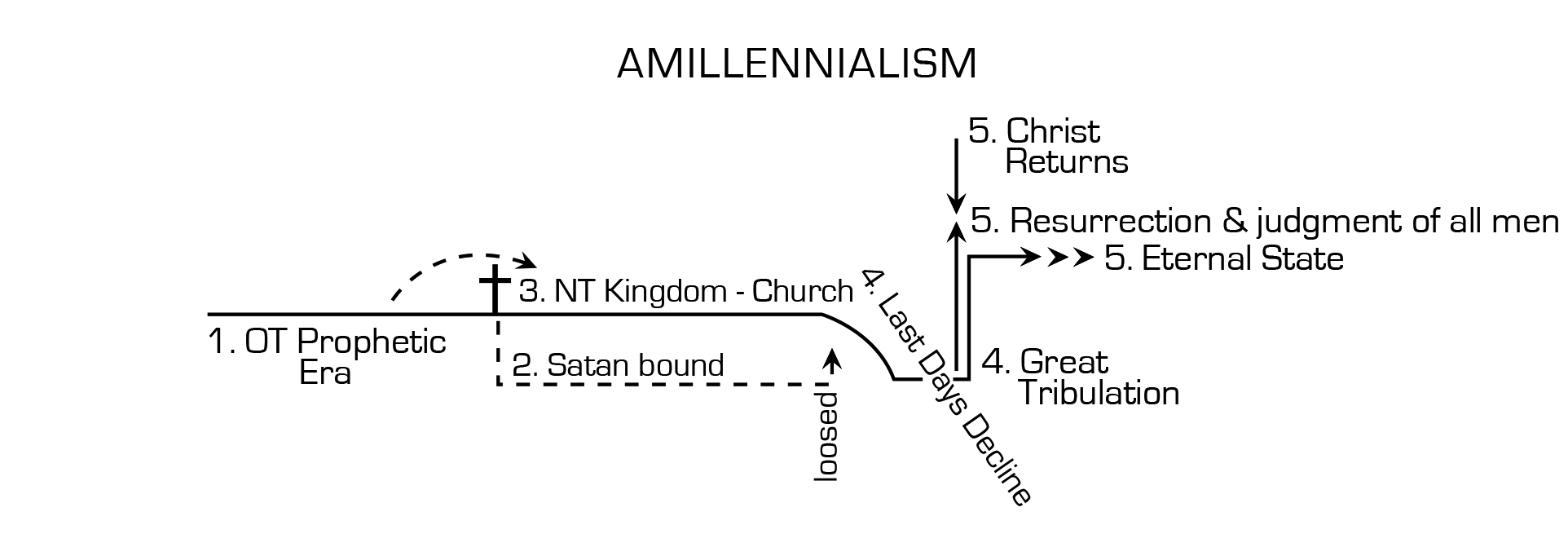
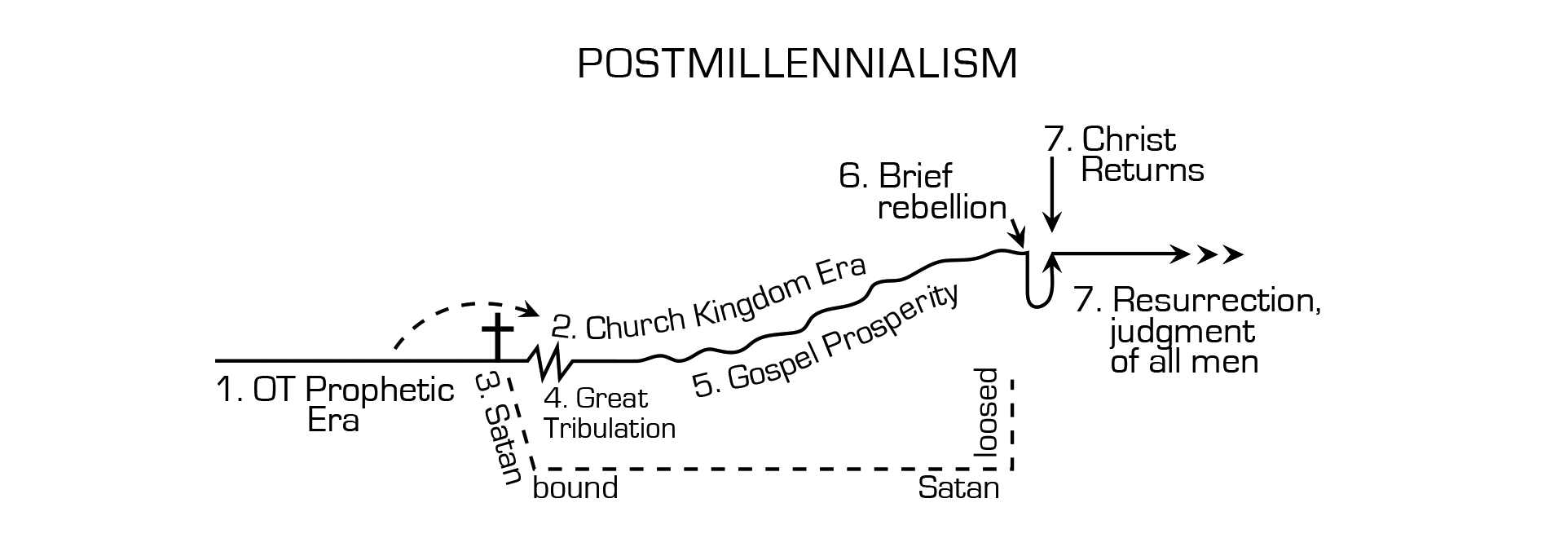
Millennial Charts of the Four Major Views

As I was preparing for tomorrow’s sunday school lesson, I thought it might be helpful to post up a few charts of the four predominant views on the millennium. I have to thank the folks at Postmillennialism.com for their work on these (I’m not endorsing everything on their site, but these charts were helpful).

amil disp-pre hist-pre postmil

Introduction to Revelation: Part 4

The Kingdom of God & the Already Not Yet

Often it is very easy to get caught up in viewpoints about the millennium, and I do not want to detract from the importance of the millennium. For even though the millennium – the 1,000 year reign of Christ mentioned in the first few verses of chapter 20 – takes up a very short space in terms of the book itself, its importance is seen in how we interpret what its saying.

But before we discuss these things specifically, I believe we need to begin our study of this book by briefly examining the nature of the kingdom of God. For when we speak of the “millennium” we’re talking about the Kingdom of God, and specifically the reign of His Christ.

Tom Schreiner says, “Those who participate in the first resurrection will reign with Christ for a thousand years (Revelation 20:6), although the nature of this reign is intensely debated, and scholars differ on whether it refers to the reign of saints in the heaven during the time between the resurrection and the return of Christ or to a reign of the saints on earth before the inauguration of the new heavens and new earth.”[ix]

We can see the importance of this idea of the reign of Christ in how it manages to seep into how pastors and theologians comprehend the overarching theme(s) of this book. For instance, Warren Wiersebe, a Premillennialist, says, “The overriding theme of the book of Revelation is the return of Jesus Christ to defeat all evil and to establish His reign.”   Note how he uses the word “establish” in lieu of the word “consummate” which is the term an amillennialist would use because of the emphasis on Christ’s current reign.

The amillennialist would remind us of verses like we find at the end of Mark’s gospel, “So then the Lord Jesus, after he had spoken to them, was taken up into heaven and sat down at the right hand of God” (Mark 16:19 – also see Ephesians 1:20-23)[i]

Now, most theologians believe that Christ is reigning now, but what is the nature of that reign? I think the difference lies in whether or not one believes that His current reign is somewhat lesser or mostly spiritual (i.e. in the hearts of his people).

Dispensationalist John MacArthur puts it this way:

So God rules spiritually now over the hearts of those who know Him by faith. And that’s been the case since His saving work began. There is a spiritual element of the Kingdom that has existed since God started redeeming men. But this is not that spiritual Kingdom of which we read here, but rather that earthly literal Kingdom which comes at the culmination of human history.[ii]

However, I think that this emphasis on the future nature of Christ’s kingdom does injustice to His victory at Calvary, and does not fully comprehend the fullness of Christ’s current reign.

You can now see the rub, can you not? How we think about the kingdom of God shapes how we view the book of Revelation, and perhaps the millennium question in particular.

The Already/Not Yet

I believe the critical hermeneutical principle which will help us most is called the “already/not yet” principle. In order to understand most of the NT – especially the words of Jesus and the book of Revelation – we need to understand this important principle.

For our purposes, I believe that we need to get our heads around two truths about the nature of God’s kingdom. The first is that it has been inaugurated by Jesus Christ, and will be consummated upon his return. The second is that God is working dynamically in history to bring about the expansion of His kingdom and its final consummation.

Regarding the first truth, it is worth quoting R.C. Sproul at this point at length:

Many professing evangelicals today believe the kingdom of God is strictly in the future, although there is no biblical foundation for that. This view robs the church of important teachings concerning the kingdom that are clearly set forth in the New Testament. In fact, the New Testament opens with John the Baptist’s announcement of the kingdom: “Repent, for the kingdom of heaven is at hand” (Matthew 3:2).

Another time the Pharisees asked Him when the kingdom of God would come, and Jesus replied, “Behold, the kingdom of God is in the midst of you” (Luke 17:21). The kingdom was in their midst became (sic – because) the King was there. In another occasion, He said, “But if it is by the finger of God that I cast out demons, then the kingdom of God has come upon you” (Luke 11:20).

So John came first with his warning of the radical nearness of the kingdom. Then Jesus came announcing the presence of the kingdom. This was followed by the acme of His redemptive work in the ascension, when He left earth to go to His coronation, where God declared Him King. As Jesus stood on the Mount of Olives, read to depart, His disciples asked him, “Lord will you at this time restore the kingdom to Israel?” (Acts 1:6). They had been waiting for Jesus to make His move, to drive out the Romans and establish the kingdom, but Jesus replied, “It is not for you to know times or seasons that the Father has fixed by his own authority. But you will receive power when the Holy Spirit has come upon you, and you will be my witnesses in Jerusalem and in all Judea and Samaria, and to the end of the earth” (Acts 1:7-8).

In answer to their question about the kingdom, Jesus gave the fundamental mission of the church. Men would be blind to His kingship, so His disciples were given the task of making it visible. The fundamental task of the church is to bear witness to the kingdom of God. Our King reigns now, so for us to put the kingdom of God entirely in the future is to miss one of the most significant points of the New Testament. Our King has come and has inaugurated the kingdom of God. The future aspect of the kingdom is its final consummation.[iii]

When Jesus returns it will not be to establish a kingdom, but rather to consummate a kingdom which has been established from before the foundation of the world, and which He reigns over at this very moment.

Indeed the book of Revelation, as we mentioned earlier, was written to assure Christians that He is in control over all things – He is the Lord of history.

Interestingly, Beale thinks that John wrote Revelation with the book of Daniel in mind – especially important in Daniel is the already/not yet function of his literature. Some things were occurring right away for Daniel during his time, while others he saw as distant and far away. Those things which Daniel saw as far away, John saw as fulfilled at least partially in the death, burial and resurrection of the Lord Jesus and the inauguration of his kingdom.

Beale puts it this way:

John probably views the death and resurrection of Christ as inaugurating the long-awaited kingdom of the end times predicted by Daniel, which will now continue throughout the church age.

Side note: for those more advanced in prophetic study or curious about these things, one of the things Beale and other see in Revelation is that at the beginning of some of the major sections/division there is a reference or allusion to something from Daniel chapter two (1:1, 4:1, and 22:6) Beale says that a pattern definitely emerges, “John is employing the same allusion as a literary device to give structure to his whole book.”

This also has ramifications for how we understand the millennium.

Douglass Kelly says, “The exercise of this heavenly authority over all lesser powers is the main thing that is happening in this age between the two comings of the Lord; which, as we shall seek to demonstrate, is the prime meaning of the millennium. The millennium is not a literal period of only one thousand years that will occur much later; rather it is that period of victorious outreach of the Gospel to the nations: a time that last from Jesus’ first coming to his last.”[iv]

All of this can be comprehended by identifying how the Bible speaks about the kingdom of God and the reign of His Christ in other places, and how we are to understand this in light of what we read in chapter 20. Is Jesus’ reign something future, or is it now and to be seen with our eyes in the future? How should we think of, and describe his reign?

This is what R.C. Sproul was speaking of earlier when he said that Christ’s kingdom was “inaugurated” but not yet “consummated.” There are some promises, and some realities that are presently being realized in the church age, yet will not come to their full glory until Christ returns. Our very salvation is like this, for we are saved NOW, yet we have not yet fully realized that salvation. We have the down payment of this reality in the giving of the Spirit, yet not the consummation of this reality in the presence of our Lord and Savior.

The second principle is tied to the first, and it is this: The kingdom of God is “dynamic.” That is to say it is more than just this idea of God separately reigning in heaven, He is working out His will in and amongst us in time and space. He is ruling here – He is involved in our lives – His rule is not detached.

John Frame quotes Geerhardus Vos for us on this matter:

To him (Jesus) the kingdom exists there, where not merely God is supreme, for that is true at all times and under all circumstances, but where God supernaturally carries through his supremacy against all opposing powers and brings men to the willing recognition of the same.

Then Frame says, “On this definition, the kingdom is dynamic, indeed dramatic. It is a world-historical movement, following the fall of Adam, in which God works to defeat Satan and bring human beings to acknowledge Christ as Lord. It is, preeminently, the history of salvation.”[v]

Anthony Hoekema puts it this way:

The kingdom of God, therefore, is to be understood as the reign of God dynamically active in human history through Jesus Christ, the purpose of which is the redemption of God’s people from sin and from demonic powers, and the final establishment of the new heavens and the new earth. It means the great drama of the history of salvation has been inaugurated, and that the new age has been ushered in. The kingdom must not be understood as merely the salvation of certain individuals or even as the reign of God in the hearts of his people; it means nothing less that the reign of God over his entire created universe. “The kingdom of God means that God is King and acts in history to bring history to a divinely directed goal. (quoting Ladd)”[vi]

He goes on to say, “The Kingdom of God involves two great moments: fulfillment within history, and consummation at the end of history.”[vii]

Now given what we know of these two principles, we know that God is both reigning supreme over all, but also dynamically working in and through His creation to bring about His purposes. This points to the linear nature of history – God is working toward something.[viii] What He is doing now in and through us by His Spirit and His Lordship over all history and creation is a shadow of what will be upon the consummation of His purposes.

Christ inaugurated a kingdom (the already) and with that inauguration has brought forth fruit first by His cross work, and now by His Spirit’s powerful work here on earth through the spread of the gospel. One day He will return to consummate His kingdom (the not yet) and upon that return will usher in the visible reality of his reign (the already).

While futurists await a future “literal earthly” kingdom (which we all look for), the way in which we speak about and think about God’s exercise of power and authority over the world, and the souls of lost people is important. I believe its crucial that we understand God as working even now dynamically, personally, powerfully in history and in the lives of men all across the globe to expand his kingdom – a real kingdom of real people.

So you can see how these perspectives function to shape our viewpoint of the book itself and the millennium. But they also shape how we live our lives as Christians – especially what kind of mindset we take toward events here on earth and circumstances in our personal lives.

NOTE: Some of the dispensationalists might argue that God rules “spiritually in the hearts” of men, but not physically here on earth, and does not rule them in any way other than in their hearts. To me this is a false dilemma. The postmillennialist has it right in the respect that when God saves a man, there is fruit and evidence of change not only in that man’s heart, but in his life and in the society in which he lives. To argue a distant futurist reign of Christ is to argue the opposite of how the Bible describes the efficacy of Christ’s work on the cross. He truly is Lord of all and he exercises that Lordship full now, though it is unseen (as Sproul mentions above). I’m not saying that the Postmillennial view is perfect, but their mindset on the nature of the kingdom certainly seems to make more sense and align more Biblically to me.

The Millennium

With this cursory understanding of the kingdom of God under our belts, let us examine the four major views on the reign of Christ in the millennium.

Amillennialism

The Amillennial view (Amil) is probably the simplest of the four major viewpoints on the millennial question.

Wayne Grudem says, “Those who are said to be reigning with Christ for the thousand years are Christians who have died and are already reigning with Christ in heaven…This view is called ‘Amillennialism’ because it maintains that there is no future millennium yet to come.”[x]

John Frame describes it:

The Amil believe that the millennium is now, the whole period from Jesus’ ascension to his return. He emphasizes that the resurrection and ascension of Jesus ushered in a new era of world history. Jesus has now achieved a great victory over Satan, sin, and death…The Amil says that Satan no longer deceives the nations (20:3) as he did before the coming of Christ. Before Jesus came, believers in the truth God existed mainly in Israel. The other nations were deceived by Satan into worship idols. But after the resurrection, the Christian church received power to reach people of all nations with the message of the gospel. And God will continue to empower this mission until the last day, until there are believers from every kingdom, tongue, tribe and nation.[xi]

R.C. Sproul adds…

The Amillennial position, which holds some points in common with both of the premillennial positions, believes that the church age is the kingdom age prophesied in the Old Testament. The New Testament church has become the Israel of God. Amillennialists believe that the binding of Satan took place during Jesus’ earthly ministry; Satan was restrained while the gospel was preached to the world, and this restraint continues today.[xii]

The verses that come to my mind as typically cited in terms of the defeat of Satan are as follows:

The seventy-two returned with joy, saying, “Lord, even the demons are subject to us in your name!” And he said to them, “I saw Satan fall like lightning from heaven. Behold, I have given you authority to tread on serpents and scorpions, and over all the power of the enemy, and nothing shall hurt you. Nevertheless, do not rejoice in this, that the spirits are subject to you, but rejoice that your names are written in heaven.” (Luke 10:17-20)

He disarmed the rulers and authorities and put them to open shame, by triumphing over them in him. (Colossians 2:15)

Frame describes how the Amil views the future…

Amils affirm that toward the end of this era Satan will be released briefly, as Revelation 20:3 indicates (also verses 7-8). He will then deceive the nations again, presumably achieving some measure of his old power. But he will be frustrated and defeated by the return of Christ and the judgment that will result in his final destruction.[xiii]

Amils believe that the first resurrection is simply that spiritual resurrection that has taken place and realized during the intermediate state. The second resurrection is the physical resurrection of the body preceding the judgment when Christ returns. Frame says, “Similarly, the first death is the physical death of human being; the second death is the condemnation of the wicked, a death that believers do not experience.”[xiv]

Postmillennialism 

Most folks who are of the post-mil persuasion also believe that the millennium period of 1,000 years is NOW just like the Amils believe. John Frame notes that some older literature reveals that there are a few Post-mills who have said that is a part of this time now, but more will reside in the future. Post-mills also agree with Amils on the binding of Satan during Christ’s ministry and his release for a short time before Jesus’ return.

John Frame describes the difference between Amils and Post-mills:

Well, although the postmil agrees with the amil that our age is a time of persecution for the church, he also thinks that during this time Christians will come to have more and more influence in general culture. Believers will indeed gain wealth, influence, and even dominance.[xv]

Sproul describes this unique part of Post-millennialism:

What distinguishes postmillennialists from amillennialists and premillennialists is the belief that Scripture teaches the success of the Great Commission in the age of the church.[xvi]

Grudem says, “ The primary characteristic of postmillennialism is that it is very optimistic about the power of the gospel to change lives and bring about much good in the world.”

I must admit that when I study the history of the world since the spread of the gospel, I do not see a uniform trajectory upward toward a world of people who are united in morals and standards. Certainly I believe that since Christ the world has been changed in huge part by the Gospel of Jesus Christ. There is no doubt that the world was in darkness before He came – so much so that every other nation worshiped idols except Israel. Can you imagine if we looked around the world today and every other nation except one the size of Rhode Island worshiped wooden blocks and golden statues? So certainly the gospel has transformed our world.

However, the post-millennial viewpoint was really made popular and caught on prior to the 20th century. It was perhaps at its height at the end of the 19th century when medical cures were being found, the industrial revolution was in full swing, and great revivals had swept across the world many times over the course of the past several hundred years. Then came World War I. The gruesome bloodshed and seemingly worthless outcome was more than conservative theologians could swallow in their assessments of world events and the human situation on earth.

However, not all theologians and pastors had to wait until the bloody events of the 20th century to object to Postmillennialism’s optimistic theology. J.C. Ryle, the great 19th century contemporary of Spurgeon, wrote hinting about this way of thinking:

Let us dismiss from our minds the vain idea that nations will ever give up wars entirely, before Jesus Christ comes again. So long as the devil is the prince of this world, and the hearts of the many are unconverted, so long there must be strife and fighting. There will be no universal peace before the second advent of the Prince of peace. Then, and then only, men shall “learn war no more” (Isaiah 2:4).

Let us cease to expect that missionaries and ministers will ever convert the world, and teach all mankind to love one another. They will do nothing of the kind. They were never intended to do it. They will call out a witnessing people who shall serve Christ in every land, but they will do no more. The bulk of mankind will always refuse to obey the Gospel. The nations will always go on quarreling, wrangling, and fighting. The last days of the earth shall be its worst days. The last war shall be the most fearful and terrible war that ever desolated the earth.[xvii]

The theology fell out of style, yet there are some very smart theologians whom I respect who still hold this theology today. John Frame[xviii] and Keith Mathison both consider themselves Post-Millennial.

I say all that because, while I do not consider myself Postmillennial, I really respect those who take that view, and their arguments are generally very scriptural. They point to many times, both in Scripture and in the time since Christ, when Christian influence has changed the world for the good. They remind us that when Jesus changes someone’s head and heart, those changes lead to changes in our actions which affect the society in which we live.

NEXT TIME…..Premillenialism…..

FOOTNOTES

[i] Ligonier has a devotional published about the kingdom of God which cites these verses in Ephesians: http://www.ligonier.org/learn/devotionals/seated-at-gods-right-hand/

[ii] John MacArthur sermon on Revelation 20 (Part 1): http://www.gty.org/resources/print/sermons/66-73

[iii] Sproul, Everyone’s a Theologian, Pg. 307.

[iv] Kelly, Pg. 11

[v] John M. Frame, ‘Systematic Theology: An Introduction to Christian Belief’, Pg. 87

[vi] Hoekema, The Bible and the Future, Pg. 45

[vii] Anthony Hoekema, ‘The Bible and the Future’, Pg. 51

[viii] For more on the linear nature of history, see Anthony Hoekema’s ‘Created in God’s Image’

[ix] Tom Schreiner, New Testament Biblical Theology, Pg. 846-847.

[x] Wayne Grudem, Systematic Theology, Pg. 1110.

[xi] John Frame, Systematic Theology, Pg. 1087-1088

[xii] R.C. Sproul, Everyone’s a Theologian, Pg. 313.

[xiii] John Frame, Systematic Theology, Pg. 1088

[xiv] John Frame, Systematic Theology, Pg. 1088

[xv] Frame, Systematic Theology, Pg. 1088.

[xvi] Sproul, Everyone’s a Theologian, Pg. 314.

[xvii] J.C. Ryle, Expository Thoughts on the Gospels, Luke 21:10-19. Here Ryle is discussing the Olivet Discourse and particularly, “Christ’s predictions concerning the nations and the world.” That this important, and sound, theologian and pastor would raise such a warning flag against the post-mil mindset while its popularity was at its zenith is (to me) a very important note.

[xviii] Frame, Systematic Theology, Pg. 1094

Weekend Reading: November 14, 2014

Welcome to your (chilly) weekend! I’m writing from the post-election construction site of what used to be my quiet home in Ohio. While renovations on the first floor tick away, I’ve been catching up on interesting articles and videos – lot’s of interesting stuff for you to check out! So here’s the best of what I’ve read, heard, and watched this week – grab a cup of joe and enjoy!

Let’s start out with some political news, shall we? John Boehner is going to be reelected as Speaker of the House, Bruce Springsteen is beginning to receive blow back from his disingenuous (and inconsistent) political agenda, Glenn Beck revealed he has some major health issues, and Mike Huckabee is seriously considering running for President.  Lastly, the House just approved building the Keystone Pipeline.

And, not sure whether to label this ‘politics’ or ‘the arts’, but George W. Bush has a new painting out of him and his pops, check it out here. I think its actually a pretty good painting of George H, but ‘W’ was right to admit he lacked focus on himself during the process. Interestingly he also revealed that he has difficulty painting noses…

Lot’s of John Piper cropping up on my radar this week. First, he has a new (free) advent devotional book out. Second, thanks to Tracy Lear for sending this short 7 min. podcast where Piper answers the question “Can I Confess the Name of Jesus and Be Unsaved?” Third, as I was listening, reading all this, I stumbled on his video poem from last year called ‘The Calvinist’….I think its really good (shocker?)!

Also, you may have seen that mega church pastor Mark Driscoll’s career took a nose dive this week. Piper, a friend of Driscoll’s, comments on the situation along with 8 lessons we can learn from it.

Also, (and by way of contrast) Voddie Baucham is headed to…Zambia. 

On to the interesting, and bizarre…

Kirk Cameron is out (or soon to be out) with a new movie called ‘Saving Christmas’ or some such thing.  Not sure if it will be good, or just another hokey remix of the same stuff he’s done for the last 10 years…

And Tim Challies linked to a website that lists “common myths”…there’s some interesting ones on here! A strange mix of topics from chastity belts to headaches…some of this is just opinion (ironically!), but some of these are funny.

Also, did you see Mark Zuckerberg’s attempt to speak Mandarin? No? Well, despite him (apparently) sounding like a 6 year old, it went over pretty well…

Speaking of the Chinese, apparently they have a pretty lame non-stealth ‘stealth fighter’…

And, while I know the economy isn’t good, has it really come to this?

And a few interesting and cool items…

This new robotic toy looks like a lot of fun! (I’m partial because of the name)

This week I was sent an article showing how far we’ve come as a country. In 1994 President Clinton intervened to stop his (wacko) AG Janet Reno from making a mess of a religious freedom issue. W.W.O.D.? How far we’ve come indeed…(h/t David Clementson)

And apparently I’m sending this email out too late in the day…you won’t be able to concentrate on anything you’re reading right now…

D.G. has a fascinating interview with Ebola-tested missionaries...

R.C. Sproul had a fun little article on the ‘Session of Christ’ where 50% of the post is subsumed in a Robin Hood analogy.

Speaking of which, Ligonier Ministries released a video about their Wold Cup outreach experience…this is pretty cool stuff! And as I was doing some research on another issue, I ran across this old article on ‘The True Israel of God’ (sure to ruffle the feathers of any of you dispensationalists, oh well…)

That’s it!  If you want to check out my latest post on the Introduction to the Book of Revelation you can do so here, or check out last week’s weekend reading links here. Have a great weekend!

PJW

NOTE: I’m not going to have any links for next week since I will be enjoying a few days in NYC with my wonderful wife!

lisa_benson_current_cartoon_2014-11-11_5_
Real Clear Politics Cartoon of the Week…

Introduction to Revelation: Part 3

Welcome to part three of my introduction to Revelation.  On Sunday morning we covered the nature of symbolism in Revelation as well as the four main overarching viewpoints of the book. I hope you enjoy this post!

PJW

Symbolism in Revelation

It has occurred to me after studying many of the viewpoints of the pre-trib rapture folks that understanding proper hermeneutics is really fundamental to understanding Revelation. Of course, I’ve mention his before in this study and also in other books I’ve taught through. But I think that when it comes to Revelation, getting the symbols right is important – in fact, just understanding that symbols are, well, symbolic is important!

I bring up the pre-trip rapture folks because as I read through the work of one such seminary professor’s work this evening, I began to really be impressed with his knowledge of Scripture, and his desire to bring Scripture to bear in the forming of his opinions. As I read through his Scripture references, I began to see where he was coming from, but it didn’t make complete sense until I read that, in his view, Revelation 4-18 contained no mention of the church. Of course this is a major point in the pre-trib rapture argument. These folks believe that the church must have been raptured prior to chapter 4. Furthermore, they assume the book works chronologically, and not simply a series of visions describing the inter-advental period.

Now, I disagree with their chronological assumption, and I will address that later. But let me just hone in on this major issue of not seeing the church mentioned anywhere between chapters 4 and 19. This particular professor held a similar belief of many pre-trib folks who say that the “elect” and “Israel” are mentioned, but not the church. Of course, just a simple understanding of the meaning of “the elect” tells us that he doesn’t understand that the elect ARE the church. But again, we will set aside this equally stupefying misunderstanding and just realize that these people come to the conclusion that “the church” is not mentioned in these chapters because they are not reading the book symbolically.

I spent all that time laying that example out so you can see that hermeneutics have consequences. If we ignore the obvious symbolic nature of Revelation and instead choose to take every image we possibly can as literal, then we will never understand this great book.

The question is really not whether we should interpret the book symbolically, but rather how do we go about understanding the symbols? I have given Johnson’s 7 ways to “see” Revelation above, and now I want to just overlay that with some thoughts from Hendriksen who has just 3 different things for us to consider:[i]

1. There is a need to concentrate on the central theme


Just like in Jesus’ parables, each symbol usually has just one main theme or message its trying to convey. You might find other truths associated with the symbols, but that doesn’t take away from the one or two driving principle thoughts/themes.

2. There is a need to distinguish between the principle and the detail


Hendriksen puts it this way:


One must not begin to press the details. One must not ask, in the symbol of the locusts that came out of the abyss (9:1-11), what is the separate meaning of their hair, teeth, breast-plates, etc.” We must not pluck the symbol apart and lose the unity. These details belong to the picture, just as the mule, wine, oil, etc. belong to the parable of the Good Samaritan. One should ask, first, what is the picture taken as a whole? Second, what is the one central meaning of this picture?


As a rule the details belong to the picture, to the symbol. We must not try to give a ‘deeper’ interpretation to the details, unless the interpretation of these details is necessary in order to bring out the full meaning of the central idea of the symbol. Thus, in the symbol of the new Jerusalem (chapters 21, 22), the central idea is perfect fellowship with God. The details – wall, foundations, gates, river etc. – describe the glorious character of this fellowship. What we are after is the total impression, the central idea, of each complete symbol. As in the parables, so here, the context helps to explain the meaning of the picture, and a thorough study of all the details is also necessary in order to determine what is the central thought.


  1. Learning what the symbols mean


Hendriksen says that there are really two kinds of symbols. The first are those “symbols which describe the beginning or the end of the course of the new dispensation…for example, the radiant woman who is delivered of a Son, a Man-child, refers to the Church bringing forth the Christ, His human nature (12:1-5)” or “…the twofold harvest (14:15) refers to the final judgment, to that one great event.” These are big events at the beginning of the first advent or the end of the age etc.


The second type of symbol is that which fills the majority of the book and could be people, tribulations, place etc. happening in time between the first and second advent of Christ. These symbols are such as the lamp stands, the bowls, the trumpets, seals etc. The question is, do these symbols represent particular people or specific events – single happenings – in history or in the future? Hendriksen, Baucham and many others say “no”, and I agree with them. This probably puts them (and me) in some sort of fashion under the “idealist” view of the book – which we will discuss momentarily!


The reason for these symbols not representing specific one-time events or people in most cases is evident for numerous reasons. First if they did, how would we ever know which events or people in history? Everyone would have their own “interpretation”! Who would be the final judge? We’d have to give up and say that this book isn’t able to be interpreted. But we don’t do that because we believe that this book was indeed given to “reveal” to us God’s purpose, and to edify the church.


Furthermore, these symbols operate in a sphere (to paraphrase Hendriksen) that is very extensive. Large swaths of the earth are involved in the descriptions of the effects of these seals, bowls, trumpets and so forth. “This could hardly be true if each seal, trumpet or bowl had reference to just one single event in history, an event that takes place at a certain specific date in a definite locality…again, these symbols affect not just one very limited group of people, but a multitude that cannot be counted.”


Hendriksen also points out that most of the symbols operate in groups of seven – not a coincidence I think. “This number seven indicates completeness. It harmonizes very well with the idea that the symbols refer to principles in human conduct and of divine government that are always operative, especially throughout this entire dispensation.”


Hendriksen sums up the viewpoint I take on most of these symbols:


Yet we do not believe that this is a closed book. We fully believe that it is a revelation, an unveiling. So we must look for some other rule of interpretation (other than that of specific symbols representing specific one-time events or people).

…It is on the basis of the symbols themselves, as described in the Apocalypse, that we arrive at this very significant conclusion, namely, that the seals, trumpets, bowls, and similar pictures, refer not to specific events or details of history, but to principles that are operating throughout the history of the world, especially throughout the new dispensation.


And…


We should constantly bear in mind that the purpose of God and of the seer is to make men wise unto salvation. The book has an ethical and spiritual purpose. For if these symbols merely indicate and predict isolated, future events, it may satisfy some people’s curiosity, but it can hardly be said that people, in general, are edified. On the other hand, if we believe that the book reveals the principles of divine moral government which are constantly operating, so that, whatever age we happen to live in, we can see God’s hand in history, and His mighty arm protecting us and giving us the victory through our Lord Jesus Christ, then, and only then, are we edified and comforted.


Which leads us to our next topic…


But first… a NOTE: As I personally work through the book of Revelation, I will be leaning heavily on those who have closely examined the symbolic nature of the book. While Hendriksen provides a wonderful layman’s outline of how to think of these symbols in broad terms of interpretation, Beale agrees with these and adds another level of study. Beale’s work is very thorough and while he agrees with Hendriksen on OT background, and immediate context, he also explains in-depth the way to both discover when one is seeing a symbolic reference, as well as how and when to approach each symbol to a degree of study that others simply haven’t touched. Beale relies on Sweet, Caird and others as well as his own language and grammar expertise. Much of this is found throughout the commentary, but on pages 50-69 he spends time diving into the grammar and contextual matters involved in this book, and what grammatical/literary and logical rules we must apply when thinking through this book. I just mention this as an aside because for me to go through each of his points in my own notes and teaching would fall beyond the scope and patience level of most people, yet I want those who I’m teaching to understand where I’m deriving my frame of reference for these grammar and literary rules. Indeed I want to assure those in my care that such careful consideration has been taken in these points so that my teaching might be clear, yet without subjecting those reading and listening the tediousness of combing through grammar and literary matters on a Sunday morning.

The Overarching Viewpoints

In the approach to this book there have been several perspectives. There are mainly four overarching perspectives with several modified versions of each. The main four are: Historist, Idealist, Futurist, and Preterist. Let me give a brief overview of each one.


Historist


The Historist view is very interesting. They see Revelation as dealing with the big events in Christian history from Christ’s ministry until this day. Beale describes this view:


The majority of these (Historist) commentators have understood the seals, trumpets, and bowls as unfolding successive events in history in general chronological order. Christ’s final coming is usually seen as very imminent. Typically this view identifies parts of the Apocalypse as prophecies of the invasions of the Christianized Roman Empire by the Goths and the Muslims. Further, the corruption of the medieval papacy, the reign of Charlemagne, the Protestant Reformation, and the destruction wrought by Napoleon and Hitler have been seen as predicted by John.[ii]


Issues with this view include its exclusion of non-western church events as important to world history, and also there’s the problem that different people who’ve held this view at different points in history have not agreed with each other on the particulars of each major historical movement. Beale also points out that, “such a projection of future history would have had little relevance to the first-century readers of Revelation.”


Preterist


The Preterist view has two main iterations. The destruction of Jerusalem by Titus’ armies in 70 A.D. figure prominently in both views. The first believes that the entire book of Revelation is really a prediction about the fall of Jerusalem in 70 A.D. (of course this necessitates an early dating to the book). These folks believe that “Babylon” represents Israel “who aids Rome in oppressing Christians.”[iii] Israel is therefore being judged, and their temple’s destruction is the climax of all the judgment prophecy in Revelation (not to mention Daniel 2 and 7). There are several problems with this, not the least of which is that Daniel 2 and 7 – which are integral to Revelation’s judgments – indicate a worldwide/universal judgment of nations, whereas Preterists see these judgments as exclusive to Israel.


The second main form of Preterism indicates that what Revelation talks about was fulfilled in the fall of Jerusalem in 70 A.D. but that “Babylon the Great” refers to Rome, and not to Israel. This makes a little more sense, but still encounters the difficulties mentioned above.


Now there is a view called “Partial Preterism”, which R.C. Sproul describes as follows:


Partial Preterism holds that many of the prophecies of the future were fulfilled in the first century – chiefly in the events surrounding the destructions of Jerusalem in AD 70. Most Partial Preterists say that the first twenty chapters of Revelation have taken place while the last two chapters have yet to be fulfilled. Partial Preterists tend to be postmillennial in their thinking, holding that the millennium (not a literal one thousand years) began with the first advent of Christ.[iv]


There are other forms of preterism which are really nothing more than heresy. One says that John prophesied worldwide destruction, but was mistaken. Another is similar to the first form I mentioned only goes so far as to say that Jesus came back in 70 A.D., judged Israel, and went back to heaven. In this view there will be no second coming of Christ, for He has already come.


John Frame wisely remarks, “It is also significant that the early church fathers of the generation following the apostles never speak of a return of Christ that occurred in A.D. 70. If this were the momentous event that preterists make it out to be, one would think that the fathers would have made that one of the main themes of their writings. But in fact, they never even mention it.”


Futurist


There are two forms of the Futurist viewpoint and (as Beale notes) both see John’s vision from Chapter 4 – 22:5 as referring to the future time that will come immediately prior to the end of history.


The dispensational version of Futurism is complicated, so I will quote Beale’s summary here as it is helpful:


…Dispensational Futurism , which interprets very literally and generally sees the order of the visions as representing the historical order of future events: (1) the restoration of ethnic Israel to its land (apparently beginning directly prior to the events depicted in 4:1-22:5), (2) the church’s rapture into heaven, (3) a seven-year tribulation, (4) the antichrist’s reign, (5) the assembly of evil nations to fight over Jerusalem, (6) Christ’s second coming, when he defeats the evil nations, (7) his millennial reign, (8) Satan’s final rebellion at the end of the millennium, which he gathers together unbelievers from throughout the world to fight against Christ and the saints, and (9) Christ’s eternal reign together with the saints in a new heaven and new earth. 1:19 is often seen as the outline of the book: “Therefore, write what you have seen” represents the past, which is described in ch. 1; “and what is” represents the present, which is described in chs. 2-3; “and what things are about to come to pass after these things” represents the future, which is described in 4:1-22:5.[v]


The second form of futurism doesn’t interpret events in the book as literally as the dispensationalists do, and it doesn’t “hold as strictly that the visions represent the chronological sequence of future history.” Beale says that, “In particular, this version can affirm that the church is true Israel and that there will be no ‘pretribulational rapture.’”[vi]


There are several issues with these views, we will deal with them as we get into the book, but Beale is right to state that, “The futurist position especially encounters the difficulty that the book would have had no significant relevance for a first-century readership.”


Idealist


The Idealist perspective sees Revelation as symbolic and portrays the general conflict between good and evil. There are some versions of this viewpoint which doesn’t see any real historical fulfillment in what John predicted, but rather see it as just lessons to be learned and a depiction of the overall battle between God and Satan.


Beale says, “The problem with this alternative is that it holds that Revelation does not depict any final consummation to history, whether in God’s final victory or in a last judgment of the realm of evil.”


That being said, Beale, Hendriksen, Johnson, and Baucham and others hold to a modified version of idealism. Beale calls his view “Eclecticism” and I really appreciate his viewpoint. He takes the best of idealism and the other views and tosses out those views which have obvious difficulties.


One of the things that we ought to benefit from as Christians living in the 21st century is that men and women have been thinking about these issues for thousands of years. When one view becomes popular, but has holes/issues, then we ought to give it serious consideration and ask ourselves whether our assumptions are wrong. This is why I like Beale’s approach.


Because Beale is one of the most respected scholars on this book, we will be referring to his work a great deal, therefore it may be helpful to give you his own summary of the approach he advocates taking:


A more viable, modified version of the idealist perspective would acknowledge a final consummation in salvation and judgment. Perhaps it would be best to call this fifth view “eclecticism.” Accordingly, no specific prophesied historical events are discerned in the book, except for the final coming of Christ to deliver and judge and to establish he final form of the kingdom in a consummated new creation – though there are a few exceptions to this rule. The Apocalypse symbolically portrays events throughout history, which is understood to be under the sovereignty of the Lamb as a result of his death and resurrection. He will guide the events depicted until they finally issue in the last judgment and the definitive establishment of his kingdom. This means that specific events throughout the age extending from Christ’s first coming to his second may be identified with one narrative or symbol. We may call this age inaugurated by Christ’s first coming and concluded by his final appearance “the church age,” “the interadventual age.” Or “the latter days.” The majority of the symbols in the book are transtemporal in the sense that they are applicable to events throughout the “church age.”

Therefore, the Historicists may sometimes be right in their precise historical identifications, but wrong in limiting the identification only to one historical reality. The same verdict may be passed on the Preterist school of thought, especially the Roman version. And certainly there are prophecies of the future in Revelation. The crucial yet problematic task of the interpreter is to identify through careful exegesis and against the original historical background those texts which pertain respectively to past, present, and future.


FOOTNOTES… 

[i] Hendriksen, Pg.’s 37-43

[ii] Beale, Pg. 46.

[iii] Beale, Pg. 44

[iv] R.C. Sproul, Everyone’s a Theologian, Pg. 314.

[v] Beale, Pg. 47.

[vi] Beale, Pg. 47

Weekend Reading: November 7, 2014

My entire week since Election Day has been one big weekend, but for those of you sane enough to work in normal professions, “welcome to your weekend”!

Speaking of elections, this weekend’s edition will be dominated by politics, though there are some other interesting and helpful items below as well. So put on another pot of coffee and enjoy encouraging blogs, informative articles, and funny videos!

On Tuesday Republicans won back the U.S. Senate and increased their majority in the House of Representatives by 13 seats (as it currently stands).  Here’s a cool interactive graph that shows the new balance of power.

Here is my own (very short) analysis on the election and why winning the Senate is important for Republicans (and Christians).

Here’s a pretty decent overview from a professional political pundit.

Here’s National Journal’s race tracker, which I really liked.

Could this be the blueprint for GOP victories? John Wayne might think so…(h/t Greg Ungru)

The level of ticked-offedness at our Narcissist in Chief was rising pretty high prior to EDAY, and though the Dems normally count on the female demo to carry them over the finish line electorally, perhaps they’d have done better among females if the President wasn’t actively insulting them prior to ballot casting activities! (h/t Katie Wenzel)

Much more than just the Federal races were on the line Tuesday, control of state legislatures proved to be the story behind the story, as many fell into GOP hands.

The wave was big enough that 18 year olds were winning State Delegate seats in West Virginia…(h/t Ed Pfaff)

Despite the historic gains, the map for Republicans in 2016 looks very difficult, and Dems are already plotting their revenge…

In the meantime, Chris Matthews is not a happy camper…(but as Jim Gaffigan says, is anyone?)

IMG_0705

Now on to other matters…

It was revealed that ISIS has been honing ancient Islamic rules pertaining to the sale of women and children as (sex) slaves. New evidence came to light on this front earlier in the week…and it seems that Imams from around the Islamic world are cool with this stuff (since they are the religion of peace, after all).

Perhaps the goings on around the planet are best captured in FP.com’s week in photos which you can find here. I like these because there’s short blurbs at the bottom of every photo and it gives you a sense at least for what’s going on outside our standard frame of reference.

On the technology front, Amazon sought to take marketshare away from Apple and Google et all when they announced a new benefit for Prime customers – unlimited photo storage. Don’t know about you, but how to store pictures is always a big challenge. You see guys standing around talking at their kids’ recitals or birthday parties and this is usually a pretty big topic of confabulation.

The best link anyone sent me this week was a follow up to Reformation Day, and its called the ‘Lutheran Insulter’ – simply keep clicking to get a fresh insult from the sharp tongued Reformer! (h/t Alex Wenzel)

And in case you missed it amidst the hubbub of Election coverage and celebrity twitter activism, One World Trade Center opened up for business. 

Also in the news is Robert O’Neil’s claim that he was the one who shot Osama Bin Laden. His claims have been disputed by fellow Seal Team Six members, which begs the question: Who cares?! The guy is dead right? Okay…that’s what I thought…thank you for your service and bravery…now carry on soldier.

And since its a very political issue of the Weekend Reading, check out this sketch of the ideology of our cities. Do you live in a conservative or liberal area?

Now leaving you on a more positive note, check out my good friend Matt Parker’s blog post titled ‘Where Can We Find Power?’ It’s a good reminder that 1, 2, 5 or 10 steps to this, that, or the other thing don’t always have the power or direction we need to solve life’s problems.

And a final note to those who have sent me articles this past week or so, I promise I’m reading them, though I have many unfinished. My focus this past week was very political (obviously), and I’ve also been submerged in the theology surrounding eschatology (end times study) as I teach through the book of Revelation. Now that the election is over, you can once again expect a wider diet of theology, tech, foreign policy and news that isn’t so politics-centric (I promise!).

PJW

Elections Matter; but What Matters Most?

A good friend asked me today why last night’s wave election actually mattered – and frankly its a fair question.  For those of you perhaps wondering the same thing, here’s how I summarized the tangible results from last night’s Republican wave election victory:

1. The Keystone Pipeline will likely pass the Senate now creating jobs, revenue etc.

2. There will be a check on the President’s lawlessness (I mean that in the strictest of senses; he’s a lawbreaker)

3. Federal judicial appointments – the positions that have been legalizing the homosexual revolution in America – run through the Senate and will undergo higher levels of scrutiny.

4. Gov. institutions that have been bullying Americans (IRS, EPA etc.) will face greater scrutiny

5. Administration officials will face greater consequences for Foreign affairs debacles like Benghazi et all. Those are just a few items, not to mention spending held in at least something of a check.

There are many more things that will result – many are political and have bearing on the 2016 Presidential race, and what will end up being a massive (and difficult) battle to keep control of the Senate for the GOP. I won’t detail them all, but 2 of them come to mind: 1. Fundraising parity with Democrats will probably be achieved by GOP senate committees and groups, and 2. Senators like Rand Paul, Marco Rubio, and Ted Cruz will not be harangued by Harry Reid’s floor schedule while they travel and campaign for the GOP Presidential Primary.

Last night was a gigantic sweep for Republicans, and a clear repudiation of President Obama’s policies.  This wasn’t a small victory with barely a plurality of voters or seats won in close elections. This was a drubbing from the lowest offices to the highest. Erick Erikson pointed out this morning that, “More than 25 of the Senators who voted for Obamacare have now been thrown out by the voters since 2010.”  This collective reality is really important to remember.

All of this being said, as I hammered out final last-minute work orders yesterday from my desk, I had the movie Chariots of Fire playing in the background on my iMac and there’s a line uttered by Eric Liddell that is worth remembering here this morning:

God made countries, God makes kings, and the rules by which they govern.

Those who rule nations in pride and rejection of God’s purposes for man will eventually – inevitably – be brought low and driven from power, either today or in the years to come as eternity spans before us. This is in accordance with His purposes and according to His time schedule, not ours.

Therefore I encourage those reading to keep politics and their results in perspective. These things are of tremendous import, but they pale in comparison to what matters at the end of the race.  Perhaps Liddell knew that better than most:

It has been a wonderful experience to compete in the Olympic Games and to bring home a gold medal. But since I have been a young lad, I have had my eyes on a different prize. You see, each one of us is in a greater race than any I have run in Paris, and this race ends when God gives out the medals.


Revelation: An Introduction Part 2

This morning I taught the second part of our intro to Revelation.  This is part two, of what will likely be a 4-6 part introduction.  I hope you enjoy!

 The Importance of Hermeneutics (continued from last week)

It is so important that before we begin our study in this book that we have an understanding of how to interpret what we’re reading. The book of Revelation is classified as what theologians call “apocalyptic literature”, which means that the genre of this writing is not poetry, historical narrative, or epistolary – though it has some elements of the latter form.

R.C. Sproul explains this very well, and its worth quoting him at length here:

The basic principle of biblical interpretation established by the Reformers was literal interpretation, sensus literalis, which means that responsible interpreters of Scripture always interpret the Bible in the sense in which it was written. Poetic literature should be interpreted as poetry, didactic literature should be interpreted as didactic, and so on. A verb remains a verb, a noun remains a noun, a simile is a simile, and a metaphor is a metaphor.

Conversely, the style of interpretation called “literalism” involves applying a wooden interpretation, which does not work well for poetic literature. For example, when the psalmist says that the rivers clap their hands (98:8), we do not take that to mean that rivers somehow grow hands and begin clapping. We do not interpret such poetic images in an overly literalistic way.

When it comes to interpreting prophetic literature, the question is whether the language is figurative or ordinary prose, and there is widespread disagreement about that. Some believe that we must interpret the prophecies of the future literally in order to be faithful to the Bible, but that can lead us in circles.[i]

Revelation is a book will need to be interpreted differently than, say, the book of Genesis. We will encounter all manner of symbols, numbers, and visual descriptions that will leave us in awe – and perhaps a little confused, especially if we take the wrong approach to the book. Dennis Johnson rightly says, “The strength of symbolism is vividness, for often a picture is worth a thousand words. The challenge of symbolism, however, is its ambiguity.”[ii]

Johnson says there are 7 “strategies for seeing”[iii] the book of Revelation correctly. From those 7 I have listed my favorite quotes and points below because I have found his outline very helpful:

  1. Revelation is given to reveal. It makes its central message so clear that even those who hear it can take it to heart and receive the blessings it promises.

Johnson also says, “Our starting point should be confidence that God has given this book not to confuse, terrify, or divide his people but to give us light, to reveal to us the invisible forces and the secrets of his invincible plan that make sense of the visible events and movements experienced by his church in the world.”[iv]

  1. Revelation is a book to be seen, a book of symbols in motion. Because the appearance of individuals and institutions in every day experience often masks their true identity. Revelation is given in visions full of symbols that paradoxically picture the true identify of the church, its enemies, and its Champion.

Johnson mentions earlier that, “One of the key themes of the book is that things are not what they seem…Paradox is central to the symbolism. Not only are the things not what they appear to be in history, but also typically their true identities as portrayed in the visions are the opposite of their appearance in the world.”[v]

Hendriksen says, “The theme (of the book) is the victory of Christ and of His Church over the dragon (Satan) and his helpers. The Apocalypse is meant to show us that things are not what they seem. The beast that comes up out of the abyss seems to be victorious…But his rejoicing is premature. In reality it is the believer who triumphs.”[vi]

“If we are to follow an interpretive rule of thumb in reading Revelation, it should be that we take what John sees as symbolic where possible”, says Johnson. This reality is one that is the opposite of many in popular theology who says that we should take a “literal approach whenever possible.” Our hermeneutic shouldn’t be determined by our presuppositions, but rather by the kind of literature, the context etc. that we are reading.

This is a very important point – probably one of the most important things to keep in mind as we go through the book. Dispensationalists disagree with this viewpoint. John MacArthur represents that viewpoint and makes the case that we should take a literal view because that’s the most obvious one to take – he does not even address the different kinds of literature and how a genre affects our reading of it.[vii]

  1. Revelation makes sense only in light of the Old Testament. Not only the visions of such prophets as Ezekiel, Daniel, and Zechariah but also historical events such as creation, the fall, and the exodus provide the symbolic vocabulary for John’s visions.

Kelly agrees with this, “These images must be understood in terms of how they were originally used in the Old Testament prophecies, such as Isaiah, Ezekiel, and Daniel. There, they do not mean the literal falling of the stars to earth, but rather the down-falling of governmental powers (such as Joseph’s dream of the sun and the moon, and the twelve stars bowing before him, meaning his parents and brothers). Not to take this into account makes it hard properly to interpret Revelation.”[viii]

  1. Numbers count in Revelation. Since numbers are used symbolically in Revelation, we must discern the meaning they convey rather than trying to pull them as numbers directly into our experience, measured by calendars and odometers.

When speaking about the number “666” Beale says, “The other numbers in Revelation are probably used figuratively without specific reference to one historical reality at one particularly point in history.”[ix]

Johnson explains that the numbers mean different things. Seven is the number of completeness/fullness, ten is significant and frequently is used in multiples to symbolize vast numbers of years or people (1,000 year, 144,000 people, 12,000 stadia etc.), twelve is the number of the people of God and so forth.

Johnson concludes, “The symbolic use of numbers in Revelation is flexible. Readers un-accustomed to this flexibility are perplexed…When we recognize the symbolic significance of numbers and the flexibility of numerical symbolism in Revelation, we will get the message that the numbers are intended to convey without pressing for a literal connection between the numerical measurements in the visions and the temporal, spatial, or demographic dimensions of their referents.”[x]

  1. Revelation is for a church under attack. Its purpose is to awaken us to the dimensions of the battle and the strategies of the enemy, so that we will respond to the attacks with faithful perseverance and purity, overcoming by the blood of the Lamb.

Johnson says of Revelation that, “It’s purpose, to reveal ‘things which must soon take place,’ is not to satisfy idle eschatological curiosity or feed a hunger for revenge but to fortify Jesus’ followers in steadfast hope and holy living.” [xi]

Therefore, “our interpretation of Revelation must be driven by the difference God intends it to make in the life of his people.”[xii]

  1. Revelation concerns “what must soon take place.” We must seek an understanding that touches the experience of our brothers and sisters in seven first-century congregations scattered in the cities of western Asia Minor. Revelation is not about events and hostile forces remote from their struggle.

“Revelation gave first-century Christians insight into the purposes of God in their time. We can at least conclude, therefore, that interpretations of the visions that lie completely beyond the original reader’s frame of reference are suspect. If we begin our inquiry with the assumption that God intended first-century believers to get the message of Revelation, we read its visions against the backdrop of Old Testament imagery rather than forcing them into the template of twenty-first century technologies or politics.”[xiii]

Hendriksen agrees, saying, “A sound interpretration of the Apocolypse must take as its starting point the position that the book was intended for believers living in John’s day and age. The book owes its origin, at least in part, to contemporary conditions. It is God’s answer to the prayer and tears of severely persecuted Christians scattered about in the cities of Asia Minor.”[xiv]

But Hendriksen doesn’t stop there. He also sees that the book was written for us as well, and gives four reasons for supporting this position – reasons I believe are not only sound, but helpful as we frame our thoughts for the study. I will quote him at length for your benefit here:

First, the affliction to which the Church was subjected in the days of the Apostle John is typical of the persecution which true believers must endure throughout this entire dispensation (2 Timothy 3:12) and especially just before Christ’s second coming (Matthew 24:29-30).

Secondly, many of the predictions in which the book abounds (example, the seals, trumpets, and bowls) concerns principles and happenings which are so broad in their scope that they cannot be confined to one definite year or period of years but span the centuries reaching out to the great consummation.

Thirdly, the letters in chapters 2 and 3 are addressed to the 7 churches. Seven is the number which symbolizes completeness, its use here indicates that the church as a whole is mind and that the admonitions and consolations of this book were meant for Christian believers throughout the centuries.

Finally, all those who read and study this book in any age are called blessed (1:3) as at the beginning, so also at the close of the book, the author addressed himself not merely to one group of men living in one decade but to every man who hears the prophecy of this book (22:18).[xv]

  1. The victory belongs to God and to his Christ. Revelation is pervaded with worship songs and scenes because its pervasive theme – despite its gruesome portrait of evil’s powers – is the triumph of God through the Lamb. We read this book to hear the King’s call to courage and to fall down in adoring worship before him.

FOOTNOTES 

A note about “footnotes”: I have footnotes here not because this is an academic exercise (you’ll see this in the loose way in which I write those footnotes!), but so that I will remember where I got these quotes for future reference, and so you can look them up yourself if you’d like.  It will also show you extended thoughts on a matter that may be a little bit of a rabbit trail I didn’t want to address in class or in the main body of my text.

[i] R.C. Sproul, ‘Everyone’s A Theologian;, Pg.’s 310-311

[ii] Johnson’s commentary on Revelation is called, ‘Triumph of the Lamb’ and this quote is found on page 10.

[iii] Johnson, Pg.’s 22-23

[iv] Johnson, Pg. 6.

[v] Johnson, Pg. 9.

[vi] Hendriksen, Pg. 8

[vii] John MacArthur says this, “If you just take all of that literally you come up with a premillennial view. And one of the compelling reasons to take it all literally is because there’s no other way to interpret the Bible because as soon as you say you don’t have to interpret the Bible literally, then what in the Bible don’t you have to interpret literally? I mean, how do you…how can you just say, ‘Well we don’t interpret prophecy literally, but we interpret everything else literally,’ on the basis of what? We maintain a literal, historical, grammatical contextual hermeneutic of interpretation because that’s the only way that we can understand the Bible, to take it at its historical, contextual, linguistic face value. And when you do that, you find you’re drawn to be a premillennialist because that’s the literal aspect.” But in his ardency to read the Bible “literally”, he discards simple logic and other standard interpretive rules. Sensus Literalis is thrown out the door. The approach to how we’d read any kind of literature, be that poetic, prophetic, didactic etc., are not considered.  Additionally, and much to my consternation, I’ve found that dispensationalists generally make arguments about their hermeneutic that are disingenuous. 1. They use language about “literal” and “face value” interpretations to smack down discerning theologians who see spiritual or symbolic interpretations. Then, they interpret passages which they view as symbolic as such because it suits them in the situation. They do this because they are convinced that one must approach any literature with a literal interpretation first, and then only symbolically if the literal doesn’t work – often they refuse to interpret the literature symbolically at all therefore forcing the passage at hand into a future occurrence (since nothing like a talking “beast” lives among us today!) This is a wrong-headed way to approach Scripture.  2. They regularly write about other views in a condescending manner, while continually stressing how theirs must be correct (far from the humble approach of those who hold other views, and this is found throughout Walvoord, MacArthur, and Ryrie). 3. They use terms like “replacement theology” for the views of other’s which is inaccurate. 4. They seem to completely ignore historic premillenialism – often not even mentioning it as an option. In a sermon on the millennial views MacArthur says there are only “three” major views, then goes on to describe his form of premil as one of the three. Certainly it is one of the four major views, but there is another form of premil! All of these reasons and more (not the least of which is their undervaluing of the new covenant and Christ’s current reign) give me great pause when quoting or reading from dispensational authors. Every time I read their work my stomach turns from their arrogance, condescension, and very often their lack of academic accuracy or integrity in the representation of opposing views (see J. Vernon McGee!).

[viii] Kelly, Pg. 11

[ix] Beale, Pg. 24

[x] Johnson, Pg. 16

[xi] Johnson, Pg. 16

[xii] Johnson, Pg. 18

[xiii] Johnson, Pg. 20-21

[xiv] Hendriksen, Pg. 10

[xv] Hendriksen, Pg. 10

Weekend Reading: November 1, 2014

Happy weekend, and happy (belated) Reformation Day to you! A few hundred years ago an augustinian monk by the name of Martin Luther nailed a piece of parchment to the door of a church in Wittenberg Germany. That piece of paper contained 95 “theses” having to do with with abuses of church (Catholic Church) leaders had made in order to raise money for the church by selling indulgences. The church had gotten away from the Gospel, which says plainly that men are saved by grace through faith and through no work of their own, but by God’s power alone (Eph. 2:8-10 – as opposed to a coin in the coffer). Luther’s stand was meant to start an academic discussion, instead it sparked a reformation. Enjoy your weekend, and the many great story and links!

Let’s begin with Reformation Day because it seems like everything else is a tad depressing in the news world…The history channel did a little video on Luther. The Kuyperian blog has an 8 minute long ballad that gives the history of Luther. All week long the Ligonier folks were posting short biographies of leading reformers. This week they had Calvin, Luther, and an overall piece on Reformation Day which was really nice. Finally, check the bottom of this email for Erik Eriksen’s great Martin Meme…

Next up (ironically) the Pope this weekend reminded Protestants why they left the church. I was thinking of calling it “another gaffe” but it seems he actually means what he’s saying – normally a good thing. But in all the outcry about the Pope’s comments on evolution (which were nothing earth shattering), what stood out to me was how he degraded the ability and power of God. This coming from the man charged with being the most important pro-God cheerleader on earth.

Meanwhile, the gay rights movement scored a pop-culture victory. Front and center this week was Apple CEO Tim Cook’s declaration that not only is he a homosexual, but he’s proud to be, and says, “I’m proud to be gay, and I consider being gay among the greatest gifts God has given me.”  For men like Cook, theology does not extend past what suits them – it is simply a waxed nose which can be shaped to fit their desires. 

Besides all of this, there are elections coming up on Tuesday (the reason my email is late). New reports say that North Carolina and Iowa have Senate races that are “too close to call.” But Kentucky seems to be leaning toward Republicans, and South Dakota (once a Dem dream, now a pipe dream) is fading from competitiveness, as is New Hampshire as Scott Brown’s chances at getting back to the Senate seem dim. Kansas seems still very up in the air, however, and Louisiana and Georgia will likely both go to runoffs. On the lighter side, the RNC released a funny commercial this week.

What’s at stake in this election? Apparently its condoms.

A bit of a set back for those hoping to hop a jet for an intergalactic vacation in the near future. A crash in the Mojave desert of a test flight from Virgin Galactic (seriously, that’s the name) has left one dead and one injured. A very sad story. Horribly, this occurred not long after NASA’s first commercial space jet exploded after just leaving the platform. Thankfully it was an unmanned craft.

In the spirit of controversy, you’ve maybe heard about the New York woman who recorded herself walking through NYC for 10 hours and receiving all manner of comments – cat calls and compliments among a host of other odd occurrences. Now this lady is receiving “rape threats.” It’s hard to know what the make of this. Many of the comments seem overblown as you watch the video – we can’t completely close down society here or no man would ever approach a woman for fear of getting sued. That being said, that this lady is receiving such hostile responses indicates the depth of depravity our society has fallen into. Ironically, the same people who are pumping sex and smut into our culture are the ones complaining about its affects…what did they think would happen?

On the lighter side – at least mankind is working on the critical steps forward in term from a mechanical/scientific standpoint.  Unfortunately it doesn’t seem like we’re investing enough money in Ebola yet…But we have figured out how to make the world a better place through bird poop.

Speaking of popular science, researchers are finding out what happens to a body when it does to “sleep with the fishes.”

And in case you missed it, the big to-do this week internationally was the increased tension in the already rocky relationship between the US and Israel. Hard to work together when you’re getting anonymously trash talked by your friends.

Staying on the international theme, FP.com did a write up on the influence of ISIS on children and how youngsters are being used in the terror war.

Meanwhile, our military is getting smarter and using some really cool new technology for mapping purposes. 

Everyone seems to have a different take on Halloween. Personally I think its a rather creepy holiday. I mean, what are we celebrating here? But one pastor is more pragmatic about the day and has some good thoughts. 

Ligonier Ministries released a ginormous study this week having to do with the state of American theology. About 3000 people were polled. R.C. Sproul discusses it here. Info breakdown here, along with a cool (and depressing) info-graphic.  

American’s are not only getting dumber theologically, the New York variety would like to stop learning history as well.  

Here’s a great success story involving receiving blankets that you might enjoy as you sip coffee this morning.

Back to politics…if you haven’t seen this little blooper, it won’t be the last time you hear about it. If Hillary Clinton runs for President, she’ll have to explain why businesses and corporations “aren’t the ones creating jobs.”  Seriously. That’s like saying soldiers don’t kill people, birds don’t fly, and Clinton’s don’t lie.

Lastly, Jon Bloom asks the question “what is it about C.S. Lewis?”

martin luther nailed it


Changes To Our Reading Group!

Several years ago PJ, Derek and I set out to start a reading group where we were challenging each other to read Gods Word on a consistent basis.  Along with reading together, we also wanted the ability to share thoughts with each other on each section. Initially we would text each other once we were done with the reading. However, as we started to add more people to the group, texting became to difficult to follow.

Thankfully we found the GroupMe application which allowed us to send a group message to a large number of people in a simple way that was very easy to follow. We have been using the application for a few years now and it has been great! But there is one problem. We didn’t realize there was a maximum of 50 people per group within the application.  Soon our reading group will exceed that maximum number.  So we have decided to move the group to Google Hangouts!  Google Hangouts is an excellent communications tool.  You can use it for messaging just like the GroupMe application. You can also use it for video calls within the group. Hangouts allows for a larger number of participants and is still very simple to use and easy to follow.

I have provided instructions below on how to download and setup the application.  You can also find out more information about the application by visiting this website, https://www.google.com/+/learnmore/hangouts/


Step 1) You need to have a google (gmail) account. You can do that by going here. If you already have a gmail account you can skip this step.

Create_your_Google_Account


Step 2) Download the application.  You can click one of the links below or just search for google hangouts within the iOS App store or the Google Play Store.


iOS   Android


Hangouts_-_Android_Apps_on_Google_Play

If you use Google Chrome as your web browser you can download the Google Hangouts web application. Chrome Web App – http://goo.gl/cr3XE


Step 3) Send your gmail email address to PJ or me and we will add you to the Hangout!


That’s it!

If you have any questions please feel free to email one of us.