Israel day 4: the Shabbat

20140806-184246-67366973.jpg

It’s close to 12:30am here in Jerusalem and we’ve just wrapped up a traditional Friday night Shabbat meal with some great people here in David’s City.  The meal included several stages of food, blessings, readings from the Torah, songs, prayers, and kind play by play explanations from our hosts (BTW: all pics from the day are at the bottom).

The meal was a hybrid of food that our hosts, the Rivka’s, had prepared personally or had catered in for the evening.  Three of their ten children were with us last night, two of which were still in the Army and had been in Gaza recently completing the military campaign against the Hamas Terrorists.

If you’ve never had a traditional Shabbat Meal the easiest way to sum up the thought is in the word Remembrance.  I would spend more time on this here, but there are too many other thoughts and events to relate right now.  This meal was not the Passover meal, but rather a Friday night sabbath meal which the Jews celebrate every week. It’s a time to stop, and relax, to be still and “know that I Am God” so to speak. For an older post on the parallels between the Passover and Christ our Sacrificial Lamb, click here. 

Before I go much further in describing the day, I just have to note that one of the things that continues to leave its mark on me is how our hosts or speakers are continually saying “thank you for coming to Israel, thank you for being here.”

Despite the violence, the rockets, the mortars we’ve come here, and its meant a great deal to these folks on the ground – people from all walks of life.  Not a one has missed the opportunity to pull us aside and with profuse words coming from the heart say “thank you.”  What does one say to that?  They know we speak with people who vote for Iron Dome funding that saves their lives, and the lives of their children.  It’s a small thing for us to be over here compared to what they are going through.

One former IDF officer looked me in the eye and said, “Thank you for coming at this time, its very brave and it makes us feel stronger.”

You don’t just walk away from these encounters unchanged.  I was moved to tears more than once during the day.

This evening was more of the same. The hospitality and the love has been simply amazing.

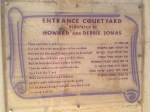
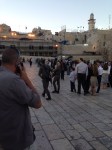
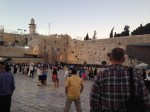
Before dinner we went to the Western Wall (the Wailing Wall) again, and this time the atmosphere was very different than it was earlier in the week. Tonight it was a highly energized crowd – with many people there! The songs, the prayers, the smiles and the dancing all indicated a people who were in the midst of a celebration.

The time of prayer at the wall was, again, just wonderful. How do I describe something like this? It is like a deep breath, or a long cool drink in the midst of an intense sports contest.  It is refreshing and renewing – it refocused me once again on why I’m here and who my God is and what He has done.

Now I realize I’m I’m starting at the end and moving backwards…so bear with me. Earlier in the day we met with two groups and then a lady who is part of a Kibbutz in the south of Israel.  It is the south that is getting shelled today by the terrorists from Hamas.

The first organization was called ‘Shalva’ which means “peace of mind” in Hebrew and finds its origin in Ps. 123:7 were the word “prosperity” can be translated “peace or mind” or “tranquility.” UPDATE: Our tour guide wrote an article in the Jerusalem Times about our visit – HERE.

Shalva was simply an amazing experience.  It is a huge Israeli success story about a man and his wife whose first child was normal and healthy until he was vaccinated for Diphtheria and just got a bad strain of medicine which resulted in blindness and deafness.  This is the man who gave us the tour yesterday. His energy was infectious; his passion for Israel and for children brimmed over from every word used to describe their mission here. The story is that instead of just coping, the parents (founders of Shalva) took him to New York and found treatment at the Lighthouse.

We were able to meet this an amazing young man – probably 38 or so now if I had to guess. His is passionate about politics and world affairs.  He’s met President Bush, and can’t stand Obama, although he is thankful as all Israelis are, that the U.S. has stood by Israel in this most recent conflict.  He also asks a ton of questions via a sign language method where he places his hands in another’s and impresses Hebrew alphabet shapes into the other person’s hands in order to convey his thoughts. It’s very cool. The entire center is in itself a blog post. Needless to say, I was very moved by their heart for those who are needy.  They said “we’re just fulfilling the biblical mandate to care for those who are feeble.”  I include it here so you can see the fullness of the scope of this trip – we were meeting with parts of this society that were conveying the diverse culture of innovation here.

In conclusion on Shalva…They did such an amazing thing that the government has come to them and asked them to do it nationally.  They’re now building a $50million facility on 7 acres in the middle of the city of Jerusalem.  7 acres is a gigantic amount of land considering what they have and how much of a fight it is over every single pebble over here.  Pictures from our time there are below.

Next we met with former IDF soldiers who are working to help assimilate wounded soldiers back into society and a normal life.  It’s one wounded soldier helping out another.  To listen to their backgrounds really paints a picture of what the mentality is over here, ad how these men view their work and their country.  To hear the heroic tales of their bravery on the front lines, but then also in supporting and lighting a fire under these other wounded soldiers to press on, was just amazing.

One of the things that is key for these IDF Soldiers that stood out to me was how they take teams of wounded soldiers and go to the hospitals right away after a soldier is hit.  They come alongside their parents (with their own parents coming with them!) and help them get the best doctors, describe the rehab process, and give them hope for the future.  All the while promising not to leave until their process is done…that will be years considering the effects of PTSD on these guys and gals.

After meeting with the former IDF guys, we had what was probably the most intense and raw meeting of the day with a lady whose Kibbutz we had been scheduled to visit that morning.  We were unable to travel to the south where her village is because of the rocket fire that started up and actually wounded two people near the entrance to the village. So she came to us – leaving her 15 year old son to watch the house.  She was nervous and very tightly wound to say the least.

During her talk he goal seemed to just tell us about what life was like on the southern border with Gaza.  She did this by simply telling us her last 29 days during operation Protective Edge, and the fact that for their Kibbutz this reality had been haunting them since March when random rocket fire and mortars had been landing in their area.

One of the great things about Israel’s Iron Dome technology is that it has an over 90% success rate – its just an incredible system.  However, because it costs well over $60,000 per missile (vs. the $500 rockets Hamas is launching most of the time) to take down these rockets coming from Gaza, the IDF doesn’t take down every single one – they take missiles down that aren’t heading for population areas and are landing in “open fields.”  The truth is though – for those living in the south especially  – that the open fields are their gardens and back yards sometimes.  The stress these people are under was written all over this lady’s face.

As she began to describe her day to day life and some of the personal affects the last few months have taken, the toll was evident.  The meeting ground to a halt at one point from the raw emotion of what was being conveyed, and we all stopped and prayed over her.  Not a dry eye in the place.

Yet, she continued on.  She pulled up her Facebook account to show the village, her friends, her life and we saw first hand mortars in gardens and backyards, and began to realize the fears now of underground tunnels popping up in the middle of their homes or schools.  How do you ward off this fear?  She said she represses it as best as possible, but it is very hard.

The obvious question when you read things like this without being here is: why stay?  The answer was given to me by our tour guide (a former IDF soldier himself who was actually in mid-town Manhattan during 911) “you don’t leave because this is our home.  If she were to leave, and go north, and then shelling started there, what then? Does she pack up her home, leave again? When does it end???  No.  This is our home, we don’t leave, we solve the problem as best we can and we live our lives as best we can (paraphrase).”

This is the resilience of the Israeli people, and that was my experience from yesterday.


Israel Day 3: It is the Heart that Matters

20140806-184246-67366973.jpg

It’s 6am here in Jerusalem.  I’m taking stock of what I’ve seen, heard, and the conversations I’ve had on this trip thus far and I am struck to the point of tears this morning at one simple reality: It is the heart that matters above all else in the affairs of man.

Yesterday we met with Jerusalem Post journalist Herb Keinon who offered an insiders view of Prime Minister Netanyahu from his years covering Israeli politics, and traveling oversees and around the country with him.  Then we visited Yad Vashem, the Holocaust museum here in Jerusalem.

The Yad Vashem experience was led by a tour guide who asked a lot of questions in order to convey her ideas and the thrust of the museum – perhaps it was just her style, but it was a good way to open up the lid a little and get people thinking about the deeper issues surrounding not only the Holocaust, but hatred and killing in general. The questions that summed it all up were: How could human beings do this to other human beings? What is it that happened inside their minds and hearts? What is the genesis of this grotesque defect? What can be done to stop it in the future?

Hold that thought…

After Yad Vashem, we had lunch with Brig. General for the IDF Reserves Nitzan Nuriel.  The lunch was nothing short of fantastic.  Nuriel is an amazingly candid and heroic man.  His vision of survival, optimism, and hope for future Israeli generations was clearly what surfaced during our time together.  He exuded strength, good naturedness, and resolve.  In short, this was one of the greatest leaders I have ever met in person.

During our conversation with the General, we asked many questions.  The dialogue was great – as it has been all week here in Israel.  And Nuriel seemed to echo what Keinon had said earlier in the morning, namely that long term peace and long term solutions to living in peace are elusive, and frankly probably not the way to focus all one’s efforts.  Living life to the fullest and best in-between conflicts is what counts, said Nuriel. What do we do with that time?  In the context of why he has hope for the future, Keinon put it this way, “Israel is remarkably good at finding solutions to short term problems.”

When you approach the problems these men are describing about Hamas, the Palestinian Authority, Lebanon, Iran, Syria, the border with Jordan, and on and on, you come to quickly realize there is no easy solution. They are dealing with people who are not playing by the same rules.  A member of Hamas has one goal in mind: exterminate the Jews. If they die trying, so much the better – they aren’t afraid to die, because of all they’ve learned about their supposed rewards in the afterlife.  YET, many palestinians who live in Gaza or the West Bank simply aren’t as militant.  They want a life of their own, and they are people with rights as well.  Israelis, more than anyone I know, understand the fundamental gritty truth that Palestinians, Muslims, Arabs etc. are human beings with families, lives, and souls.

The rock and the hard place are coming into focus, are they not? How do you live next to people and sit across the negotiating table with people who want to kill you because you’re a Jew.  They are completely unreasonable – they are terrorists.  Yet, there are millions and millions of men, women, and children whose lives are at stake and if you come from a Jewish background, there’s no way you’re going to wantonly kill innocents in any battle – even to defend your own people.  This is a nation of people defined by the holocaust, and that means it has been indelibly marked on them the fact that all people are human beings – just as they are.  That is one of the impressions, by the way, that one learns from Yad Vashem.

Making it all Make Sense

In the evening we had the privilege of meeting with three start-up businessmen and women who were success stories here in Israel.  It was a great dinner at a fun Moroccan restaurant in the Center City portion of Jerusalem.  As fun as it was to meet them, I was even more moved by a meeting that occurred just prior with a Palestinian Christian Pastor. I won’t tell you his name because he’s suffered enough persecution and I’d like to protect his privacy.

This young pastor was about my age – mid 30’s – and is on the front lines of spreading the Gospel of Jesus Christ to Palestinians – Muslims.  He has been beaten, had his church bombed, had his friends harassed and on and on.  But he still continues to preach.  What does he emphasize?  Loving your enemy. Why? Because this is what Jesus taught, yes, but how is he able to do it?  Because His heart has been changed radically by God. 

And…his ministry is flourishing. People are coming to Christ.  Interestingly enough, it is this idea of “love” and an understanding of mutual humanity that bridges gaps on an interpersonal basis even among secular Jews and Palestinians.  The entrepreneurs we listened to last night confirmed that as well.  But the difference between common decency and the radical nature of Jesus’ love is that one promotes harmony until the other party wrongs us, while the other – the love of Jesus – helps us love people while they wrong us.

Why did men mass murder other men and women?  Why do members of Hamas blindly hate and target Jews – sacrificing their own citizens in order to do this?  These questions are deep, but not as deep as the answers to how these problems are solved.  If we acknowledge the depth of our sin and fallenness as humans, that is the starting point.  That is the obvious answer to Yad Vashem.  But what is the answer to the second question?  How is this nature overcome?  How is hatred and ignorance overcome?  By the love of Jesus Christ.  

This is a supernatural love, an alien love, a love not found naturally in the corrupt hearts of man. It is also a gracious love, a love which God has shed abroad in the hearts of men and women who share a faith in Christ.  For those who are Christians, we need to understand that the ultimate answers to the difficult questions of our time both here and at home, begin not at the military, political, or diplomatic level, but in the hearts of mankind.

Pictures from Day 3 below:

Israel day 2

20140806-184246-67366973.jpg

We started the day today hearing from professor Reuven Hazan from Hebrew University. Mr. Hazan gave us an overview of the political/government system here in Israel. It was extremely insightful and very enjoyable. Israel is a Parliamentary democracy and, unlike the U.S., elects it’s governing body nationally and not by districts – in fact, the names of candidates aren’t on the ballot, only the party names. Vote for a party and you get the whole ball of wax – every candidate that the party chooses to install.

After each election the parties are allowed to send to parliament a certain number of candidates based on the percentage of what their party received from voters nationally.

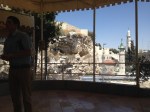
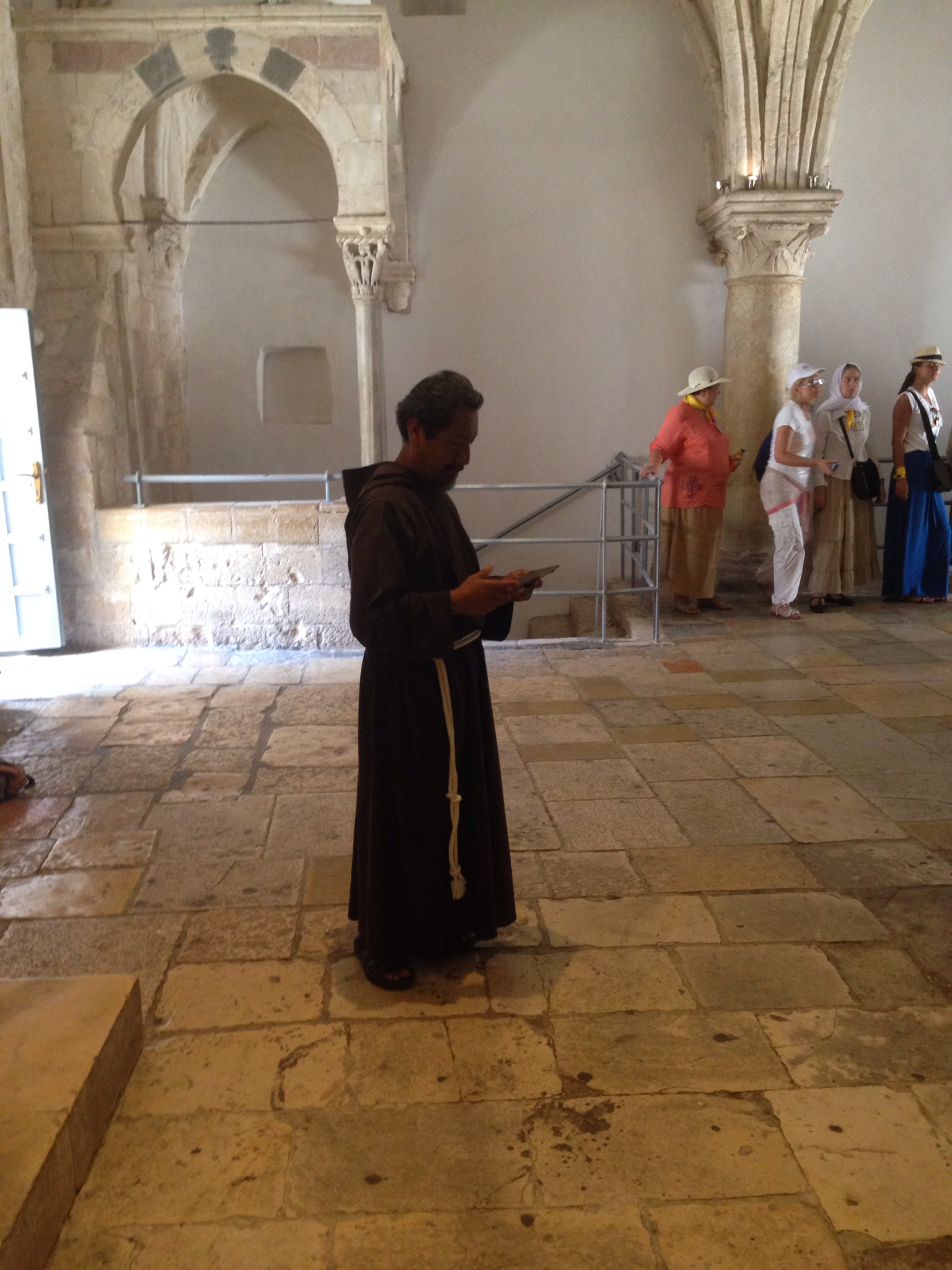
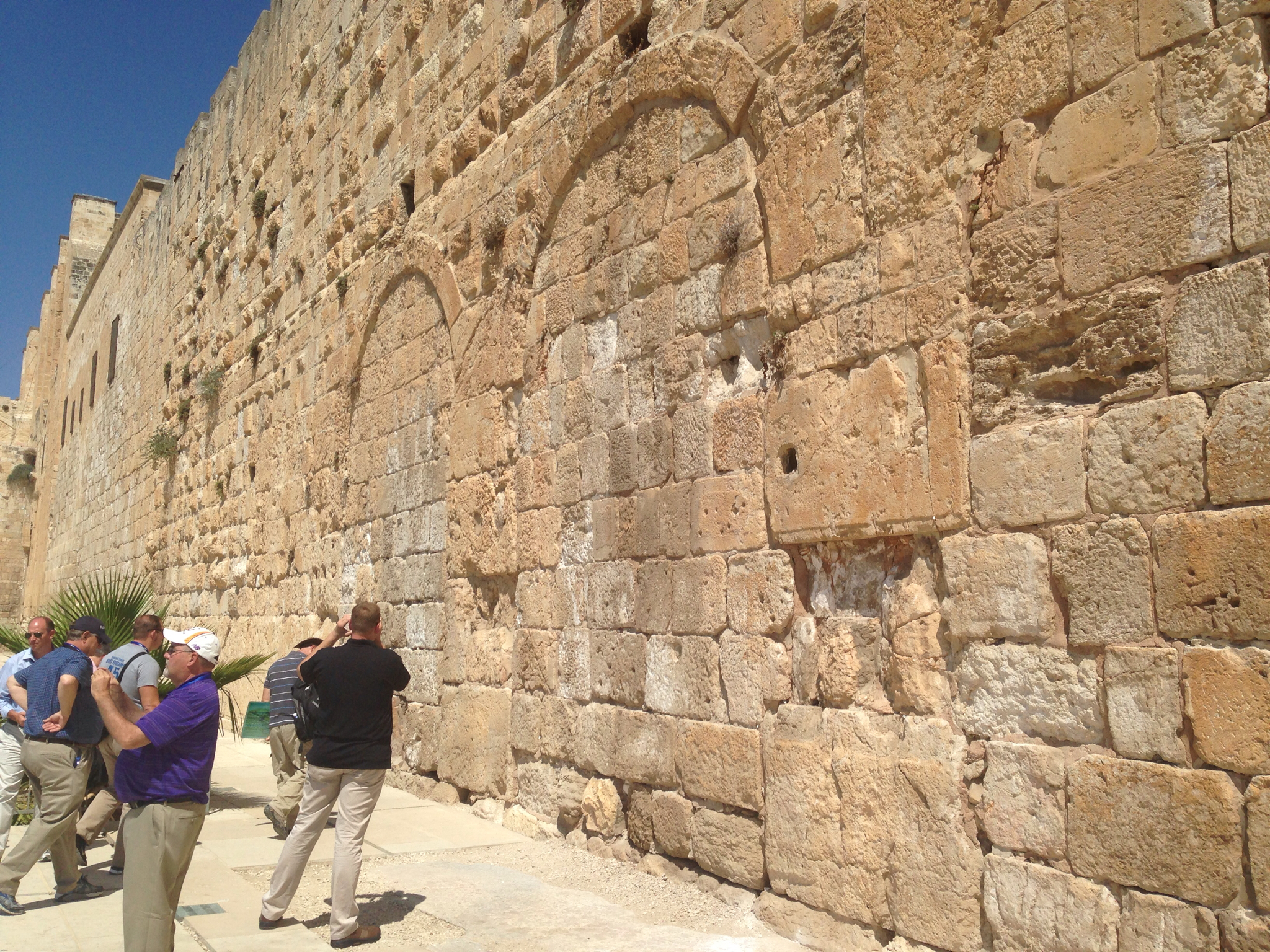
After this morning session we toured the old city which included many of the holy sites you’ve likely heard of before.  These included the temple mount, the wailing wall (western wall), the church of the holy sepulcher and the room Jesus was believed to have eaten his last supper in.

For me, walking up the temple mount, knowing that Jesus had walked on those stones, and taught in that place, and that Peter had likely delivered his sermon in Acts 2 from that spot, was indescribable.  The best way to describe it would probably be to coming home.  A tremendous peace and amazement that lay unsettled in my gut – until the prayer at the western (wailing) wall whereupon I felt like for the first time in my trip I had met God in this place.  Mostly I attribute this to taking in all that I had seen, and then getting to come in prayer to the Lord.  When one pastor asked what I had prayed about, I told him that my entire mindset was dominated by thoughts of “come back quickly, Lord.”  I say that because there is an overwhelming sense – for me at least there was – that this is where it all took place.  And you want it to happen again.  You want Him to come again and to consummate His kingdom.

All the graves alongside the road leading up to the old city with the Mt. of Olives on the left etc. are there because they want a “front row seat” as our tour guide put it, to the coming of the Messiah —- now jokingly he said that the Jews first question will be “this your first time to Jerusalem?”  LOL!   For me, that resonated on a deeper level.  You see this wide swath of grave stones/head stones there laid out at the base of the Kidron as it wraps around toward the valley of Gehena and you realize they’re like seats in a movie theatre waiting for the great act of world history to sweep across the planes of that desert region and call them up to either judgment or to life everlasting.  Regardless, this is going to be the “place to be” so they say.

All of this sense, this feeling, comes to a nexus at the wall – at the time of prayer.  And needless to say it is very special.

We had several meetings after this.  One with a humanitarian activist from the Palestinian perspective, another with the leader of the Labor party opposition in the Knesset, and lastly we had dinner with an amazing journalist who is an Arab, Muslim, Palestinian, Israeli.  Crazy combination!  But that Palestinian perspective has been interesting.  Even the Palestinians we spoke with are against the Hamas, they think of Hamas as a terrorist group, and think of Barak Obama and John Kerry as closely aligned with the Muslim Brotherhood – at at the very best, empowering the Muslim Brotherhood!

Despite this sentiment toward Obama and Kerry, the Israelis and Palestinians we have met have been very very hospitable toward Americans and have nothing but good things to say about our country in general.  In fact, there hasn’t been an elected official, professor, journalist or expert of any kind that has not gone out of their way to thank us for coming at this time to show solidarity with Israel.  I can’t begin to describe how amazing it is to receive that kind of message from these men and women who have their lives in danger from terrorists every day.

Now, some of you have asked about my safety, and many are praying for me – thank you!  I want you all to know I’m safe, and couldn’t be enjoying this time more if I tried.  We’ve talked openly with people on the street, and because there has been a ceasefire for over 24 hours now (observed), we’re in good shape.  No rocket sirens thus far.

I’m pasting some pictures below of what I saw today.  This is only a sample, of course, but hopefully you’ll get a sense for what we saw and did today.  It was an amazing day.  The Israelis, I am learning, are a very courageous people.  Their political system is diverse, they have a unique outlook on life, they are surrounded by enemies, and they’re a beacon of freedom and morality in this part of the world.  It makes all the sense in the world, therefore, to stand by them in their efforts to not only exist as a nationstate (something Hamas’ charter puts them diametrically opposed to), but to thrive and to lead this part of the world out of the darkness of terror and radical Islam.

Several more amazing days in front of me.  If I went into everything I learned in each session and at every stop, these blogs would be way too long!  But needless to say, this trip is so well rounded that one cannot come away without a very thorough understanding of the geopolitical, religious, historical, moral, and military significance of this place.

Until tomorrow…Soli Deo Gloria!

The Last Super
The Last Super
Dome of the Rock, Temple Mount, Mount of Olives
The Temple Mount
The Temple Mount
Church of the Holy Sepulcher


Israel day 1

20140805-194122-70882201.jpg

This is day one of my AIEF (American Israeli Education Foundation) trip. I’m typing this from the plane (no internet yet on this Boeing 777 – only four craft in their 777 fleet have wifi…seriously) and we haven’t yet landed. It’s 9:45am eastern and we didn’t take off right away as scheduled due to a problem with the plane not wanting to accept fuel – obviously that wasn’t very obliging of their aircraft…So we switched planes. The result was a relaxing 2+ hour delay in Newark’s very nice airport. Now that we are on the way and somewhat rested, the anticipation for the day is beginning to build.

Most of this first day will be spent traveling and getting settled in. So not much to report. But the group of folks in traveling with (13 of us I believe) is a great and diverse group of men and (1) women. Mostly people from the Midwest who grew up with cold winters, fall football, and Christian faith backgrounds.

The several pastors who came with us include Tim Throckmorton, a fellow Ohioan, who has been my seating companion on each leg of our trip this far. Tim is from the Circleville area and pastors a church of about 500 folks.

There are also several politicos along for the adventure. My good friend Gregg Keller is on the trip. Gregg is a Missouri boy, and got his big break in politics working for former U.S. Senator Jim Talent.

I’m hoping to be able to share some of the journey here as we go. All my posts will come after events or the day following, for security reasons. Some will simply be pictures and others a mix (so long as the app I’m using doesn’t flake out on me!).

UPDATE: 30 min until Tel Aviv (from the journal, transposed)

The sense from all the men I’ve talked to on our trip is that this is a once in a lifetime/bucket list type of trip. A real privilege.

Of course the accommodations and hospitality are all first class, so in a superficial sense that is what is meant. But in a deeper sense, everyone knows that soon they will be walking on ground walked on by their Savior. And what that may feel like is yet unknown.

All Christians long for the Day He returns, and we feel and sense this desire from within us from God’s Spirit. So I wonder if there is some of this sense coming alive in our small party. As if setting foot in Jerusalem and Galilee were going to bring His Day and His presence nearer. The sense perhaps can be likened to that great joy one feels when a friend is born again. A touch of eternity is nearby…

Humans are designed for more than the temporal. We are beings created for an eternal God. When one comes alive from the dead it is a reminder of the eternal, the weightiness of these realities is more tangible to us in those moments.

So also, perhaps, we glimpse what the Spirit is reminding us of as we contemplate Israel, and that is namely this: we are here for a purpose, on a mission, grounded in what happens on that Hill outside the city.

And though seeing it will be wonderful, the reality is that the it is the Spirit that is the guarantee, and setting foot in Israel doesn’t change that. All a Christian need do is open the Pages and read.

And the Word became flesh, and dwelt among us…and we have seen His glory…

Until the next post…
Soli Deo Gloria

PJW

Landing in Tel Aviv
Landing in Tel Aviv

Journey to Israel

20140803-140916-50956304.jpg
This coming week I will be traveling to Israel on an adventure to learn more about the relationship between the U.S. and Israel, the defense of that country, and the economic success it has seen.

Of course I will also be seeing some of the historical and religiously significant sites during my trip, and I’m looking forward to updating this blog as much as possible, both with pictures and text.

So stay tuned as I travel throughout the nation of Israel and report back on what I see and do! Your prayers for safety and health are definitely appreciated!

Many people have asked what organization I’m going with – AIPAC is the name of the group. You can learn more about them here.

Soli Deo Gloria!

PJ Wenzel

Study Notes for John 19:1-16a: ‘Behold the Man’

Here are my (rough) notes for John 19:1-16a. As a side note, there aren’t as many written out parallels with Is. 53 as I will likely reference tomorrow while teaching this. I will not be back to teach for another two weeks. In the meantime, I hope these notes are edifying to you, and that you see the sovereign hand of God in every step of Jesus’ final hours before death.

ecce homo by Antonio Ciseri

John Chapter 19

19:1 Then Pilate took Jesus and flogged him. [2] And the soldiers twisted together a crown of thorns and put it on his head and arrayed him in a purple robe. [3] They came up to him, saying, “Hail, King of the Jews!” and struck him with their hands.

As we read these words, those of Jesus come to mind: “For he will be delivered over to the Gentiles and will be mocked and shamefully treated and spit upon. And after flogging him, they will kill him, and on the third day he will rise.” (Luke 18:32-33)

I just note this passage again, as I did previously, and as I will do in the future, because as these things happen to Jesus I want to keep in the forefront of our minds that Jesus knew exactly what would happen to him. The “flogging”, the “mockery” and the “shameful” treatment is already taking place. The rest is soon to come.

With that in mind, a few notes on what was going on here. The flogging of someone who wasn’t proven guilty was pretty common. In America in the 21st century, we have this concept of being presumed innocent until proven otherwise. What is so despicable about so much of the media attention that surrounds modern trials is that in the minds of the public innocence and guilt is obscured, and justice is whatever people’s emotions dictate. This is what is means to make a “mockery” of justice.

What we are seeing here is mockery at its zenith.

Of course the purple robe is intended to signify royalty or importance. Purple was expensive, and was held in high regard. In Acts 16 we read of a lady named Lydia who was a clothier of some kind, and Luke goes out of this way to mention that she dealt with “purple” cloth:

One who heard us was a woman named Lydia, from the city of Thyatira, a seller of purple goods, who was a worshiper of God. The Lord opened her heart to pay attention to what was said by Paul. (Acts 16:11)

By looking at this fact, and the other clues in the passage, Pastor Matt Chandler says its safe to assume Lydia was a wealthy, successful lady who catered to the upper class (that final part is my own assumption).

The crown of thorns, and what kind of bush these came from, is a subject of debate. Easton’s Bible Dictionary takes the view that the thorns were not very long or painful, but could be easily made into the crown described by John and the other gospel writers:

…our Lord was crowned with a, in mockery by the Romans (Matt. 27:29). The object of Pilate’s guard in doing this was probably to insult, and not specially to inflict pain. There is nothing to show that the shrub thus used was, as has been supposed, the spina Christi, which could have been easily woven into a wreath. It was probably the thorny nabk, which grew abundantly round about Jerusalem, and whose flexible, pliant, and round branches could easily be platted into the form of a crown.

Fausset seems to agree upon the pliable nature, though not the type of plant:

Christ’s “crown of thorns” has been supposed to have been made of the Ramnus nabeca (Hasselquist) or the Lycium spinosum, probably the latter (Sieber). To mock rather than to pain Him was the soldiers’ object, and they took whatever came to their hand first. The dark green was a parody of the triumphal ivy wreath.

Whatever the nature of the crown, it made a mockery of the kingship of Jesus. And I am personally reminded that those who suffer mockery for the sake of Jesus will eventually win the “crown of life” (Rev. 2:10).

Lastly, and I was struck by this, the Romans struck Jesus with their hands. I really think that at this point they weren’t working to inflict pain as much as make a mockery of Him. I began to think about the thoughts and emotions that go through a person’s mind before inflicting any kind of blow upon another person. Usually human beings react in anger to being hurt, or are defending their honor or another’s before taking a swing at someone. However, that doesn’t seem to be the case here. These men have not been wronged by Jesus, nor have they likely even heard of Him before. To them, He’s just another Jew.

What do I bring this up? Because it displays the nature of mankind. Man is in a depraved and evil state from birth. His nature is twisted, and his motives are selfish and turned against his Maker. Environment (so-called “nurture”) can lessen or increase the outward effects of sin, but it’s effects are there on the heart – branded, as it were, from birth.

Ironically, these are the types of men Jesus came to save. He came to save us from ourselves.

NOTE: There is a lot of debate among the scholars as to the nature of the beating administered here. There were three grades of beating (cf. Carson) that the Romans administered, and this one was likely the least severe, with the intent to simply appease the Jews – this of course didn’t work. The most severe beating is the one which involved the famed ‘cat of nine tails’, each “tail” having bits of metal or bone embedded into the ends. The bones and metal chips would land in the flesh, and then rip the flesh off, thus exposing the body’s internal organs and bones after a time. This third degree of beating was likely what Jesus received after being formally and finally condemned by Pilate (we aren’t quite there yet in the narrative, and its hard to see how Pilate would have moved to this degree of beating without a final verdict being given).

19:4-5 Pilate went out again and said to them, “See, I am bringing him out to you that you may know that I find no guilt in him.” [5] So Jesus came out, wearing the crown of thorns and the purple robe. Pilate said to them, “Behold the man!”

I am reminded of the fakery of this ceremony when I read these words simply because it was typical to adorn a king with certain trappings of the office and then hail him as king before the people. For instance, in 2 Chronicles 23 we read of the crowning of Joash, a very young man at the time:

Then they brought out the king’s son and put the crown on him and gave him the testimony. And they proclaimed him king, and Jehoiada and his sons anointed him, and they said, “Long live the king.” (2 Chronicles 23:11)

When Pilate declares, “behold the man”, he is of course mocking Jesus. But in his words there is a great deal of irony. Jesus is the man. He is the God-man. He is certainly human, and yet the passage is inescapably tinged with His divinity.

All of this occurs despite the fact that Pilate found no guilt in Jesus. I don’t suppose we have a full account of all that was said, but John has included what was necessary to give us a picture of the proceedings.

19:6-7 When the chief priests and the officers saw him, they cried out, “Crucify him, crucify him!” Pilate said to them, “Take him yourselves and crucify him, for I find no guilt in him.” [7] The Jews answered him, “We have a law, and according to that law he ought to die because he has made himself the Son of God.”

Now Pilate once again seeks to release Jesus. The Jews didn’t want Him released, and it is typical that when people are riled up about something they cool down after a while and after seeing their enemy sufficiently humiliated. But for these Jews, Pilate’s humiliation of Jesus wasn’t enough.

Their desires now fully match their father the Devil’s. They want to see Jesus dead, and they begin to cry out for His death with shouts of “crucify him!”

I spoke of this before, and so won’t spend a lot of time on it, but Pilate doesn’t really find anything wrong with Jesus, and he doesn’t feel the need to be involved in killing Him either. But we shouldn’t mistake this for altruism on Pilate’s part. It may be true that his heart was being softened at this moment, but that doesn’t seem likely. What seems likely given the context is that he is simply mocking the Jews.

When Pilate says, “take him yourselves and crucify him” he’s just rubbing in the lack of ability for the Jews to do this because they were under the governance of the Romans. It’s as if Pilate was saying, “go kill him yourself…oh, wait, that’s right you’re under the boot of Roman rule…ya sorry about that!”

Now the response of the Jews shows how laser focused they were in accomplishing their objective. They didn’t blink an eye at the insult of Pilate, for they knew very well that they weren’t allowed to kill anyone. Instead they continue to make the case that Jesus has to die, and therefore the Romans need to be the ones to do it.

Why They Want Him Dead

If you notice here, it’s the chief priests who are demanding the execution of Jesus. Why? Because “he has made himself the Son of God.” Their case is based on theological grounds.

Here’s why I think that its worth taking a minute to pause and reflect on this statement: There have been many liberal scholars, and secular academics, who claim that Jesus never claimed to be God, or divine, or anything more than a good teacher, but this assertion simply doesn’t hold up.

This text is “exhibit A” as to why the “good teacher” argument doesn’t hold up: Even His enemies knew what He was claiming. Though they had many other accusations to hurl (i.e. that he intended to destroy the temple), this is the one they come to Pilate with when everything is on the line. Their main accusation is one of blasphemy. Jesus, this man from Nazareth, has claimed to be equal with God.

There are several passages to show this, but one need only look at chapter eight to see an excellent example of the clash between Jesus’ claims and the teaching/leadership of the Pharisees:

Are you greater than our father Abraham, who died? And the prophets died! Who do you make yourself out to be?” [54] Jesus answered, “If I glorify myself, my glory is nothing. It is my Father who glorifies me, of whom you say, ‘He is our God.’ [55] But you have not known him. I know him. If I were to say that I do not know him, I would be a liar like you, but I do know him and I keep his word. [56] Your father Abraham rejoiced that he would see my day. He saw it and was glad.” [57] So the Jews said to him, “You are not yet fifty years old, and have you seen Abraham?” [58] Jesus said to them, “Truly, truly, I say to you, before Abraham was, I am.” [59] So they picked up stones to throw at him, but Jesus hid himself and went out of the temple. (John 8:53-59)

So here we have just one example of His clear claim to divinity. And we’ve spoken about this passage in the past, but its important to realize the profundity of these words and how they must have antagonized the Pharisees.

Carson summarizes with great circumspection:

In man contexts that was demonstrably untrue. The anointed king of Israel was sometimes referred to as God’s Son in the Old Testament (Ps. 2:7; 89:26-27), and in some intertestamental sources ‘Son of God’ is parallel to ‘Messiah’ (4Q Florilegium). But Jesus’ opponents rightly recognize that as he uses the title there are overtones not only of messiahship but of sharing the rights and authority of God himself (vs. 1:34; 5:19-30).

19:8-11 When Pilate heard this statement, he was even more afraid. [9] He entered his headquarters again and said to Jesus, “Where are you from?” But Jesus gave him no answer. [10] So Pilate said to him, “You will not speak to me? Do you not know that I have authority to release you and authority to crucify you?” [11] Jesus answered him, “You would have no authority over me at all unless it had been given you from above. Therefore he who delivered me over to you has the greater sin.”

It’s interesting to read Carson and Ridderbos and others discuss what John must mean by Pilate being “more afraid.” They seem to think that Pilate, like many Romans, was likely a very superstitious man, and that it wasn’t so much that he was convinced or had a strong feeling of Jesus’ deity that this statement confirms.

No, the man Pilate had no clue that Jesus was the God-man, and indeed very God of very God. Rather, he was either concerned that there might be something super-human about him (as in Greco-Roman mythology – so Carson) or he was afraid/nervous about his tenuous position as maintainer of order during the proceedings (so Ridderbos), which were tending toward absurdity and chaos, rather than justice and order.

Jesus then doesn’t answer Pilate – He’s really already answered this question before (see vs. 36) and, as is remarked upon by some, He likely doesn’t see Pilate as a rightful judge in these matters. The silence, of course, is not indefinite. But it partly fulfills what we read in the prophets “He was oppressed, and he was afflicted, yet he opened not his mouth; like a lamb that is led to the slaughter, and like a sheep that before its shearers is silent, so he opened not his mouth” (Is. 53:7).

Next, Pilate severely aggravated by the silent treatment, flaunts his authority before the One who created him from nothing in the first place.

What is interesting about Jesus’ response is that in our English translations, the word “therefore” seems to act as a connector word to the previous sentence about the nature of how Pilate derived his authority. However, that is deceiving. Jesus is not connecting the authority of Pilate with his lack of culpability/responsibility for the sin of this ridiculous trial. Rather He is making two separate statements.

The first statement leaves us in great awe of the majestic sovereignty of the Lord, and reminds us of the compatibilist viewpoint of the New Testament writers (cf. Carson). God is behind every thing going on in this situation. God is the ultimate source of all authority, and therefore Pilate could not be operating – or living and breathing for that matter – without the express consent and decree of God. Yet this does not rob men of their responsibility to obey God. He is mysteriously ordaining every act of men, yet we are still responsible for our actions.

Secondly, playing off the first statement, Pilate is still responsible for his sinfully unjust trial. Yet the degree of this sinfulness is eclipsed by those men (or man – it is in the singular in the Gk) who delivered Jesus over to him.

I can’t personally decide with certainty who it is that is at issue here – whether it is Caiaphas (as Morris and Carson have deducted), or whether it is the Jewish leaders as a whole (as Ridderbos says – he says that the Evangelist is speaking in a redemptive-historical sense, and thereby the singular use of the pronoun “he” is figurative in a sense). If I were pressed, I would say that it represents Caiaphas directly, and the Jewish leaders and the people as a whole indirectly. Caiaphas was the leader of the Council, and the head of the governing body of the Jews. He represented the nation in a federal sense, one might say (just as Jesus represented a nation so to speak, on the cross – see also John 11:49-52)

The key to this passage is this: God is in control of the large and small aspects of history. He ordains all that comes to pass. Not one evil deed is done without His oversight and permission. Yet this does not excuse wickedness, nor does it deny the culpability of man. Rather it shows God’s mercy and the depth of His mysterious ways that He allows evil to work in its fashion for good. These things will not long be the case, as when He comes back in glory the Lord Jesus will put all evil to death, and will usher in an eternity of joy, peace, and abundant life – that which was inaugurated will be consummated.

19:12-16a From then on Pilate sought to release him, but the Jews cried out, “If you release this man, you are not Caesar’s friend. Everyone who makes himself a king opposes Caesar.” [13] So when Pilate heard these words, he brought Jesus out and sat down on the judgment seat at a place called The Stone Pavement, and in Aramaic Gabbatha. [14] Now it was the day of Preparation of the Passover. It was about the sixth hour. He said to the Jews, “Behold your King!” [15] They cried out, “Away with him, away with him, crucify him!” Pilate said to them, “Shall I crucify your King?” The chief priests answered, “We have no king but Caesar.” [16a] So he delivered him over to them to be crucified.

Now Pilate has asked once again if the Jews will allow Jesus to be released. Pilate is troubled by this Jesus, and he is annoyed at the petulance of the Jews. Yet he is walking a fine line here, and he’s a smart politician. He won’t allow the Jews to get their way on a whim, as if they rule the province, yet he won’t allow the situation to devolve into anarchy which would cause an even bigger headache for him.

Ridderbos rightly says, “Though he (Pilate) knew from long experience with the Jews the hypocrisy of this sudden loyalty to the emperor, he understood from this renewed mention of the emperor that all further delay was futile and could even get him into trouble.”

Therefore it is at this moment that the Jews play a final card – and an effective one at that. In a statement simply drenched in irony and hypocrisy, they claim that if Pilate releases Jesus he will show himself to be a disloyal subject of the Caesar! In other words, they’re claiming that they are more loyal to Caesar than Pilate is! The Jews – specifically “the chief priests” – solidify their (fraudulent) claim to loyalty by shouting “we have no king by Caesar!”

Indeed they had surrendered all kingship to secular authorities, and by this statement revealed for all to see that they were under the kingship of Satan and his ruling authorities rather than the God they claimed to serve.

What immediately came to mind was the rejection of Samuel in the OT. The people claimed to want a king like all the other nations. But what was God’s interpretation of those events? Here is what He said to Samuel:

But the thing displeased Samuel when they said, “Give us a king to judge us.” And Samuel prayed to the LORD. [7] And the LORD said to Samuel, “Obey the voice of the people in all that they say to you, for they have not rejected you, but they have rejected me from being king over them. (1 Samuel 8:6-7)

All of this serves to remind us of all that Jesus had to suffer before being crucified. Wrongly accused, Jesus has to go through the injustice of a trial which is nothing but a sham. Then He observes as the people He created in His own image deny His kingship and swear a false loyalty to a pagan worshiping man thousands of miles away, all in an effort to crucify the One sent to save them from their sins.

The terrible irony of of this back and forth between Pilate and the Jews is finally put to rest as Pilate acquiesces to their Satanically inspired desires.


Weekend Reading: August 1, 2014

There are several interesting articles and videos that grabbed my attention, and sparked my curiosity this week.  Also, since I received some good feedback on posting the books I’m reading or have read this week, I’ve done that again at the bottom of the links.  I hope you enjoy the links, and have a wonderful weekend! Please note: I’ll not be publishing an edition of Weekend Reading next week as I’ll be out of the country.

PJW

It’s political season, which means RedState has some interesting stuff this week. That includes an article on how the US Senate has changed (for the worse) under Harry Reid’s leadership.  But they also have a pretty amusing poke at Atheist Richard Dawkins.  Also, by way of Ohio politics, there’s a breaking story that could be bad for Democrat Gubernatorial candidate Ed Fitzgerald…

Voddie Baucham addresses the (incorrect) theory that Jesus never said anything about homosexuality. (h/t Parris Payden)

Fascinating article about how a new form of propulsion is being successfully tested by NASA and other scientists.  This would involve microwave energy powered by the sun and would eliminate the need for fuel-based propulsion systems in space, thus saving untold millions of dollars in the satellite (and other) industries…this seems really confusing, but scroll to the last graph for a good summary.

Ligonier Ministries pushed out a post yesterday advertising their ‘Crucial Questions’ series by R.C. Sproul for kindle/e-reader…FREE.  The one on prayer is fantastic!

Speaking of fantastic, here is the best sermon on tithing I’ve ever heard. 

Great article here on Nintendo, and how past tech companies like Motorola have had big hits which cause them to miss long term strategy, and eventually go out of business. In a similar vein, here’s a story on how wall street experts see trouble ahead for Target and Walmart. 

Evernote for Academics – if you’re into Evernote, and do a lot of reading online, check this out. PS – Evernote is awesome!

Is Washington DC experiencing a post-government shutdown baby boom(let)? 

The Bible Project is out with their second video on Genesis 12-50. These are really really cool videos! The introduce the Bible to those who are unfamiliar or just learning the basics of Scripture.  Just really good.  Masterfully illustrated, solid theology thus far… + they’re from Portland Oregon (where I grew up!)

This…might frustrate you a bit…apparently the US has spent more money “rebuilding” Afghanistan than the total cost for all of the European rebuilding combined post WWII under the Marshall Plan.

Here’s a beautiful post on DG from Samantha Poteat on God’s grace after not reading your Bible for a while.

The World Cup is coming to Qatar (in case you haven’t heard), and already there are issues of human labor exploitation and terrible working conditions.

In rather interesting, yet slightly off the wall type news, here’s a video that celebrates the service of an 86 year old marksman who served in WWII.  It’s neat to watch him still display his skills, and be honored by the Service.  (h/t Katie Wenzel)

Speaking of off the wall videos, the GOP candidate for Governor of California spent a week trying to make it on the streets with only $40.  Several nights are spent on park benches, and he finds that its really hard to get a job.

On a serious note, Wolf Blitzer took a first hand look at the tunnels that Hamas has been digging into Israel.

Speaking of terrorists, here’s a scary (and long) piece from the NY Times on how Al Qaeda is being bankrolled by their hostage taking businesses…and the European governments willing to pay millions to free the men and women they abduct.

Also, and this is funny, here’s a post on FP.com title ‘9 things to avoid when creating your own caliphate’. 

Two sort of humorous articles from Quartz this week.  The first is how – no matter what anyone says – its never acceptable to wear sweatpants in the place of, well, anything in public. And another on how snap-chat IS really worth as much (or more) than the $3billion Facebook was going to offer them.

And finally, John Piper posted an short article on J.I. Packer and his philosophy of living “flat out” until you die.  Packer is now 88 years old, and still as valuable to the church as ever.  Piper also posted an article that Parris sent me titled ‘The Majesty of the Teacher in the Sermon on the Mount’ 

Here are the books I’ve finished or am I’m reading this week: Loving Your Wife as Christ Loves the Church, Winston Churchill: The Last Lion (Volume I), Bilbo’s Last Song, Start Up Nation, The World of the Old Testament, The Atlas of Middle Earth, and The Empire Striketh Back. Also, in case you missed it, Amazon Prime Members should note that ‘Band of Brothers’ is now FREE for streaming.  Katie and I finished it two nights ago, and we really enjoyed it – it made me remember how grateful I am to be living in a free country, and for the sacrifices of previous generations.

Death Can’t Beat You

I was reading in Frank Matera’s excellent Biblical Theology this week, and though he is a Catholic (a VERY conservative one), and I disagree with him on many points, he is also a brilliant Biblical Scholar who says some really wise things on the nature of our union with Christ. What Matera says concerns the fact that those who are joined to Christ will benefit from the resurrection of Christ.   Here’s what Matera says:

Those who believe already enjoy resurrection life because the one in whom they believe is resurrection and the life. Because they already possess this life, they will live even if they die, and they will not suffer eternal death because the eternal life they already possess cannot be taken from them. Consequently, even though they must face physical death, they will not lose the eternal life they already enjoy. Their resurrected life will be the continuation of a life they already possess.

This is a concept that I spoke about on Sunday morning, and that I believe Luther understood when he wrote the famous hymn ‘A Mighty Fortress is Our God’.

Luther puts it this way:

That word above all earthly powers, no thanks to them, abideth;
The Spirit and the gifts are ours through Him Who with us sideth:
Let goods and kindred go, this mortal life also;
The body they may kill: God’s truth abideth still,
His kingdom is forever.

In other words, once you are joined to Christ, you’re unstoppable.  Death can’t keep you from life.  You’re going from life to life.  This reality is only ours through the finished work of Jesus.  This week, I’m going to stop and remember that fact, and preach it to my fears and my self-centered concerns, giving thanks to Jesus who has overcome death to give us life everlasting.

Notes on John 18:33-40 – God on Trial Part 2

God on Trial Part 2

18:33-36 So Pilate entered his headquarters again and called Jesus and said to him, “Are you the King of the Jews?” [34] Jesus answered, “Do you say this of your own accord, or did others say it to you about me?” [35] Pilate answered, “Am I a Jew? Your own nation and the chief priests have delivered you over to me. What have you done?” [36] Jesus answered, “My kingdom is not of this world. If my kingdom were of this world, my servants would have been fighting, that I might not be delivered over to the Jews. But my kingdom is not from the world.”

The Setting

Hendricksen is right that the Evangelist assumes that the reader has had some account already of the goings on here in more detail and is just getting to the point he wants to make – John has an agenda.

In fact, each gospel writer has an agenda. Each one wants to show the reader something about Jesus. Matthew, for instance, wanted to show that Jesus was the Messiah – the one who the Jews had long awaited, the son of David. Luke, writing to gentiles, wanted to show that this Jesus was the Son of God and the Savior of the World. And John’s goal is spelled out in his thesis statement just a few chapters from now:

Now Jesus did many other signs in the presence of the disciples, which are not written in this book; [31] but these are written so that you may believe that Jesus is the Christ, the Son of God, and that by believing you may have life in his name. (John 20:30-31 ESV)

Later in his first Epistle John would write:

I write these things to you who believe in the name of the Son of God that you may know that you have eternal life. (1 John 5:13)

These are good things to keep in mind as we’re reading this account. John’s goal is to show us the character of this man, Jesus, and what He came to do.

The Question

Pilate is skeptical of the Jews’ accusations against Jesus. So in order ascertain for himself what the situation is surrounding this man, he takes Jesus into Roman custody and begins to question Him.

The first question that John records for us pertains to His kingship. Hendricksen rightly (I think) notes that the emphasis must be placed on the pronoun “you”, if we’re to understand the thinking of Pilate. To put it into the negative, he’s saying, “You aren’t the king of the Jews are you?”

Surely this meek Jewish teacher isn’t their king! In Pilate’s mind this is a joke.

Jesus begins to answer the question with one of His own – because it’s not as if He can answer this with a simple “yes” or “no.” If He answered “yes” then Pilate would suppose Jesus to mean a political type of king – for that’s what he had in mind when he asked the question. But if Jesus answered “no”, then He would be overstating the case. Answering “no” would almost be to say “in no way shape or form am I king – they have it all wrong.”

So in order to answer the question correctly, He must first qualify the question. That qualification earns a scoff in return.

Pilate’s reply confirms our interpretation of the snarkiness we detect in the first question. He says, “am I a Jew?” In other words, “Do I have anything to do with any of this nonsense? I don’t think like a Jew, I don’t look like a Jew, and my king is much more majestic than what the rabble brought before me today!”

Now there are some really interesting ironies here in these contrasts, and Carson exposes one of them having to do with Pilate’s question “Am I a Jew?”

It is just possible that under Pilate’s question ‘Am I a Jew?’ the Evangelist finds lurking deeper ironies. Pilate despises and distrusts the Jews, yet in the course of the narrative he is eventually forced to adopt their position. Insofar as the Jews here represent the ‘world’, Pilate joins them. And in any case, the reader knows that in a profound sense Pilate’s question really means (though certainly not intended this way by Pilate), ‘Are you my king?’ (Carson, pg. 593, cites Duke).

Pilate then demands of Jesus “what have you done?” In other words, “what is it that you’ve done to rile these detestable Jews to this point? How have you annoyed them so as to have them demanding your execution???”

The Reply

Now we are at verse 36, and the reply of Jesus to the questions Pilate has been asking. He’s had Pilate clarify the question, and Pilate is clearly annoyed, and has replied with derision at the Jews and their idea of kingship. Surely it can’t be this man!

There are so many passages in Scripture where we can look to for evidence of the kingship of Jesus. We look at passages that show His authority, or descriptions of His sovereignty and control over lives and nature and so forth. But perhaps this is one of the passages we overlook.

**I think that in Jesus’ reply there are two things we learn: 1. The nature of the kingdom of Jesus and 2. The purpose for His coming to Earth.

First, the Kingship of Jesus is described here in terms of a “kingdom” – and not just a normal kingdom, but an other-worldly kingdom. His kingdom is not like the kingdoms we’re used to seeing or reading about in books. There are no knights in shining armor. There are no castle walls or protective moats. Missing are the court jesters, friars, monks, dukes, and large gathering of couriers (you can tell I think of “kingdom” in terms of the middle ages!).

Furthermore, the kingdom of Jesus is not situated geographically in a static physical location. And although all the world and its heavens are the footstool of God, for He owns all things and made all things, yet His kingdom is more than simply the physical created order that is visible to us today, rather it includes ALL of the created order including the spiritual realm.

The nature of the kingdom of God has been a topic much debated among theologians, but I would like to read a few comments by pastors and theologians to help us have a better understanding of how the church has understood Jesus’ words here throughout the last 2000 years

Perhaps George Ladd had the best definition. He described God’s kingdom in this way:

The Kingdom of God is the redemptive reign of God dynamically active to establish his rule among human beings, and…this Kingdom, which will appear as an apocalyptic act at the end of the age, has already come into human history in the person and mission of Jesus to overcome evil, to deliver people from its power, and to bring them into the blessings of God’s reign.

Commenting on Ladd’s definition, Tom Schreiner says, “We can say, then, that the kingdom was inaugurated in the ministry and death and resurrection of Jesus, but the kingdom will not be consummated until he returns.”

J.C. Ryle’s explanation on the nature of the kingdom Jesus is describing is great. He says, “It is a kingdom which is neither begun, nor propagated, nor defended by the power of this world, by the world’s arms or the world’s money. It is a kingdom which took its origin from heaven, and not from earth, – a spiritual kingdom, – a kingdom over hearts and wills and consciences, – a kingdom which needs no armies or revenues, – a kingdom which in no way interferes with the kingdoms of this world.”

I love how Ryle remarks that the kingdom of Jesus is timeless. It didn’t have a beginning and it won’t have an end. His kingdom is forever.

Martin Luther expressed this idea well in the final verse of his famous hymn ‘A Mighty Fortress is Our God’:

That word above all earthly powers, no thanks to them, abideth;
The Spirit and the gifts are ours through Him Who with us sideth:
Let goods and kindred go, this mortal life also;
The body they may kill: God’s truth abideth still,
His kingdom is forever.

Of course what Luther caught a hold of in this hymn is that the consequence of being united to Christ is that no matter what happens to this body, our place is in heaven with Jesus whose “kingdom is forever.”

This reality is what governs Jesus’ responses. He abides in the truth – the reality that in this moment is hidden from Pilate and the bloodthirsty Jewish leaders.

And though His kingdom is timeless, as Ryle points out, we find in Jesus’ words a hint of the already-not yet character of the kingdom. He was already a king. He had reigned forever with the Father and the Spirit over all that they created. By definition God is king over all because He created all things and therefore has authority over all things.

Yet, the Son, having set aside the privileges and rights ascribed to Him ontologically as God temporarily, still did not deny here before Pilate that He indeed was and is a king – THE King. And His kingdom will one day be consummated in a great and glorious triumph! Oh what a day that will be!

Carson’s comments reinforce what Ladd and Schreiner have to say (and help temper Ryle a bit):

It is important to see ‘that Jesus’ statement should not be misconstrued as meaning that h is kingdom is not active in this world, or has nothing to do with this world’ (Beasley-Murray, pg. 331). John certainly expects the power of the inbreaking kingdom to affect this world; elsewhere he insists that the world in conquered by those who believe in Jesus (1 John 5:4). But theirs is the sort of struggle, and victory, that cannot effectively be opposed by armed might.

And although Pilate does not recognize in sincerity the kingship of Jesus, he certainly would have had He seen Him in His glory just 33 years before, and, of course, he now knows the error of His ways being (we assume?) in eternal torment in Hell.

Therefore, as I mentioned before, these men are blind to the truth, and Paul was right in what he spoke to the Corinthians about the veiled nature of Christ’s glory during His time on earth:

And even if our gospel is veiled, it is veiled to those who are perishing. [4] In their case the god of this world has blinded the minds of the unbelievers, to keep them from seeing the light of the gospel of the glory of Christ, who is the image of God. [5] For what we proclaim is not ourselves, but Jesus Christ as Lord, with ourselves as your servants for Jesus’ sake. [6] For God, who said, “Let light shine out of darkness,” has shone in our hearts to give the light of the knowledge of the glory of God in the face of Jesus Christ. (2 Corinthians 4:3-6)

18:37 Then Pilate said to him, “So you are a king?” Jesus answered, “You say that I am a king. For this purpose I was born and for this purpose I have come into the world—to bear witness to the truth. Everyone who is of the truth listens to my voice.”

The Purpose for His Coming

So first we looked at the nature of the kingdom of God, and now we’re going to look at the purpose of His coming.

When Jesus replies to Pilate that He is a king and rules over an other-worldly kingdom, Pilate responds “So you are a king?” and we can almost assume that the sarcasm is kicking in at this point, as Pilate completely misses what Jesus is saying…though I think he will sober up here soon.

Jesus’ reply is not to simply confirm what He’s already said, but to give Pilate some insight into why He came to earth. Namely, He came to bear witness to the truth. This truth is the truth of God’s plan, and His gospel for mankind. Jesus’ mission is summed up in Luke’s gospel this way:

For the Son of Man came to seek and to save the lost. (Luke 19:10)

Now, Jesus ends His explanation by stating that, “Everyone who is of the truth listens to my voice.” If you are of the truth, if you have “ears to hear”, then you will listen and understand what Jesus is saying.

Remember that John plays up the contrasts in his book, and one of the biggest contrasts is between light and darkness. Pilate is in the darkness. He can’t understand what Jesus is saying to him. It’s all nonsense to his ears – and that’s why that passage from 2 Cor. 4 that I quoted earlier is so important.

It seems hard to fathom that if you were to stand in the presence of the Lord of Glory that you’d be able to miss that He is God incarnate. Yet many did. They’re eyes were darkened, their hearts were hardened, and they were not looking for the kingdom of God to come in such a remarkable way.

Furthermore, Jesus recognized this and explained this reality throughout the gospels, and we have read a lot of it in John’s gospel. For instance, compare these other instances to what we’ve read just now:

Jesus answered, “Truly, truly, I say to you, unless one is born of water and the Spirit, he cannot enter the kingdom of God. (John 3:5 ESV)

Truly, truly, I say to you, whoever hears my word and believes him who sent me has eternal life. He does not come into judgment, but has passed from death to life. (John 5:24 ESV)

And the Father who sent me has himself borne witness about me. His voice you have never heard, his form you have never seen, [38] and you do not have his word abiding in you, for you do not believe the one whom he has sent. (John 5:37-38 ESV)

Jesus answered them, “Do not grumble among yourselves. [44] No one can come to me unless the Father who sent me draws him. And I will raise him up on the last day. [45] It is written in the Prophets, ‘And they will all be taught by God.’ Everyone who has heard and learned from the Father comes to me— (John 6:43-45 ESV)

Why do you not understand what I say? It is because you cannot bear to hear my word. [44] You are of your father the devil, and your will is to do your father’s desires. He was a murderer from the beginning, and does not stand in the truth, because there is no truth in him. When he lies, he speaks out of his own character, for he is a liar and the father of lies. [45] But because I tell the truth, you do not believe me. (John 8:43-45 ESV)

We know that God has spoken to Moses, but as for this man, we do not know where he comes from.” [30] The man answered, “Why, this is an amazing thing! You do not know where he comes from, and yet he opened my eyes. [31] We know that God does not listen to sinners, but if anyone is a worshiper of God and does his will, God listens to him. [32] Never since the world began has it been heard that anyone opened the eyes of a man born blind. [33] If this man were not from God, he could do nothing.” (John 9:29-33 ESV)

I am the good shepherd. I know my own and my own know me, [15] just as the Father knows me and I know the Father; and I lay down my life for the sheep. [16] And I have other sheep that are not of this fold. I must bring them also, and they will listen to my voice. So there will be one flock, one shepherd. [17] For this reason the Father loves me, because I lay down my life that I may take it up again. (John 10:14-17 ESV)

The point all of these citations is to show that Jesus has come on a mission to find His sheep, to seek and save the lost sheep, and that before anyone is saved they are in darkness and unable to find their way to the safety of God’s arms. It is Jesus Himself who searches us out, who calls us to Himself, and whose truth must abide in us if we’re to be saved. It is He who sovereignly changes the hearts and minds of men, softening us to His call and His message, and giving us the truth of His gospel which is able to save our souls.

This is the truth He came to hear witness to, this is the truth He proclaims now before Pilate.

18:38-40 Pilate said to him, “What is truth?” After he had said this, he went back outside to the Jews and told them, “I find no guilt in him. [39] But you have a custom that I should release one man for you at the Passover. So do you want me to release to you the King of the Jews?” [40] They cried out again, “Not this man, but Barabbas!” Now Barabbas was a robber.

Oh the Irony!

Finally, as we wrap up chapter 18 we read of Pilate’s reply to Jesus’ mission statement that He came to hear witness to the truth. Jesus extolls all the great things that we Christians hold dear and Pilate responds with scoffs. He says, “what is truth?”

Of course the irony of this statement/question is that Pilate scoffs at the notion that there is an absolute truth standard to the man who embodies the truth itself and whose character is the basis for the very standard Pilate doesn’t believe exists.

Ryle is perhaps right that this state of mind reflects that which many rich and powerful men throughout every age have held. Pilate has heard of all the many philosophical systems and ideas in his own time and he’s given up even trying to figure out who and what is right. And I think that perhaps in Pilate’s mind, the very fact that he’s having to try a man for a crime that is so obviously absurd is more evidence in his mind that if there is an absolute standard, it doesn’t seem discernable to him or these ridiculous Jews.

The Response of the Jews

Pilate goes back to the Jews now and, not convinced that there’s anything wrong with this man Jesus – for how can he be a king? – says that he’s willing to release Him and chalk it up to their yearly custom of letting a prisoner go.

It’s fitting of the sarcastic narrative I’ve been painting here of Pilate that he continues to call Jesus ‘The King of the Jews’ – in his mind this is meant to denigrate the Jews that they would have such a lowly king.

Now the response of the Jews seals their fates and fulfills the prophecies that they would reject the Messiah, and stumble over the Great Cornerstone of the Church. Their salvation is at hand, and their reply is an enthusiastic call for the release of the robber Barabbas.

Weekend Reading: July 25, 2014

Here’s what I read this week and what’s going on in the world around us.  Hope you have an enjoyable weekend!

PJW

Here’s an excellent post by conservative blogger Erik Eriksen on the recent immigration issues on the southern border. Speaking of “border” issues – make sure you read a little bit (there’s also video) about how Russia is launching rockets across its’ border into the Ukraine…it’s getting real over there!

This week Desiring God and John Piper revealed their first look at Piper’s new Ministry called “Look at the Book”.  They do a demo of what Piper will be doing for different passages of scripture.

Tim Challies has a hilarious article on why its so painful to buy cars.

The Gospel Coalition looks at Tony Dungy’s comments about some dude who is going to be the NFL’s first openly gay football player.  I saw some of this controversy during the week, but didn’t pay much attention to it as its just become par for the course. (h/t Parris Payden) By the way – FL. Sen. Marco Rubio spoke this week about how ridiculous this kind of thing is getting. 

Free Audiobooks? I was on the road today and listed to some of the classics.  You can get apps for this, or you can check out this site to listen to some of your favorite classics!

The guys at Cripplegate look at the often misused passage in Philippians 4 (h/t Parris Payden)

With all the hubbub over the FAA suspending travel to Israel for 24 hours earlier in the week, I thought this was a pretty interesting map.  It shows where the US DOES NOT fly…ALSO, political communications expert Rich Galen has an overview of GAZA (keep in mind all of his columns are tinged with just a bit of dry humor).

Peter Jones has a very interesting blog post this week on the value of a set liturgy.  If you’re not from a more formal religious tradition, then this will actually probably impact you MORE.  He makes some great points.  (I’ve actually forwarded this to several people and have yet to get feedback – frankly I think most people have never considered the perspective Peter is offering).

In case you’re wondering, the IRS doesn’t know how to take care of their computer equipment…or something along those lines…

This morning the Drudge Report had an interesting article on how Facebook’s Founder will soon be the richest man in the world…well…he’s got a little ways to go yet, but he’s making progress.

DG had an interesting series of posts this week that are worth checking out.  The first is on sanctification, and likens it to the “autocorrect” function on most smart phones.  The piece has some great insights but it poorly written.   They also have a longer piece on how your smart phone is changing you.  I only skimmed this one, but some of the main points are definitely on track.

There’s a great post here on how to and how NOT to minister to someone with cancer.  Frankly this one is helpful for anyone ministering to someone with any illness. (h/t Tim Challies)

Speaking of posts from Tim Challies…he wrote a blog this week called ‘7 Different Ways to Read a Book’, and I thought it was great.  I love reading, and love finding ways to absorb as many books as possible.  I read or finished half a dozen books this week, all in different formats using different apps (kindle, hardcopy, audiobook, flash reader, and PDF) and found that mixing it up was the key to successfully plowing through the material. But Challies takes a different approach in this article, and tries to show that there’s more than one way to approach a book…

Dating Advice? I guess it can be helpful – Even though my kids are still a few years away from dating or courting anyone, I found this post on the Gospel Coalition edifying. Also – Parris Payden was kind enough to point my attention to this post by a guest columnist subbing in for Kevin DeYoung at Gospel Coalition.  The post directs us to the matter of whether we’re idolizing our families or not…good one to check out ahead of a busy weekend!

Well that’s it for now!  Hope you enjoy a lovely weekend wherever it may find you!

PJW

PS – I’ll inevitably get asked this, so here’s a list of the books I read this week and where to find them: New Testament Theology by Tom Schreiner, New Testament Theology (Catholic Perspective) by Frank Matera, Pride and Prejudice by Jane AustenWilliam Shakespeare’s The Empire Striketh Back by Ian Doescher, The Final Days of Jesus by Kosternberger and Taylor, The Loveliness of Christ by Samuel Rutherford, Everyman by Unknown, The Explicit Gospel by Matt Chandler, and To Live if Christ to Die is Gain by Matt Chandler.