Forgiveness and Repentance in Luke 5

Last week I had the privilege of teaching on a portion of Luke 5 that I found really challenging.  The authority of Jesus is clearly shining through the passage, and the response to His work is just as clear.  We simply can’t respond in a neutral way to this man.  If you look at what Jesus is saying, He’s clearly calling us to repent and follow.

I hope you enjoy the notes!

PJW

The Son of Man has Authority to Forgive You

5:17 On one of those days, as he was teaching, Pharisees and teachers of the law were sitting there, who had come from every village of Galilee and Judea and from Jerusalem. And the power of the Lord was with him to heal.

The Context

Now Jesus is still presumably in the region of the Galilee. In 5:1 we read that He was “standing by the Lake of Gennesaret” which is another name for the Sea of Galilee. Also in verse 12 it says the “he was in one of the cities, there came a man full of leprosy” and one can assume these cities being described are part of the Galilee region. We know He isn’t in Jerusalem, because verse 17 says that people came from every village of Galilee and Judea and from Jerusalem. Therefore it seems safe to assume given these clues and the general flow of Luke’s gospel, that this passage occurs during the height of Jesus’ ministry as He walked around the small towns of the Galilee.

The Power of the Lord was with Him

In an important editorial note, Luke mentions that Jesus has been empowered with the Lord’s power to heal. This undoubtedly references the work of the Holy Spirit in the life of Jesus, and specifically in these days as He walked through the region of Galilee healing men and women by His words, and His touch.

I think its important to realize that Jesus was filled with the Spirit of God, and that throughout His ministry it was the Spirit who worked through Him to heal.

In fact, if we turn the Bibles back just one chapter we’ll read that Jesus began His ministry in a similar fashion:

And Jesus returned in the power of the Spirit to Galilee, and a report about him went out through all the surrounding country. (Luke 4:14 ESV)

And…

And he came to Nazareth, where he had been brought up. And as was his custom, he went to the synagogue on the Sabbath day, and he stood up to read. [17] And the scroll of the prophet Isaiah was given to him. He unrolled the scroll and found the place where it was written, [18] “The Spirit of the Lord is upon me, because he has anointed me to proclaim good news to the poor. He has sent me to proclaim liberty to the captives and recovering of sight to the blind, to set at liberty those who are oppressed, [19] to proclaim the year of the Lord’s favor.” (Luke 4:16-19)

This all serves as the context of Jesus’ ministry. He did nothing that could not be described as Spirit-driven.

Now, in the following two accounts I think we’re going to see two main overarching truths:

  1. Jesus is Lord of all and has the authority to heal bodies and forgive sins because He is the Son of Man.
  2. Jesus’ mission on earth wasn’t neutral – it’s impossible for us to encounter Jesus and not respond in some way, and the response He’s calling us to is repentance.

Now, the passage…

5:18-19 And behold, some men were bringing on a bed a man who was paralyzed, and they were seeking to bring him in and lay him before Jesus, [19] but finding no way to bring him in, because of the crowd, they went up on the roof and let him down with his bed through the tiles into the midst before Jesus.

For those who have grown up in the church this is likely a very familiar story. I remember the children’s church papers with the pictures of a man being lowered down through the roof of a small house – much to everyone’s amazement. In fact, when watching reenactments and movies on the scene, it always seemed like the people were more amazed at the fact that the friends lowered him down through the roof than what Jesus had to say!

How were they able to do this in the first place? Well, roofs were very often flat, and most were composed not of tile or concrete but of mud and grass. It would have been fairly easy to scrape away the mud from this roof and get their friend lowered inside. Furthermore, since these roofs were replaced (out of necessity) once a year (at least) it wouldn’t have been like they were destroying personal property in the way we would picture them doing so today.

5:20 And when he saw their faith, he said, “Man, your sins are forgiven you.”

Recently I was in Israel and had the opportunity to interact with several folks of Jewish background as we toured around the country. One discussion about this passage came to the fore and our Israeli tour guide remarked that it was the faith of this man’s friends that must have saved him. And, upon a cursory reading, it may seem that this is so. But one only needs to take a scan of the entire NT as a whole to understand that it is the faith of the individual – not any representative – that saves.

And our passage here doesn’t preclude orthodoxy in the least. For Luke tells us that “when He say their faith” the word “their” is likely to include the man who is sick. In fact, it must include that man for the passage to make sense.

Jesus is moved by men and women who cast their hopes on Him. There was no misconception, denial, or kidding about the state of this man. He was paralyzed. His life was miserable, and a shadow of what it should have been. He didn’t live each day fooling himself into thinking he wasn’t paralyzed. His condition was obvious and desperate and he knew it well enough to do whatever was necessary to improve his lot.

It is this attitude of desperation, of holding nothing back, that moved the heart of our Savior.

5:21 And the scribes and the Pharisees began to question, saying, “Who is this who speaks blasphemies? Who can forgive sins but God alone?” [22] When Jesus perceived their thoughts, he answered them, “Why do you question in your hearts? [23] Which is easier, to say, ‘Your sins are forgiven you,’ or to say, ‘Rise and walk’? [24] But that you may know that the Son of Man has authority on earth to forgive sins”—he said to the man who was paralyzed—“I say to you, rise, pick up your bed and go home.”

What is the issue here? Why are the Pharisees so upset? Because this man Jesus was claiming to be able to forgive sins. It’s one thing to heal a man using medicine. In fact, its something great if a prophet heals a man with power from God Himself! But – BUT – it is another thing entirely for that prophet, for that mortal man, to arrogate to himself that which only belongs to God.

This man Jesus, this dude from Nazareth, this carpenter’s son, just uttered blasphemy, they say. And…they would be right, wouldn’t they? It is wrong for any man to claim for himself the ability or privilege or right to forgive someone else’s sins. Who made them the judge, or the arbiter? Who wronged them that they might extend forgiveness? What business is it of theirs?

All of these are valid concerns if —- IF —- Jesus isn’t who He said He was.

However, Jesus’ actions and word prove His identity. This is a man who – while they question His right to divine judgment – exhibits divine knowledge by READING THEIR MINDS!

There should have been sirens going off at this point. Red flags ought to have been hoisted before their tired synapses.

For this is how God would also prove in the OT that He was indeed God. He was show His superiority over idols, for instance, by explaining His divine omniscience and then calling on the block of wood to do the same. Here’s an example from Isaiah:

Set forth your case, says the LORD; bring your proofs, says the King of Jacob. [22] Let them bring them, and tell us what is to happen. Tell us the former things, what they are, that we may consider them, that we may know their outcome; or declare to us the things to come. [23] Tell us what is to come hereafter, that we may know that you are gods; do good, or do harm, that we may be dismayed and terrified. [24] Behold, you are nothing, and your work is less than nothing; an abomination is he who chooses you. [25] I stirred up one from the north, and he has come, from the rising of the sun, and he shall call upon my name; he shall trample on rulers as on mortar, as the potter treads clay. [26] Who declared it from the beginning, that we might know, and beforehand, that we might say, “He is right”? There was none who declared it, none who proclaimed, none who heard your words. [27] I was the first to say to Zion, “Behold, here they are!” and I give to Jerusalem a herald of good news. [28] But when I look, there is no one; among these there is no counselor who, when I ask, gives an answer. [29] Behold, they are all a delusion; their works are nothing; their metal images are empty wind. (Isaiah 41:21-29)

Jesus says in effect, “I know your thoughts and I am endowed by divine prerogative to forgive whomever I will. In fact I can do so in whatever way I will. I can say whatever words I wish. It’s not in the words, its in my superior authority and will that whatever I should wish to come to pass does simply because I think it to be so.”

THAT is why the Pharisees are mistaken. They didn’t realize they were talking to GOD in the flesh.

5:25-26 And immediately he rose up before them and picked up what he had been lying on and went home, glorifying God. [26] And amazement seized them all, and they glorified God and were filled with awe, saying, “We have seen extraordinary things today.”

There are two important fruits we see in the lives of those touched by Jesus. First, men whose lives have been changed by Jesus are obedient to Him. They don’t slave under His law, but rejoice to obey His Word. Secondly, they give glory to the God who brought them out of darkness and into marvelous light. God deserves glory for His work in our lives.

This is exactly what we see in these two verses.

The first thing this man does is “immediately” rise up and obey the Lord Jesus. This is indicative of all believers who come to love the Lord Jesus. This man is a picture – a physical picture – of what happens in the hearts and minds of men who are born again by His Spirit.

Obedience is the fruit of regeneration. Those who love Jesus love His law. They hear the Master calling and they are quick to obey. Why would this man not obey? Jesus has done more than He could ever ask. The first command he receives, therefore, he obeys!

Secondly, when God does something in our lives and the lives of those around us it is right to marvel. It is right to praise Him and to be amazed.

In verse 26 it says that “amazement seized them all” – and their reaction is to give glory to God.

SIDENOTE: One of the ways you can easily recognize a false prophet comes in whether or not they give glory to God or take the credit for themselves. Tragically, history is full of men like Mohammed who elevated themselves to a point far beyond what is Biblical or appropriate. The results have been devastating – hundreds of millions populate Hell’s cauldrons who once thought Mohammed something grand. Such will be the fate of any who fail to recognize the Son as Supreme and repent before Him.

All you whose lives have been touched by Jesus rejoice and give Him glory, for as Fanny Crosby said in her hymn ‘To God be the Glory’:

Great things He hath taught us, great things He hath done,
And great our rejoicing through Jesus the Son;
But purer, and higher, and greater will be
Our wonder, our transport, when Jesus we see.

Now, onto our last section…

5:27-32 After this he went out and saw a tax collector named Levi, sitting at the tax booth. And he said to him, “Follow me.” [28] And leaving everything, he rose and followed him. [29] And Levi made him a great feast in his house, and there was a large company of tax collectors and others reclining at table with them. [30] And the Pharisees and their scribes grumbled at his disciples, saying, “Why do you eat and drink with tax collectors and sinners?” [31] And Jesus answered them, “Those who are well have no need of a physician, but those who are sick. [32] I have not come to call the righteous but sinners to repentance.”

What Jesus knew about the physical state of the paralytic He also saw in the heart of the tax collector Levi. The paralytic was a physical example of the disastrous condition of mankind. Since the fall our lives have been marred by sin – both physically and spiritually.

Each of these hemispheres of decay are represented for us in the passage above – both illustrating man’s need, and Jesus’ solution.

I mentioned before that there are two key points we have to take away from this passage, and I’ll bring your attention back to them now:

First…Jesus is Lord of all and has the authority to heal bodies and forgive sins because He is the Son of Man.

The Son of Man has the ability to look inside your mind – He knows your evil thoughts. He knows your selfishness. He knows your crookedness, your stinginess, your self-righteousness. He knows it all. Because He has the power to know it all. He is God. But He also has the ability to forgive it all.

In fact, if you’re here tonight at this prayer meeting/Bible study, you are most likely a Christian. One of the beautiful truths about the Christian faith is that we worship a God who wants to forgive us. This is the overriding characteristic of this passage is it not?

Look at the contrast between the world as represented by the Pharisees, and God who is the Lord Jesus Christ. Jesus’ heart is forever bent toward seeking and saving the lost. That was us – it could be you! The Pharisees are like the world – they grumble when you are saved, they grumble when you are satisfied in Christ, they grumble when your guilt melts away like ice cream on a hot summer day! They HATE that you’re forgiven and have the gift of peace in your life. They hate that you’ve found peace and a hope for tomorrow.

Not Christ – His heart is ever on your spiritual well being. He is calling, He is tugging, He is nurturing, He is pleading with you. He invites men like you and me to come and surrender and be healed.

Which leads us to the Second point…Jesus’ mission on earth wasn’t neutral – it’s impossible for us to encounter Jesus and not respond in some way. You can’t read this story and just say “well, that’s interesting.” It doesn’t work that way.

Well what kind of response does a Christian have to this? What do you think? When you read about these men who are healed and who dine with Jesus, what is your heart telling you? What did Jesus tell them? How did He tell them to respond? What was it about them that was similar?

These men couldn’t have been more different. One’s rich, one’s poor. One’s a powerful tax collector, the other is a weak and lowly member of society. One probably has no true friends (since he’s seen as a traitor to his people), the other has friends close enough to do whatever it takes to help him. The common characteristic is this: They both had a humble and repentant heart.

Jesus is calling us to the same. He’s calling us to repentance: “I have not come to call the righteous but sinners to repentance.”

Conclusion

If you are here tonight and are a Christian, you need to remember what Christ has done for you – you were the paralytic, you were the tax collector. You were DEAD. You were lost. You were bound for Hell, friend.

John Owen sums up the problem we have so well:

How can we possibly believe the promises concerning Heaven, immortality, and glory, when we do not believe the promises concerning our present life? And how can we be trusted when we say we believe these promises but make no effort to experience them ourselves? It is just here that men deceive themselves. It is not that they do not want the Gospel privileges of joy, peace and assurance, but they are not prepared to repent of their evil attitudes and careless life-styles. Some have even attempted to reconcile these things and ruined their souls. But without the diligent exercise of the grace of obedience, we shall never enjoy the graces of joy, peace and assurance.

We need to be like that paralytic in our walk with Christ. Obey – immediately obey. Rejoice for what He has done in your life, take up that bed, and get to work – go live life and share eternal life with others. Unless you are too ashamed…to which Paul says this:

For I am not ashamed of the gospel, for it is the power of God for salvation to everyone who believes, to the Jew first and also to the Greek. [17] For in it the righteousness of God is revealed from faith for faith, as it is written, “The righteous shall live by faith.” (Romans 1:16-17)

The mark of a Christian is grateful obedience and surrender. It is the realization that you would be bound for eternal Hell had Jesus not supernaturally said to your heart, “follow me.”

Let us search our hearts tonight and repent of our lackluster faith. Let us rekindle the gratitude we once had for our Savior and diligently seek to obey Him each day.

Study Notes: John 19:25-42

Below are my study notes for the last part of John 19.  This section covers the death of Jesus, and the burial as well.  The main point of emphasis is the fulfillment of OT Scriptures.

John 19:25-42

19:25-27 but standing by the cross of Jesus were his mother and his mother’s sister, Mary the wife of Clopas, and Mary Magdalene. [26] When Jesus saw his mother and the disciple whom he loved standing nearby, he said to his mother, “Woman, behold, your son!” [27] Then he said to the disciple, “Behold, your mother!” And from that hour the disciple took her to his own home.

It is notable that of the 11 men that surrounded Jesus during His ministry – the 11 disciples who had been hand-picked by Jesus to comprise His inner circle – only John was at the cross from what it seems.

William Hendricksen rightly comments:

It would seem that of the entire circle of eleven men only one was at the cross. That one was the apostle John. But there were several women. All honor to them, to their courage, and to their love.

There were four women. Mary the wife of Clopas, Mary Magdalene, Mary the mother of Jesus, and Mary’s sister whose name was likely Salome. It seems that when we harmonize the gospel accounts it makes the most sense to say that Mary’s sister’s name was Salome, and that she was “the mother of the sons of Zebedee.”

It was a lifetime ago that Mary had taken this child in her hands and had Him dedicated in the temple in Jerusalem. And it was during that trip to the temple that His destiny, and her own future pain, was revealed by Simeon:

And when the time came for their purification according to the Law of Moses, they brought him up to Jerusalem to present him to the Lord [23] (as it is written in the Law of the Lord, “Every male who first opens the womb shall be called holy to the Lord”) [24] and to offer a sacrifice according to what is said in the Law of the Lord, “a pair of turtledoves, or two young pigeons.” [25] Now there was a man in Jerusalem, whose name was Simeon, and this man was righteous and devout, waiting for the consolation of Israel, and the Holy Spirit was upon him. [26] And it had been revealed to him by the Holy Spirit that he would not see death before he had seen the Lord’s Christ. [27] And he came in the Spirit into the temple, and when the parents brought in the child Jesus, to do for him according to the custom of the Law, [28] he took him up in his arms and blessed God and said, [29] “Lord, now you are letting your servant depart in peace, according to your word; [30] for my eyes have seen your salvation [31] that you have prepared in the presence of all peoples, [32] a light for revelation to the Gentiles, and for glory to your people Israel.” [33] And his father and his mother marveled at what was said about him. [34] And Simeon blessed them and said to Mary his mother, “Behold, this child is appointed for the fall and rising of many in Israel, and for a sign that is opposed [35] (and a sword will pierce through your own soul also), so that thoughts from many hearts may be revealed.” (Luke 2:22-35)

Last Will

As Jesus looks down from the cross upon those who are left to watch, He give what is called His “last will and testament.” This passage really impacts me. Jesus is in complete agony right now, yet He cared for those around Him until His dying breath. I want to love like that.

I am reminded of John’s words from chapter 13, “Now before the Feast of the Passover, when Jesus knew that his hour had come to depart out of this world to the Father, having loved his own who were in the world, he loved them to the end” (John 13:1).

How convicting is it – and revealing of our corrupted hearts – that during trials and great ordeals we cannot think of anything or anyone but ourselves and the circumstances which envelope us.

Think to your last trial – perhaps even a current trial you are wading through. What preoccupied your thoughts in those difficult hours? Who were you primarily concerned with?

I find my own thoughts in times of great peril or trial are often turned inward, at myself and my own survival.

Not so with Jesus.

Jesus was a man who was touched with the infirmities of humanity. He was suffering excruciating pain (that word, by the way, is a etymological creation passed down from the pain of the crucifixion) and yet His mind wavered not. It was on His mission, and on those closest to Him.

Also, I find it very interesting that Jesus was on a great mission to save the world, and yet He did not overlook the weakest among Him. He took care of His earthly mother before departing this world. So often it is great men of this world who are so enraptured in their work, or their circumstances, that they fail to love and tenderly care for those who are their kin. This is so much the case in the evangelical church that Pastor’s children are notoriously ill-behaved. These great men of God fail utterly to invest in their children. They are so busy carrying out their life’s mission that they overlook those whom God has given them to care for most.

Our loved ones ought not to be sacrificed on the alter of “mission” – whether that be the mission at work, or the mission of the Gospel. We have been entrusted by the Almighty God with the investiture of souls who ought to be loved and cared for above all else. This is the example of Jesus, our Lord. He suffered not to let Mary go into the remainder of her life without the care and attention of a specific caretaker. That caretaker was John.

What a grand lesson to all who are entrusted with mighty tasks. Let world leaders, church leaders, political and business leaders take note. Let us humble ourselves before the example of our Lord and Savior, and ask God to make our hearts like His!

19:28-37 After this, Jesus, knowing that all was now finished, said (to fulfill the Scripture), “I thirst.” [29] A jar full of sour wine stood there, so they put a sponge full of the sour wine on a hyssop branch and held it to his mouth. [30] When Jesus had received the sour wine, he said, “It is finished,” and he bowed his head and gave up his spirit. [31] Since it was the day of Preparation, and so that the bodies would not remain on the cross on the Sabbath (for that Sabbath was a high day), the Jews asked Pilate that their legs might be broken and that they might be taken away. [32] So the soldiers came and broke the legs of the first, and of the other who had been crucified with him. [33] But when they came to Jesus and saw that he was already dead, they did not break his legs. [34] But one of the soldiers pierced his side with a spear, and at once there came out blood and water. [35] He who saw it has borne witness—his testimony is true, and he knows that he is telling the truth—that you also may believe. [36] For these things took place that the Scripture might be fulfilled: “Not one of his bones will be broken.” [37] And again another Scripture says, “They will look on him whom they have pierced.”

To Fulfill the Scripture

Just looking at this section here as a whole (28-37), one thing we notice is that John is on a mission to show how the death of Christ has fulfilled numerous scriptures. This is something we’ve mentioned and looked at before. He is intent on proving to his readers that this man, this Jesus, is the One Messiah promised by God.

Some commentators (Carson etc) have noticed that as the crucifixion drew closer, John intensified this commentary of fulfillment. This clearly shows that in John’s theology it is through the cross that Jesus is exalted – the cross is central to the thesis of his book.

Now, the number OT scriptures fulfilled in the events and actions surrounding the death, burial and resurrection of Jesus really is amazing – to the point of near mathematical impossibility that any one man could have accomplished all of these things. There simply isn’t another person who could fulfill all of these things to the “t” the way this man from Nazareth did.

John sees this and wants us to pay attention – this is no mere man! This is the Son of God in the flesh (John 1:1-18)!

Some people have spent time calculating the odds of Christ fulfilling these prophecies, and just fulfilling 8 — only 8 —- of the several dozen major prophecies would be almost mathematically impossible. One writer puts it this way:

A number of years ago, Peter W. Stoner and Robert C. Newman wrote a book entitled Science Speaks. The book was based on the science of probability and vouched for by the American Scientific Affiliation. It set out the odds of any one man in all of history fulfilling even only eight of the 60 major prophecies (and 270 ramifications) fulfilled by the life of Christ.

The probability that Jesus of Nazareth could have fulfilled even eight such prophecies would be only 1 in 1017. That’s 1 in 100, 000, 000, 000, 000, 000.

Stoner claims that that many silver dollars would be enough to cover the face of the entire state of Texas two feet deep. Now I’ve been to Texas. I’ve driven for days to get across Texas. Texas is a very big state. Who in his right mind would suppose that a blindfolded man, heading out of Dallas by foot in any direction, would be able, on his very first attempt, to pick up one specifically marked silver dollar out of 100, 000, 000, 000, 000, 000? (see: http://christiananswers.net/q-aiia/jesus-odds.html)

I Thirst

Jesus has been hanging on the cross for a while now, and under the desert sun He is thirsty.

I’ve seen hyssup growing alongside the roadside in Israel, and it’s a very small herb. So it seems hard to understand how this same herb plant could have been used in this way. Fortunately Henricksen has done some good work on the Greek here re: the “hyssup” branch that was used to lift up the vinegar to Jesus’ mouth:

The hyssup or hyssup-stick to which John refers may have been the marjoram (Origanum maru), whose woody stalks are sufficiently sturdy and sufficient in length to satisfy all the requirements. It did not have to be very lengthy to reach the lips of Jesus, for the cross was probably not very high above the ground.

From a theological/prophetic standpoint we read earlier in our study how these words parallel David’s from Psalm 22, and I believe this saying is a reminder to us of two things:

  1. Jesus in His humanity thirsted as we do – this isn’t a merely spiritual being as the Gnostics claimed. This is a man – a human being – with feelings, hungers, pains, thoughts, and emotions etc. etc. as we have.
  2. It is His great pain, which was endured on our behalf. He wasn’t thirsty for no reason. His discomfort led to my comfort, His pain has led to my healing. He was parched so that we could receive living water and be satisfied forevermore.

We are reminded of His words to the Samaritan woman:

Jesus said to her, “Everyone who drinks of this water will be thirsty again, [14] but whoever drinks of the water that I will give him will never be thirsty again. The water that I will give him will become in him a spring of water welling up to eternal life.” (John 4:13-14)

Hendricksen rightly says, “Here also, as before, the emphasis is on the infinite love of the Lord, revealed in being willing to suffer burning thirst in order that for his people he might be the everlasting fountain of living water.”

It is Finished

Looking at these odds, and the amazing way in which Jesus fulfilled all of these Scriptures really causes you to step back in awe of who He is. But more than that, this passage gives us the account of what He said from the cross. Specifically, John records that Jesus, knowing everything that He had to accomplish had been done, said, “it is finished.”

Many of us have heard sermons and teachings on these important words before. Jesus using the business or marketplace term tetelestai which reminds us that the payment has been made. There is no more to do, no more to pay, no outstanding bill.

Whatever the sin you have, whatever the doubt you have, whatever the shame you’re hiding, there is nothing which Christ did not pay for Christian. You are His, which means He has bought ALL of you – your past, your present, and yes even your future. All that you have done and all that you will do that does not comport to His righteous standard has been covered once and for all. As Hebrews says:

And every priest stands daily at his service, offering repeatedly the same sacrifices, which can never take away sins. [12] But when Christ had offered for all time a single sacrifice for sins, he sat down at the right hand of God, [13] waiting from that time until his enemies should be made a footstool for his feet. [14] For by a single offering he has perfected for all time those who are being sanctified. (Hebrews 10:11-14)

This work of Christ, this great sacrifice, this payment is enough. It’s enough for you and its enough for me. Today, we can rest in this wonderful truth!

Now we cannot go further without noting the authority of Jesus here – and John would have us know this as well. Notice that he says, “he bowed his head and gave up his spirit.” Everything about John’s writing connotes intentionality. Jesus was acting according to His own will until the very end. Notice that it was Jesus who yielded His life – He held it until He was ready to give it up.

And this is what we read earlier:

I am the good shepherd. The good shepherd lays down his life for the sheep. [12] He who is a hired hand and not a shepherd, who does not own the sheep, sees the wolf coming and leaves the sheep and flees, and the wolf snatches them and scatters them. [13] He flees because he is a hired hand and cares nothing for the sheep. [14] I am the good shepherd. I know my own and my own know me, [15] just as the Father knows me and I know the Father; and I lay down my life for the sheep. [16] And I have other sheep that are not of this fold. I must bring them also, and they will listen to my voice. So there will be one flock, one shepherd. [17] For this reason the Father loves me, because I lay down my life that I may take it up again. [18] No one takes it from me, but I lay it down of my own accord. I have authority to lay it down, and I have authority to take it up again. This charge I have received from my Father.” (John 10:11-18)

Blood, Water, and no Broken Bones

As if he hadn’t emphasized this enough, John adds the coup de grace on his on thesis that Jesus was fulfilling scripture after scripture by stating “He who saw it has borne witness—his testimony is true, and he knows that he is telling the truth—that you also may believe.”

In other words, “You can’t make this stuff up! This is just too much to be coincidence.”

These final two prophecies concerning His death were fulfilled from OT passages. Let’s examine those passages.

First, not a single bone on Jesus was broken. This is so spectacular because if you were there with John beholding all of this it would be amazing that as badly as they had destroyed the body of this man, yet they still didn’t manage to break a single bone.

Most people don’t get through life without at least one or two broken bones. Jesus was absolutely massacred. He was whipped, beaten, scourged, and hung on a cross, yet no bones were broken. And even at the end – the time where everyone had their legs broken to speed things up – Jesus had already died! So there was no need to break his legs. Really, going a step further than that, given all that had happened to Jesus and taking into account the cruelty of these people, its crazy that they didn’t just break His legs for the heck of it! Yet somehow they restrained themselves – somehow…

In the OT law it is clear that no Passover lamb is to be broken:

It shall be eaten in one house; you shall not take any of the flesh outside the house, and you shall not break any of its bones. (Exodus 12:46)

And…

They shall leave none of it until the morning, nor break any of its bones; according to all the statute for the Passover they shall keep it. (Numbers 9:12)

Furthermore, David prophesies and speaks better than he knows at the time about the coming Lamb:

Many are the afflictions of the righteous, but the LORD delivers him out of them all. [20] He keeps all his bones; not one of them is broken. [21] Affliction will slay the wicked, and those who hate the righteous will be condemned. [22] The LORD redeems the life of his servants; none of those who take refuge in him will be condemned. (Psalm 34:19-22)

He was also pierced…MacArthur says, “His dying early also led to His being pierced to be sure He was dead. That unusual act of piercing Jesus’ side was essential to fulfill prophecy.”

Specifically, Zechariah said this:

“And I will pour out on the house of David and the inhabitants of Jerusalem a spirit of grace and pleas for mercy, so that, when they look on me, on him whom they have pierced, they shall mourn for him, as one mourns for an only child, and weep bitterly over him, as one weeps over a firstborn. (Zechariah 12:10)

From a medical perspective there are several things that could have caused this, but what I’ve read seems to indicate a bursting of the heart as the most likely occurrence.

Many theologians are undecided as to the meaning of the reference to blood and water. I think Morris is right to look to how John uses the terms elsewhere for an indicator of why it stands out to him now:

Water is used more often, but perhaps the significant references are those to being born “of water and the Spirit” (3:5), to the “living water” that is the gift of Christ (4:10, 11, 14), and to the “living water” that would flow from the inner being of the believer, which is explained as referring to the Spirit (7:38-39). There is a consistent reference in the use of both terms to the life that Christ gives. We conclude, then, that John is reminding us that life, real life, comes through Christ’s death.

19:38-39 After these things Joseph of Arimathea, who was a disciple of Jesus, but secretly for fear of the Jews, asked Pilate that he might take away the body of Jesus, and Pilate gave him permission. So he came and took away his body. [39] Nicodemus also, who earlier had come to Jesus by night, came bringing a mixture of myrrh and aloes, about seventy-five pounds in weight.

These two men had been deeply moved by the ministry of Jesus. What strikes me about this is that Jesus affected men of all ranks and from all backgrounds and nations. This man Jesus doesn’t simply have a monolithic following. The diversity of those who were touched by his word testifies to the fact that He came to seek and save men and women from every tribe, tongue, and nation.

Calvin gives us background on the men:

Matthew (23:50) says, that he (Joseph) was a counselor; that is, he held the rank of a senator. As to Nicodemus, we have seen, in the third chapter of this gospel, that he held an honorable rank among his own countrymen; and that he was also rich, may be easily inferred from the great expense which he laid out in procuring this mixture.

John MacArthur notes that the city that Joseph was from (Arimathea) is not a place known to historians: “the location of Arimathea is unknown; some identify it with Ramathaim-zophim, the birthplace of Samuel.”

MacArthur also gives some insight on the Jewish protocol of dealing with the dead during this time:

Unlike the Egyptians, the Jews did not embalm their dead; they used fragrant spices to stifle the smell of putrefaction for as long as possible. The spices were probably sprinkled along the entire length of the strips of cloth that were wrapped around the Lord’s body. More spices were then packed around and under His body once it was placed in the tomb.

19:40-42 So they took the body of Jesus and bound it in linen cloths with the spices, as is the burial custom of the Jews. [41] Now in the place where he was crucified there was a garden, and in the garden a new tomb in which no one had yet been laid. [42] So because of the Jewish day of Preparation, since the tomb was close at hand, they laid Jesus there.

Matthew says more about the tomb:

And Joseph took the body and wrapped it in a clean linen shroud [60] and laid it in his own new tomb, which he had cut in the rock. And he rolled a great stone to the entrance of the tomb and went away. [61] Mary Magdalene and the other Mary were there, sitting opposite the tomb. (Matthew 27:59-61)

All of this preparation was going on Friday and had to be done prior to sunset in order for the Jews to be at their homes and ready to obey the Sabbath. They are still working to fulfill the Sabbath. It wouldn’t be long now and the truth of what Jesus had accomplished would cause them to appropriate His fulfillment of the Sabbath in such a way that would forever change how generations of followers observed these days. Soon Sunday, and not Saturday, would become the holy day – the “Lord’s Day.”

Obviously no one expected what was going to happen next…


Weekend Reading: August 22, 2014

Well good morning!  Below are some links to videos, blog posts, articles for your weekend reading.  Have a great day and enjoy the articles! 

Richard Dawkins created a firestorm when he said babies with Down’s Syndrome should be aborted. Meanwhile a much more sane article from Keith Matheson who has a post on Abortion and Ethical Schizophrenia.

Want to read articles (and books) faster?  Try Spritz!  There are other apps as well, but I like this technology best.

Conservative power-blogger Erik Erikson is finding how difficult it is to reconcile his faith with some of the strident voices on the right.

My friend Matt Strawn wrote a nice op-ed in the Des Moines Register about his experience in Israel.  He was on the same trip I went on a few weeks ago. 

Tim Challies posted a great collection of Christian blogs written for or by women. 

Katie sent me a great post from ‘Loving My Lot’ this week – this is one to bookmark and pull out again and again and read alongside John 21:20-25. 

Speaking of Pastor Tim, he posted a book review on ‘The Last Lion’ – a biography of Winston Churchill.  Actually it isn’t “a” biography, it is “the” definitive biography. Over 100 hours of audio or 3000 pages of reading.  I’m well into volume one and am enjoying it immensely!  Tim also wrote a wonderful post about how we view time and our ability to get things done called ‘The Spasmodic Hercules’ that is well worth reading. 

This is an article (which is too long) that will amuse you sports fanatics – one man’s quest to play Jordan one-on-one…

Buzzfeed has compiled a list of IceBucket (ALS challenge) failures (you’ll laugh for sure), and one guy has a drone do the ice bucket dump for him. 

Speaking of drones, an Indian pizza company made waves recently by having one of their pies delivered using drone technology (India may become the first country where Amazon delivers packages via drone

RC Sproul posted about how there will “be no sea” in heaven and what that exactly means…

Ligonier also posted this article from John Piper on prayer where he discusses Daniel’s prayer in chapter 9 – fascinating stuff here.

Here’s a great little article on how to properly price what you sell whether its consulting or a widget. (h/t Nick Everhart) 

Mr. T was fulfilling his civic duty this past week…in the meantime he likely missed out on learning to make the perfect paper airplane! 

I was really challenged by this article on the traits of a good teacher. 

Speaking of good teachers, Justin Taylor has a piece called ‘9 Reasons We Can Be Confident Christians Won’t be Raptured Before the Tribulation’.  The timing is apropos since there’s a new ‘Left Behind’ movie out (or coming out) – this one staring Nicholas Cage!!! Even A-List Hollywood actors are getting in on the over-sensationalized theology fad. 

I haven’t posted any links about Ferguson because I’m sure you’ve been inundated by those stories.  However, he’s an interesting link to Twitter’s compilation of activity on the subject.  You can see how it explodes from a local story to an international topic of conversation. 

Why is Japan SO different??? I read this article a while back and stumbled on it again.  It’s definitely long, and requires a large cup of coffee, but some of you will find it fascinating. 

That’s it – enjoy your weekend!


Study Notes: John 19:16b-27 – The Crucifixion of Jesus Christ

The Crucifixion of Jesus

As we turn to John’s narrative of the crucifixion of our Lord Jesus, one of the things you’ll notice about his description is that he doesn’t spend a lot of time detailing the ins and outs of crucifixion. He doesn’t give the kinds of detail that one finds in the synoptic gospels.

Instead, John is more focused on what Jesus says, and the “why” of this whole event. We too should focus on the why, and not get overly caught up in the gruesomeness of the “how.” I’m not saying that it isn’t important, but rather we need to look to what is of first importance.

That being said, in each of these verses there are some interesting and relevant details that we’ll examine as we go verse by verse.

19:16b-17 So they took Jesus, [17] and he went out, bearing his own cross, to the place called The Place of a Skull, which in Aramaic is called Golgotha.

The first thing we read in the end of verse 16 is that “they” took Jesus. I think John can only be referring to the Roman soldiers at this point. Jesus is now in the custody of Rome; His trial now over, and He is making His way to the place of execution through the streets of Jerusalem – the path we now refer to as the via dolorosa (The way of Grief/Sorrows).

Lifted Up Along a Highway

Next, the place Jesus was taken was outside the old city walls, to a hill near the road which ran alongside the city where travelers and citizens of the city could see Him and the others being executed. Foreigners coming in for the feast days and for trade in the city would be coming from all over the known world at the time. Therefore, as Jesus was lifted up, He was lifted up for all the world to see.

Remember, that throughout his gospel when John talks about Jesus being “lifted up” this is His way of showing that Jesus is being exalted. The emphasis is that exaltation for the Christ comes through humiliation.

Earlier John wrote this:

And as Moses lifted up the serpent in the wilderness, so must the Son of Man be lifted up, [15] that whoever believes in him may have eternal life. [16] “For God so loved the world, that he gave his only Son, that whoever believes in him should not perish but have eternal life. [17] For God did not send his Son into the world to condemn the world, but in order that the world might be saved through him. [18] Whoever believes in him is not condemned, but whoever does not believe is condemned already, because he has not believed in the name of the only Son of God. (John 3:14-18)

Therefore it is significant that He is led to a place that is highly trafficked, and where travelers from all over the known world would have beheld His humiliation/exaltation.

Now from a Roman perspective, it made a lot of sense to bring criminals to this point along the highway because the execution of criminals near the road would send a message to those daring to oppose their rule.

Any foreigner coming to Jerusalem would know what happens to those who misbehave during their stay in the ancient city, and any native of David’s city would be reminded that they were under occupation by a regime from the north. They were living in the land, and yet living in exile.

Outside the City

The next thing we have to note is that the place the Romans took Jesus was outside of the city walls at the time. From a prophetic perspective, this is really important. Jesus died outside the city just as the OT sacrifices would be slaughtered outside the camp.

In Exodus 29 we read this:

But the flesh of the bull and its skin and its dung you shall burn with fire outside the camp; it is a sin offering. (Exodus 29:14)

And it is no coincidence that in the parable of the vineyard, Jesus describes His own death at the hands of the sinful servants as ending “outside the vineyard”:

And they took him and threw him out of the vineyard and killed him. (Matthew 21:39)

Taking all of these thoughts and words together, the author of Hebrews explains the significance:

For the bodies of those animals whose blood is brought into the holy places by the high priest as a sacrifice for sin are burned outside the camp. [12] So Jesus also suffered outside the gate in order to sanctify the people through his own blood. [13] Therefore let us go to him outside the camp and bear the reproach he endured. [14] For here we have no lasting city, but we seek the city that is to come. [15] Through him then let us continually offer up a sacrifice of praise to God, that is, the fruit of lips that acknowledge his name. [16] Do not neglect to do good and to share what you have, for such sacrifices are pleasing to God. (Hebrews 13:11-16)

So Jesus is led outside the city walls. He is to be a sin offering, our sin offering. He is lifted up, because that it is through humiliation that He will be exalted. This is all done on the edge of a road where travelers from around the known world will behold Him, indeed in this way He will be lifted up for the entire “world” to see (there is a significant parallel with how people from all over the known world gather together in Jerusalem at Pentecost just a few weeks later and hear the truth of God proclaimed in their language – see John Stott’s Acts commentary for more on this).

The Place of the Skull

Now John says Jesus was led to a place called “Golgotha.” From a contextual note, there are a few places where Jesus was said to have suffered and died and historians are not agreed on the exact location.

The two most popular are called “Gordon’s Calvary” and the ground upon which the Church of the Holy Sepulcher is built. I have just recently come back from Jerusalem, and have visited both locations. At Gordon’s Calvary there is still a very distinct side of a mountain where a face (or skull) can be seen etched out of the rock. It used to be that in days past, a rock quarry lay just beneath the etching and that Jesus would have been crucified in front of the skull in the quarry – not on top of that particular hill, but on the hill that the quarry was on top of with the skull providing the background image.

Gordon’s Calvary is named after British General Charles “Chinese” Gordon who popularized the idea that this could be the location. The Garden Tomb Association, who owns the land there now, gives this brief history on their website:

As early as 1842 a German Theologian named Otto Thenius proposed the idea that the outcropping of rock known today as “Skull Hill” could possibly be significant in the identification of the site of the crucifixion. That idea lay seemingly dormant for quite some time until General Charles Gordon on sabbatical in the area (1883) began to publish similar ideas. Because of his importance in British society at that time the idea took hold and people began to look seriously at the claims that this could possibly be the site listed in the New Testament as Golgotha (Aramaic) or Calvary (Latin) – the place of the skull. It was the efforts of two ladies in particular, Charlotte Hussey and Louisa Hope, who followed these ideas and began to take them seriously and thought that the place ought to be preserved.

They also discovered a tomb nearby which matched many of the descriptions of the tomb we find in the Bible narrative where Jesus was laid:

After people began to take seriously the claims that the area at the base of the rock cliff could possibly be Golgotha, it led to a renewed interest in other findings of earlier times. In 1867 an ancient Jewish tomb had been discovered and subsequently detailed and published by Conrad Schick. In light of all that was happening, people began to believe that the site may have significance and they re-examined what had been detailed previously. The Bible describes that Jesus was crucified outside the city of Jerusalem near a gate of the city along a major thoroughfare, that at the place where He was crucified there was a garden and in the garden a tomb. The tomb is described as being a tomb cut out of rock, belonging to a wealthy man by the name of Joseph of Arimathea. It had a weeping chamber, a burial chamber, it was sealed with a rolling stone, it had a traditionally low doorway through which the disciples were forced to stoop in order to look into (and enter) the tomb that morning. (http://www.gardentomb.com/about/why-the-garden/)

The second location, and I might say the “first” in terms of historical tradition, is the location upon which the current Church of the Holy Sepulcher is built.

This location is located in the Christian Quarter of Jerusalem and has been held at the traditional site since at least the 4th century. Wikipedia (that all knowing and trustworthy source…) has a few graphs on the early history:

According to Eusebius, the Roman emperor Hadrian in the 2nd century built a temple dedicated to the Roman goddessVenus in order to bury the cave in which Jesus had been buried.[4][5] The first Christian Emperor, Flavius Constantinus, ordered in about 325/326 that the temple be replaced by a church.[6] During the building of the Church, Constantine’s mother, Helena, is believed to have rediscovered the True Cross, and a tomb (although there are some discrepancies among authors).

In his ‘Life of Constantine’ Eusebius speaks about this location saying that it showed “a clear and visible proof” that it was the tomb of Jesus.

It is interesting that most commentators I read during my exegetical study of the passage completely rule our Gordon’s Calvary. But whatever the place, we know that both locations stood outside of where the city boundaries were during those days.

19:18 There they crucified him, and with him two others, one on either side, and Jesus between them.

Crucifixion was the most horrific way a person could die in these days. Carson gives a good explanation:

In the ancient world, this most terrible of punishments is always associated with shame and horror. It was so brutal that no Roman citizen could be crucified without the sanction of the Emperor. Stripped naked and beaten to a pulpy weakness, the victim could hang in the hot sun for hours, even days. To breathe, it was necessary to push with the legs and pull with the arms to keep the chest cavity open and functioning. Terrible muscle spasm wracked the entire body; but since collapse meant asphyxiation, the strain went on and on. This is why the sedecula (the piece of wood that was sort of like a seat) prolonged life and agony: it partially supported the body’s weight, and therefore encouraged the victim to fight on.

The history behind this form of execution is well documented. William Barclay describes the background:

Even the Romans themselves regarded it with a shudder of horror. Cicero declared that it was ‘the most cruel and horrifying death.’ Tacitus said that it was a despicable death.’ Crucifixion was originally a Persian method of execution. It may have been used because, to the Persians, the earth was sacred, and they wished to avoid defiling it with the body of a criminal and an evildoer; so they nailed him to a cross and left him to die there, and then left the vultures and the carrion crows to complete the work. The Carthaginians took over crucifixion from the Persians; and the Romans learned it from the Carthaginians. Crucifixion was never used as a method of execution in Italy; it was only used in the provinces, and there only in the case of slaves. It was unthinkable that a Roman citizen should die by such a death. Cicero says, ‘It is a crime for a Roman citizen to be bound; it is a worse crime for him to be beaten; it is well nigh parricide for him to be killed; what am I to say if he be killed on a cross? A nefarious action such as that is incapable of description by any word, for there is none fit to describe it.’ It was that death, the most dreaded death in the ancient world, the death of slaves and criminals, that Jesus died” (Boice’s Commentary on John, Volume 5, Pg. 1496).

There were also two men on either side of Jesus. Each was a criminal – the language used by John could indicate that they could have been rebel fighters/guerillas/insurrectionists. We know from Luke’s account and from the other gospel writers, that one of them had a miraculous change of heart, and place his faith on Jesus before his life expired. John, however, does not focus on that event, but rather chooses to give us insights that the other writers had not mentioned to date.

19:19-22 Pilate also wrote an inscription and put it on the cross. It read, “Jesus of Nazareth, the King of the Jews.” [20] Many of the Jews read this inscription, for the place where Jesus was crucified was near the city, and it was written in Aramaic, in Latin, and in Greek. [21] So the chief priests of the Jews said to Pilate, “Do not write, ‘The King of the Jews,’ but rather, ‘This man said, I am King of the Jews.’” [22] Pilate answered, “What I have written I have written.”

It was common practice for the Romans to inscribe the crime of an offender on a piece of wood or label like this and then hang it around the neck of the criminal during the execution. After the criminal died, the tag would be fastened to the cross as a reminder of the payment, the cost if you will, of committing that crime. People could look up, see the crime of “stealing” or “sedition” and note in one glance the blood stained cross which served as an indicator what that crime had cost the one associated with it. A significant deterrent.

Now the crime that we read is associated with Jesus is the one which the Jews used before the Romans, and not the one they had used in the Jewish trial. In the Jewish trial before Caiaphas and Annas, they had accused Jesus of blasphemy because He had claimed to be equal with God. But before the Romans they accused Him of being s traitor and inciting sedition because He claimed to be the Christ, a king. And even though Pilate didn’t buy it, he still gave Jesus over to be killed – an act of murder for one not found to be guilty.

Therefore, Jesus’ sign said – in Aramaic (Hebrew), Latin, and Greek – that He was the king of the Jews. The variance of languages served as a way for all men who would be passing by to be able to read what was written, “the local vernacular, the official language, and the language of common international communication” with Latin being the official language of the Roman soldier (cf. Ridderbos, Boice etc.).

Of course having the crime indicate that Jesus was king of the Jews enraged the Jewish leadership, so they wanted an adaptation. However, Pilate basically delivered a final shot to the Jews by saying “hey, you used this charge of sedition to accuse this man, and now your stuck with your accusation, even if it makes your people look ridiculous.” So this was another way to demean the Jews, and exact some vengeance on them for forcing his hand in the verdict.

19:23 When the soldiers had crucified Jesus, they took his garments and divided them into four parts, one part for each soldier; also his tunic. But the tunic was seamless, woven in one piece from top to bottom, [24] so they said to one another, “Let us not tear it, but cast lots for it to see whose it shall be.” This was to fulfill the Scripture which says, “They divided my garments among them, and for my clothing they cast lots.” So the soldiers did these things,

Here again John sees fulfilled prophecy in each little even that happens in the death of Jesus. He has had decades to think on these things, to search the scriptures, and to realize the depth of richness that encompass what took place here on Golgotha.

The OT passage that John cites is from Psalm 22. That Psalm was written by David and carries with it great significance. The Psalms talks of the faithfulness of God to His elect. It describes the pain of David, and his anguish and humiliation before his enemies. But his writing found its greater and fuller significance in David’s Greater Son, the Lord Jesus Christ, whose body was wasted away to nothing on our account. It is a Psalm which celebrates the salvation/righteousness of God to all who are His people – including “a people yet unborn” – from every tribe, tongue and nation.

There is one first, 22:1, which Jesus quoted from the cross, “My God, my God, why have you forsaken me?”

Later in the Psalm we read the specific passage that pertains to His garments, which we have just read about here in John, but it also mentions his hands and feet being pierced, and even his thirsty condition.

I am poured out like water, and all my bones are out of joint; my heart is like wax; it is melted within my breast; [15] my strength is dried up like a potsherd, and my tongue sticks to my jaws; you lay me in the dust of death. [16] For dogs encompass me; a company of evildoers encircles me; they have pierced my hands and feet— [17] I can count all my bones— they stare and gloat over me; [18] they divide my garments among them, and for my clothing they cast lots. (Psalm 22:14-18)

I love how the Psalm ends, and George Robertson describes its meaning:

It is the suffering of Christ that has secured these patterns of faithfulness for the unfaithful. Jesus did this by carrying out God’s eternal plan to provide “righteousness” through his own sacrificial death (Ps. 22:31; Rev. 13:8). His cry of forsakenness from the cross was the announcement that he had become a “curse” for his people, which “redeemed us from the curse of the law” and fulfilled the Abrahamic promise to bring salvation to the nations (Gal. 3:13-14; cf. Ps. 22:1). Those who put their faith in Christ can therefore be assured that they will never be cursed (The Gospel Transformation Bible).

The last few verses in Psalm 22 read this:

All the ends of the earth shall remember and turn to the LORD, and all the families of the nations shall worship before you. [28] For kingship belongs to the LORD, and he rules over the nations. [29] All the prosperous of the earth eat and worship; before him shall bow all who go down to the dust, even the one who could not keep himself alive. [30] Posterity shall serve him; it shall be told of the Lord to the coming generation; [31] they shall come and proclaim his righteousness to a people yet unborn, that he has done it. (Psalm 22:27-31)

19:25-27 but standing by the cross of Jesus were his mother and his mother’s sister, Mary the wife of Clopas, and Mary Magdalene. [26] When Jesus saw his mother and the disciple whom he loved standing nearby, he said to his mother, “Woman, behold, your son!” [27] Then he said to the disciple, “Behold, your mother!” And from that hour the disciple took her to his own home.

Last Will 

These words of Jesus are said to be His “last will and testament”, and we’ve all no doubt studied them in the past. It is of great significance that Jesus cared for those around Him until His dying breath.

I am reminded of John’s words from chapter 13, “Now before the Feast of the Passover, when Jesus knew that his hour had come to depart out of this world to the Father, having loved his own who were in the world, he loved them to the end” (John 13:1).

How convicting is it – and revealing of our corrupted hearts – that during trials and great ordeals we cannot think of anything or anyone but ourselves and the circumstances which envelope us.

Think to your last trial – perhaps even a current trial you are wading through. What preoccupied your thoughts in those difficult hours? Who were you primarily concerned with?

I find my own thoughts in times of great peril or trial are often turned inward, at myself and my own survival.

Not so with Jesus.

Jesus was a man who was touched with the infirmities of humanity. He was suffering excruciating pain (that word, by the way, is a etymological creation passed down from the pain of the crucifixion) and yet His mind wavered not. It was on His mission, and on those closest to Him.

Also, I find it very interesting that Jesus was on a great mission to save the world, and yet He did not overlook the weakest among Him. He took care of His earthly mother before departing this world. So often it is great men of this world who are so enraptured in their work, or their circumstances, that they fail to love and tenderly care for those who are their kin. This is so much the case in the evangelical church that Pastor’s children are notoriously ill-behaved. These great men of God fail utterly to invest in their children. They are so busy carrying out their life’s mission that they overlook those whom God has given them to care for most.

Our loved ones ought not to be sacrificed on the alter of “mission” – whether that be the mission at work, or the mission of the Gospel. We have been entrusted by the Almighty God with the investiture of souls who ought to be loved and cared for above all else. This is the example of Jesus, our Lord. He suffered not to let Mary go into the remainder of her life without the care and attention of a specific caretaker. That caretaker was John.

What a grand lesson to all who are entrusted with mighty tasks. Let world leaders, church leaders, political and business leaders take note. Let us humble ourselves before the example of our Lord and Savior, and seek to emulate His caring heart.

Weekend Reading: August 15, 2014

Happy Friday!  I’m glad to be back on U.S. soil this week, and am enjoying catching up on all that is going on here in America and with my family as well.  I’ve collected a series of interesting articles, interviews, and more for you to take a look at as you coast into the weekend.

Also, if you’d like to read about my adventure in Israel this past week, you can see pictures and read about what I did here on this blog. Each day is listed below:

Day 1, Day 2, Day 3, Day 4, Day 5, Day 6, Day 7

Now for your weekend reading…

Islam is on the rise here in America...only trouble is there aren’t enough Imam’s do lead worship…

Nice little article citing three traits of kids who don’t grow up and leave the church.

Fantastic perspective on the Ebola outbreak and the choice to fly the Christian missionary back to the US for treatment.

There’s been a lot going on oversees right now – especially in the Ukraine, Iraq, and Israel.  If you didn’t catch this story about a helicopter crash FYI, also, a great little interview that Joel C. Rosenberg did with an Iraqi pastor is here (h/t Lisa Wenzel).  And these folks list very clearly 5 things you can do for Christians in Iraq. 

Also, along similar lines, Jonathan Parnell has a column at DG about loving and hating your enemies. I’m not sure he is very clear in his writing, or that he really gets to the heart of the issue in the final analysis, but found it an interesting conversation starter nonetheless.

Speaking of foreign policy…Hillary Clinton bashes the Obama administration...and is right on target with her assessments…too bad no one will take her seriously. And FP.com has a smart look at why the administration is failing oversees. 

The folks at CARM, a Christian apologetics organization, dismantled Joyce Meyer’s false teaching a while back and I finally got to read through this a bit.  Pretty good reference.  If you’ve been reading or following her, well, let me just say there’s plenty of other good teaching out there that isn’t heretical for you to enjoy!

Speaking of false teachers, Tim Challies did an entire series on these people, and came to a handful of conclusions based on what he saw across the spectrum of his research.  A few traits stood out…

Pastor Challies also had a succinct little post about ‘Why We Love to Read’

And the guys at Kuyperian Commentary have continued their series that looks at tattoos. 

Also, I stumbled on this really interesting info-graphic that details how early each early morning TV show host gets us, and what their morning routine looks like.

Speaking of off-the-wall stuff, DG has a post about nude TV…yes, you read that right…

That is it!  Enjoy the weekend!

PJW

Israel day 7 – final day & the Syrian border

20140805-194122-70882201.jpg

I’m sitting on a runway here in Tel Aviv, Israel and its about 11pm local time.  We just wrapped up our final day here in Israel, and what a day it was!

We began the day on the Sea of Galilee in the coastal town of Tiberius. I woke up around 5:15am and got some early pictures of the sunrise (below). The first half of our day was spent touring the sites where Jesus ministered, the second part of our day was consumed with geopolitical briefings, specifically the Syrian threat, and the Golan Heights. We wrapped up our day in Herzliya, just outside of Tel Aviv at a restaurant and final dinner as a group before heading to the airport.

This morning began at a museum which housed a 2,000 year old Galilee fishing boat which the locals affectionately refer to as ‘The Jesus Boat.’  You can learn more about their amazing find here.  Next we drove to the Mount of the Beatitudes where Jesus delivered the sermon on the mount, and likely other sermons.  The Catholic church has stuck a small church on the hill (I know you’re shocked), but the area where He likely would have spoken – on the side of the hill – forms a natural amphitheater and it is untouched for the most part.  The Catholic church has done a amazing job of constructing a beautiful garden around the hill.  The whole area is really beautiful and it was nice to hear from Pastor Mark Smith (Cadiz, Ohio) discuss the beatitudes and the importance of reflecting outwardly the changed heart Christ makes within.

Next we traveled just a few miles around the Sea to a spot on the shore where Jesus is thought to have restored Peter in John 21.  We heard from Ashland University Chaplain Joe Maggelet about how God “kicks us in the butt” sometimes because He loves us.  After a great message, we splashed our faces in the water where He walked, and cast a few stones into the Sea.  The mood was reflective but upbeat as we walked off the shore.  It was at that point where some of us were led into a small chapel on the way up the hill, just off the shore. Inside was a woman praying – it was a very small chapel with a domed ceiling – and it was obvious she was upset.  I came to find out later that Pastor Smith had just comforted her in prayer before a few more of us stepped inside. As more of our group filed in, our tour guide Uri began to sing ‘How Great Thou Art’.  Soon we all joined in.  The acoustics in that chapel were such that the harmony resonated the sounds of what could have been mistaken for a choir of 120 members! I don’t know what happened in that moment, but it gave us all goosebumps. Perhaps the Lord sent us there to simply exalt His name, but I have a feeling that our spontaneously song ministered deeply to that lady who neither spoke english, nor knew any of those who were singing.  It was a special experience.

Upon departure from the shore, we headed to Capernaum where we saw the foundation stones of Peter’s home, and the foundation stones of the synagogue where he likely spent time listening and teaching the Word.

Once we had wrapped up our time around Galilee, we headed up north into the Golan. Uri told us that the Golan Heights are regarded as Israel’s wild west. There is wine country, there are sports, camping, hiking, and so on.  This is where Israelis go to relax and have fun. However, its also the part of the country which directly borders Syria.  Syria is currently  engaged in a bloody civil war, with militant Islamic groups (perhaps including ISIS) pouring into the country in order to leave their mark and increase their following.

Our destination was a kibbutz on the northern border.  When we arrived, our gang jumped in three land rovers and began to climb through the anti-tank trenches and between mine fields which the Israelis had laid down since their victory in the 6-Day and the Yom Kippur Wars (ironically the vast majority of remaining land mines from that time are Syrian, not Israeli, there are thought to be around 1million of them). On a ridge which looks down onto the Golan, and into Syria, we heard for ourselves the gunfire between Syrian rebels and the Syrian government. On my left I saw the Syrian flag, and the right an Israeli flag.  It was all so close, and so tangible that I’ll never forget that view and the reality of how dangerously close to the border this northern situation is.

After that we ate an amazing lunch at the kibbutz and headed for south toward Haifa and Tel Aviv, crossing the River Jordan on our way. As we ate dinner together in the Tel Aviv suburb of Herzliya, we were all asked to give the top “aha moment” for each of us this week.  Many of us had so many that it was difficult to nail down just one.  I spoke about how the trip impacted me in three ways: spiritually, emotionally, and from a knowledge/learning perspective.  My biggest “aha” moment was easy to pin point – it was hearing the lady from southern Israel whose kibbutz was under constant fire.  Her resolve was heroic, and no one could have left that meeting unchanged.  It deeply touched me and I’ll never forget it.

One of the really unexpected blessings of this trip was the amazing camaraderie that our group shared with one another. In fact, Uri, our tour guide, and group leaders from AIEF/AIPAC said they’d never seen or been a part of such a special group.  It was a very deep and meaningful bond between all the travelers. The joking, the laughing, the love was unusual for such a trip, and our guides were unusually touched and emotional as we prepared to disembark.  When something like this happens, 8 special days, it’s hard to explain, but everyone felt it and the discussion turned to how this could have happened.  Some think that perhaps it was because we came in the midst of war – when Israel is being slandered in the international community and media, 12 Americans came and toured the country, lending support to generals, businessmen, IDF soldiers, wounded veterans, patriotic journalists with consciences, and ordinary people whose lives have been devastated by the thugs from Hamas.

One staffer, Becky, who helped arrange our trip put it well, “in order to really know a people and their land, you really have to come meet those people and walk their land.”  That’s certainly true, and it was an extra comfort to know God was walking with us.

I’m thankful for the opportunity, and especially thankful for the scores of people who prayed for me during my absence.  That meant more than you can know, and its the single most important factor that I attribute to such a safe and successful trip.

“Until next year in Jerusalem”  …. Soli Deo Gloria!

PJW


Israel day 6

20140805-192521-69921913.jpg

It’s about 5am local time here at the Sea of Galilee and I’m pretty much wide awake. The sun isn’t quite out, but there’s no way I’m going to miss a sunrise in this place!

Day 6 involved a lot of travel and a lot of history and geography.  As you might recall, we arrived into the northern part of the country the night before and stayed in Tel Aviv – right on the beach, I might add.  Sunday morning, day 6, we got up and did several things in Tel Aviv that were interesting.

First we went to see the Israeli Independence Hall, which sits in a former museum, and former home of the first Mayor of the city – ironically the first Mayor’s name was “Meir”, so he was effectively “Mayor Meir”…and to make things worse, he could usually be seen writing a female horse…a mere!  To cap it off (yes there’s more) the name of the horse?  You guessed it! Mere!  Mayor Meir meandered Tel Aviv mounted on Mere the mere.

Tel Aviv is really unlike Jerusalem or any of the other cities in Israel.  It was founded by 60 families who left the ancient city of Jaffa, which is just outside Tel Aviv, and bought the land (then a plot of sand dunes) from the Ottoman Turks for 600,000 gold pieces (I have no idea how much that is in today’s dollar) around 1909ish.  Their goal was part of a vision of a man named Weis whose inspiration was Theodore Hertzel (the founder of the Zionist Movement), which specifically was to plant a city that was a Jewish New York.  They wanted wide streets, modern amenities, and a thriving economic hub.  Today, that is exactly what Tel Aviv is.

One of the things you learn at Independence Hall in Tel Aviv is how the Jewish Nation State came together in 1948. I won’t be able to do it justice, but the basics are this…  The leader of the people at the time was a man named Ben Gurion (who their airport is named for), and the timing of the formation of the state came upon the heals of the holocaust, and the ending of WWII.  There was a thirst by the Jewish people to come back to their homeland, and there was an international recognition at the U.N. that the Jewish people should have a place in Palestine to call home.

The British previously held the land and were now withdrawing. So the U.N. took a vote on giving Jews a partitioned part of the land of Palestine (that is the Roman word used for the land of Israel).  The members of the U.S. voted to do this, with most everyone voting either in abstentia or in favor of the plan – only the collective Arab states voted against the resolution. There is more nuance to this, but that is the gist.

Ben Gurion and leaders of the Jews declared their independence literally as Britain was pulling out of the region – the timing was well executed. Unfortunately, the next day they were attacked by all 5 of the surrounding Arab states….the next day!  So as they sat in Independence Hall they knew that the hour was grave, and that the future was uncertain. Yet there was hope, and courage to do what they needed to do, and for the first time the Jewish people declared their independence.

One of the things that will strike you, perhaps, when you look at my pictures of Tel Aviv (which is loosely translated “old-new” to signify Theodore Hertzel’s and Weis’ dream of creating something new from what was their thousands of years before, and what had always been their dream) is the fact that it is not simply a city of sand dunes.  It’s one of the most modern cities in the region, and a thriving metropolis.  Microsoft, Google, and many others have R&D sites here.  The Intel chips in your computer, flash drive technology, smartphone chips, surface to air missile defense, and so many other technologies we live with each day were pioneered (and in some cases manufactured) in Tel Aviv.

Tel Aviv itself is densely populated. It’s so dense that there aren’t even 400,000 people in the immediate city’s borders.  Real estate is at a premium, and because there’s no place to go but up, many tall buildings and cranes dominate the skyline.  The greater metro area is sprawling with suburban communities that promise the good life to technology experts and business entrepreneurs, with several million people calling this metro area home.

Before we left Tel Aviv we visited a trauma center that deals with all the aftermath of the constant rocket fire into the country. Here in Israel, and in the region as a whole, you essentially have an entire generation of people under the age of 25 who have never known a time without the need to run to a shelter due to rockets. This creates a massive chunk of the population (they were saying 10% or so) that suffers from a form of PTSD.  However, as our AIEF guide Becky rightly noted, its not really “post” trauma, its “ongoing” trauma.  The lift that has to be done here is enormous, and it isn’t simply inside Israeli borders. One of the things the folks we listened to continually brought up was the people of Gaza, and what they must be suffering without the ability to get treatment for trauma.  All told, its taking a massive toll on the people here in Israel, the West Bank, and Gaza.  The entire region has a generation of men and women who are scarred from growing up in this way.

Next we went further north out of the city to visit an Israeli Youth Village. The Youth Village concept/movement is an Israeli success story, and was really a heart warming and interesting place to visit.  You can read more about that concept online, but the gist of it is to take in children who are refugees from all around the region and grow them up in an “institution that has been de-institutionalized.”  What that means is that they try and imitate the family atmosphere and a normative life as much as they can without making kids feel like they are just being processed through a boarding school until they reach 18.  It’s “a deal/promise for life”, they stressed. And its this trust and this promise that actually leads to great independence and success. There are numerous success stories here in Israel who’ve graduated from this community (so to speak) – including three commanding colonels in the IDF in Gaza during this past war.

In a war-torn area the need for innovation and investment in future generations was the hallmark of the Village concept as well as the trauma center we visited earlier in the day.

From there we headed to the northern border with Lebanon.  The drive was very beautiful as we snaked our way through the mountainous region of Galilee.  Village after village in these mountains lay amongst vegetation similar to the Biblical time period.  There was wild hyssop and fig trees growing alongside the road, and the trees weren’t re-planted evergreens (as in the southern part of the country).  The region is  simply beautiful. After some time spent on the border discussing the very real, and quite astounding threat of Hezbollah, we continued our trip north to Tiberius where we ended the night. I won’t get into our briefing here, but needless to say, it gives you goosebumps to look down one hill onto several villages that you know for a fact are housing thousands of rockets all aimed in your general direction!

Our next stop, as I mentioned, was to be Tiberius which is on the Sea of Galilee.  As we headed down into the valley from the mountains the views were simply amazing.  The first time I took in the view of the Sea of Galilee from the bus it was as if my breath was taken from me, and an emotion quickly arose that choked me up. The combination of the spectacular view and the knowledge that the Lord Jesus’ ministry was all around me finally settled upon my mind in one instant.

Coming down from the mountains around the Sea of Galilee into Tiberius felt like coming home to a beautiful vision.  Hard to explain what that means. As awe inspiring as the views were, there was also a sense of calm and familiarity or comfort, perhaps, with what I was taking in.  It relaxed me to see it with my own eyes and realize how beautiful it is here, and how very peaceful it would have been to daily gaze around you and call this home.

This has been a bit of a long post, and today – in the coming hours of day 7 – we’ll be spending the first half the day looking at some key sites where Jesus ministered.  I’m really excited about this, and can’t wait to tell/show you how it went.

Until then, enjoy some pictures from today’s adventure!

Soli Deo Gloria

PJW

Israel day 5: the Dead Sea and Masada

20140806-184246-67366973.jpg

First of all, let me say from the outset that today was a much more relaxed day from a policy perspective than we’d had in the past 4 days. We started day five by leaving Jerusalem and heading easy toward the Dead Sea. Before we spent time at the Dead Sea, we went to Masada, the great fortress mansion of Herod dating back over 2,000 years.

The fortress was amazing. What’s most amazing is how they were able to keep water in the fortress in the middle of the desert. Herod had baths, lavish storehouses of food for his soldiers, and huge palace-like living quarters for his commanders (probably the only way he’d be able to get someone to enjoy living in the sweltering desert!).

From Masada we went to the Dead Sea, which I learned the Jews here call “The Salt Sea.”  I opted to try and “float” in the Sea, which is possible because of its 36% mineral content.  Trying to just sit down on the bottom of a shallow part of the Dead Sea is nigh impossible.  You try and just get pushed over by the buoyancy of the water.  It’s really strange.  But it was a good experience, and really need to visit the lowest place on Earth.

When you reach down and scrape the bottom of the sea you bring up sand-like crystals of what you soon realize are large chunks of salt.  Another interesting thing about the Dead Sea is that because its the lowest place on earth, the UV rays from the Sun have a much harder time reaching down that far, and therefore it is much harder to get a sun burn…go figure!

After the dead sea we headed back toward Jerusalem only to sling shot up toward Tel Aviv, where it was our plan to get dinner with a former member of the Israeli National Security Committee/Cabinet.

When we arrived in Tel Aviv (it took us around 2.5 hours from the Dead Sea), we immediately realized that this city was much different than Jerusalem. I think that from the pictures below you’ll immediately realize what I mean.  Tel Aviv is like the NYC of Israel.  But in truth, a more accurate description would be to picture the upper west side of Manhattan, add non-violent gang-related graffiti, and an amazing beach and you have Tel Aviv.

Our dinner tonight (it’s 1am here right now), was really interesting.  The expert we spoke with gave us the low down on the Iranian nuclear issue, and I learned a lot about the structure of Iran’s government and their geopolitical goals as a nation and religious goals as a people, among many other things.  The discussion was really good – the food was probably on par with the discussion!

I’ve mentioned this before, but I really came away from this dinner believing that there really is no diplomatic hope for permanent peace in our time in the Middle East.  The agenda of Iran – the Shiite agenda, if you will – is not going to ever stop. Eventually there has to be war for them to achieve their goals (establishment of world wide caliphate).  But perhaps that it is a discussion (a much longer one) for another day.
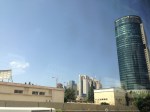
Right now I’m going to hit the hay, and leave you with some pics from the Dead Sea, Masada, and Tel Aviv.

Weekend Reading: August 8, 2014

Well I didn’t think I would have time to send out weekend reading links, but as I travel on the bus from Jerusalem to the Dead Sea this morning I thought I’d just briefly send a few good articles from the week for you to scroll through as you enjoy the pool or the little league game this weekend.  So here’s a few articles I hope you enjoy!

Excellent article on self-esteem and how deceptive it can be.  It’s aimed specifically at teenage girls, but its applicable to everyone. (h/t Katie)

ISIS is doing terrible things…no surprise.  But one of the things we need to keep an eye on is remembering to pray for our Christian brothers and sisters there in Iraq.  They’re going through a horrific persecution.

Speaking of terrorists…here is a short but helpful blog post from Joe Carter on the 9 things you should know about Hamas.

Neat tips on how to approach journaling from DG – also, Piper has a very interesting post on poetry. 

Here’s a great article on how hymns are basically mini sermons “for the soul to sing” from Nick Batzig.

If you have a logical mind, you’ll enjoy this article From R.C. Sproul which explains what happens in the order of events at moment or time of salvation.  He also has one on how suffering is not worthless. 

One of the guys over at Kuyperian Commentary has an interesting little post on tattoos. 

Jon Bloom says that you don’t have to know everything in life, just one really important thing…

Tim Challies has a great little post on ‘How to Keep the Spark Alive’ in your marriage. He also has a terrific post this week on ‘7 things Christ is’

Along similar lines – and probably the best article I read this week – Marshall Segal has a wonderful article on the worth and value of marriage. 

Lastly, there are two simply amazing articles from DG that you need to check out! The first is from Tim Keesee called ‘Stumbling into the Future‘ and one from Tony Reinke on Van Gogh and the superiority of the Word of God.