Men’s Campout 2014: Pictures and Video

Last weekend was our 6th annual men’s campout – and it was a fantastic time of fun and fellowship!  Men gathered together for cornhole, go-cart/yard-cart racing, a canoe trip, great food, riffle and handgun shooting, and challenging messages from Pastor Dennis Lankford.

Dennis’ notes can be downloaded by clicking on the link: 1Discipleship-men’s campout master.

Scott Huber also took the time to introduce us us to Viking Chess (or “Kubb” which You can get the game online now, though Scott made his own).

The Go-Carts were probably the biggest hit of the weekend and, thanks to Parris’ video skills, we have included Ben Frank’s winning yard-cart time trial (below). Also, below are some pictures from the event.  Thank you to all who participated and who helped setup and tear down – especially to our two hosts Dan and Resa Lynn, and Rick and Jen Shugert.

PJW


Weekend Reading: August 22, 2014

Well good morning!  Below are some links to videos, blog posts, articles for your weekend reading.  Have a great day and enjoy the articles! 

Richard Dawkins created a firestorm when he said babies with Down’s Syndrome should be aborted. Meanwhile a much more sane article from Keith Matheson who has a post on Abortion and Ethical Schizophrenia.

Want to read articles (and books) faster?  Try Spritz!  There are other apps as well, but I like this technology best.

Conservative power-blogger Erik Erikson is finding how difficult it is to reconcile his faith with some of the strident voices on the right.

My friend Matt Strawn wrote a nice op-ed in the Des Moines Register about his experience in Israel.  He was on the same trip I went on a few weeks ago. 

Tim Challies posted a great collection of Christian blogs written for or by women. 

Katie sent me a great post from ‘Loving My Lot’ this week – this is one to bookmark and pull out again and again and read alongside John 21:20-25. 

Speaking of Pastor Tim, he posted a book review on ‘The Last Lion’ – a biography of Winston Churchill.  Actually it isn’t “a” biography, it is “the” definitive biography. Over 100 hours of audio or 3000 pages of reading.  I’m well into volume one and am enjoying it immensely!  Tim also wrote a wonderful post about how we view time and our ability to get things done called ‘The Spasmodic Hercules’ that is well worth reading. 

This is an article (which is too long) that will amuse you sports fanatics – one man’s quest to play Jordan one-on-one…

Buzzfeed has compiled a list of IceBucket (ALS challenge) failures (you’ll laugh for sure), and one guy has a drone do the ice bucket dump for him. 

Speaking of drones, an Indian pizza company made waves recently by having one of their pies delivered using drone technology (India may become the first country where Amazon delivers packages via drone

RC Sproul posted about how there will “be no sea” in heaven and what that exactly means…

Ligonier also posted this article from John Piper on prayer where he discusses Daniel’s prayer in chapter 9 – fascinating stuff here.

Here’s a great little article on how to properly price what you sell whether its consulting or a widget. (h/t Nick Everhart) 

Mr. T was fulfilling his civic duty this past week…in the meantime he likely missed out on learning to make the perfect paper airplane! 

I was really challenged by this article on the traits of a good teacher. 

Speaking of good teachers, Justin Taylor has a piece called ‘9 Reasons We Can Be Confident Christians Won’t be Raptured Before the Tribulation’.  The timing is apropos since there’s a new ‘Left Behind’ movie out (or coming out) – this one staring Nicholas Cage!!! Even A-List Hollywood actors are getting in on the over-sensationalized theology fad. 

I haven’t posted any links about Ferguson because I’m sure you’ve been inundated by those stories.  However, he’s an interesting link to Twitter’s compilation of activity on the subject.  You can see how it explodes from a local story to an international topic of conversation. 

Why is Japan SO different??? I read this article a while back and stumbled on it again.  It’s definitely long, and requires a large cup of coffee, but some of you will find it fascinating. 

That’s it – enjoy your weekend!


Israel day 5: the Dead Sea and Masada

20140806-184246-67366973.jpg

First of all, let me say from the outset that today was a much more relaxed day from a policy perspective than we’d had in the past 4 days. We started day five by leaving Jerusalem and heading easy toward the Dead Sea. Before we spent time at the Dead Sea, we went to Masada, the great fortress mansion of Herod dating back over 2,000 years.

The fortress was amazing. What’s most amazing is how they were able to keep water in the fortress in the middle of the desert. Herod had baths, lavish storehouses of food for his soldiers, and huge palace-like living quarters for his commanders (probably the only way he’d be able to get someone to enjoy living in the sweltering desert!).

From Masada we went to the Dead Sea, which I learned the Jews here call “The Salt Sea.”  I opted to try and “float” in the Sea, which is possible because of its 36% mineral content.  Trying to just sit down on the bottom of a shallow part of the Dead Sea is nigh impossible.  You try and just get pushed over by the buoyancy of the water.  It’s really strange.  But it was a good experience, and really need to visit the lowest place on Earth.

When you reach down and scrape the bottom of the sea you bring up sand-like crystals of what you soon realize are large chunks of salt.  Another interesting thing about the Dead Sea is that because its the lowest place on earth, the UV rays from the Sun have a much harder time reaching down that far, and therefore it is much harder to get a sun burn…go figure!

After the dead sea we headed back toward Jerusalem only to sling shot up toward Tel Aviv, where it was our plan to get dinner with a former member of the Israeli National Security Committee/Cabinet.

When we arrived in Tel Aviv (it took us around 2.5 hours from the Dead Sea), we immediately realized that this city was much different than Jerusalem. I think that from the pictures below you’ll immediately realize what I mean.  Tel Aviv is like the NYC of Israel.  But in truth, a more accurate description would be to picture the upper west side of Manhattan, add non-violent gang-related graffiti, and an amazing beach and you have Tel Aviv.

Our dinner tonight (it’s 1am here right now), was really interesting.  The expert we spoke with gave us the low down on the Iranian nuclear issue, and I learned a lot about the structure of Iran’s government and their geopolitical goals as a nation and religious goals as a people, among many other things.  The discussion was really good – the food was probably on par with the discussion!

I’ve mentioned this before, but I really came away from this dinner believing that there really is no diplomatic hope for permanent peace in our time in the Middle East.  The agenda of Iran – the Shiite agenda, if you will – is not going to ever stop. Eventually there has to be war for them to achieve their goals (establishment of world wide caliphate).  But perhaps that it is a discussion (a much longer one) for another day.

Right now I’m going to hit the hay, and leave you with some pics from the Dead Sea, Masada, and Tel Aviv.

Israel day 2

20140806-184246-67366973.jpg

We started the day today hearing from professor Reuven Hazan from Hebrew University. Mr. Hazan gave us an overview of the political/government system here in Israel. It was extremely insightful and very enjoyable. Israel is a Parliamentary democracy and, unlike the U.S., elects it’s governing body nationally and not by districts – in fact, the names of candidates aren’t on the ballot, only the party names. Vote for a party and you get the whole ball of wax – every candidate that the party chooses to install.

After each election the parties are allowed to send to parliament a certain number of candidates based on the percentage of what their party received from voters nationally.

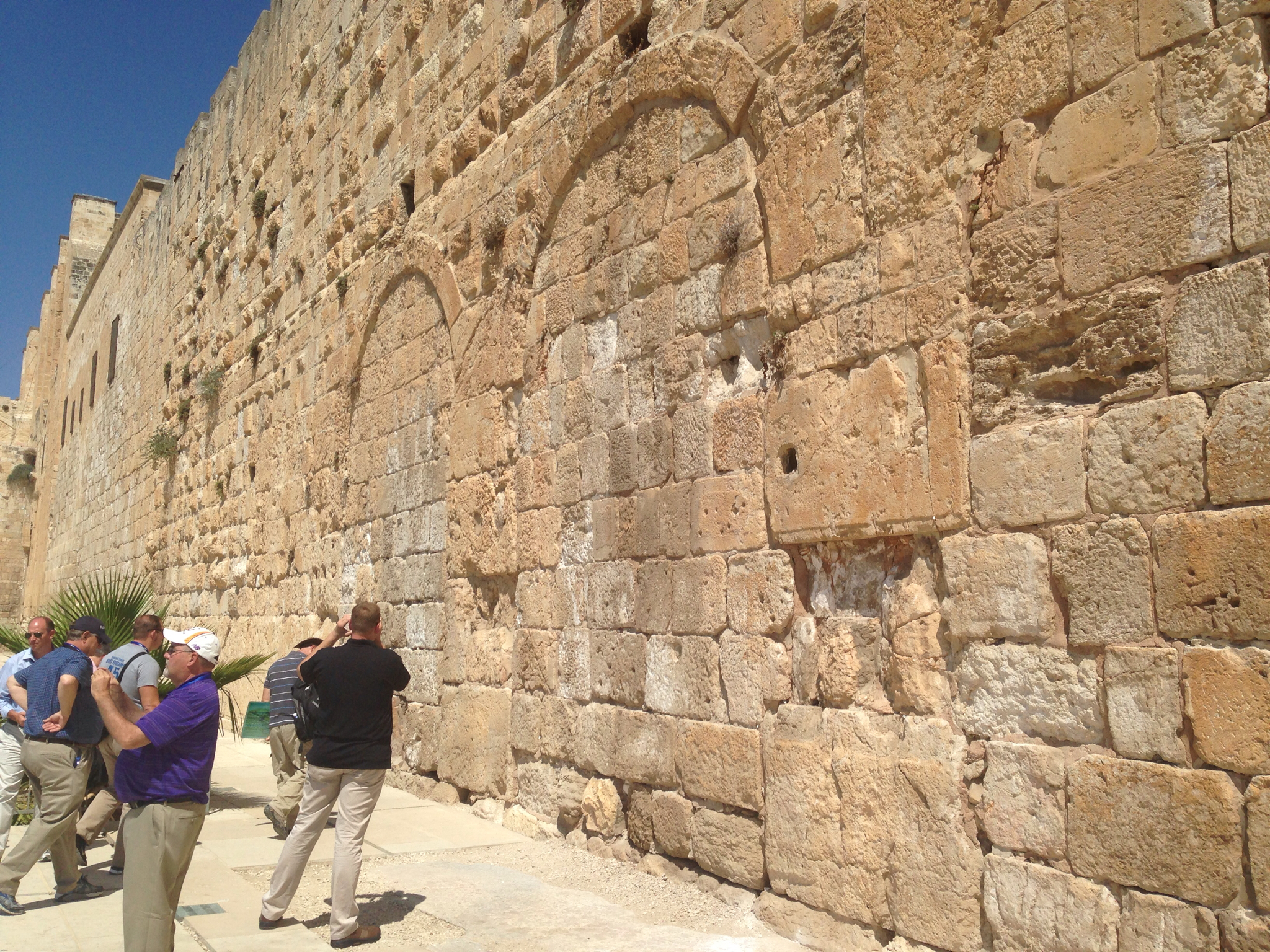
After this morning session we toured the old city which included many of the holy sites you’ve likely heard of before.  These included the temple mount, the wailing wall (western wall), the church of the holy sepulcher and the room Jesus was believed to have eaten his last supper in.

For me, walking up the temple mount, knowing that Jesus had walked on those stones, and taught in that place, and that Peter had likely delivered his sermon in Acts 2 from that spot, was indescribable.  The best way to describe it would probably be to coming home.  A tremendous peace and amazement that lay unsettled in my gut – until the prayer at the western (wailing) wall whereupon I felt like for the first time in my trip I had met God in this place.  Mostly I attribute this to taking in all that I had seen, and then getting to come in prayer to the Lord.  When one pastor asked what I had prayed about, I told him that my entire mindset was dominated by thoughts of “come back quickly, Lord.”  I say that because there is an overwhelming sense – for me at least there was – that this is where it all took place.  And you want it to happen again.  You want Him to come again and to consummate His kingdom.

All the graves alongside the road leading up to the old city with the Mt. of Olives on the left etc. are there because they want a “front row seat” as our tour guide put it, to the coming of the Messiah —- now jokingly he said that the Jews first question will be “this your first time to Jerusalem?”  LOL!   For me, that resonated on a deeper level.  You see this wide swath of grave stones/head stones there laid out at the base of the Kidron as it wraps around toward the valley of Gehena and you realize they’re like seats in a movie theatre waiting for the great act of world history to sweep across the planes of that desert region and call them up to either judgment or to life everlasting.  Regardless, this is going to be the “place to be” so they say.

All of this sense, this feeling, comes to a nexus at the wall – at the time of prayer.  And needless to say it is very special.

We had several meetings after this.  One with a humanitarian activist from the Palestinian perspective, another with the leader of the Labor party opposition in the Knesset, and lastly we had dinner with an amazing journalist who is an Arab, Muslim, Palestinian, Israeli.  Crazy combination!  But that Palestinian perspective has been interesting.  Even the Palestinians we spoke with are against the Hamas, they think of Hamas as a terrorist group, and think of Barak Obama and John Kerry as closely aligned with the Muslim Brotherhood – at at the very best, empowering the Muslim Brotherhood!

Despite this sentiment toward Obama and Kerry, the Israelis and Palestinians we have met have been very very hospitable toward Americans and have nothing but good things to say about our country in general.  In fact, there hasn’t been an elected official, professor, journalist or expert of any kind that has not gone out of their way to thank us for coming at this time to show solidarity with Israel.  I can’t begin to describe how amazing it is to receive that kind of message from these men and women who have their lives in danger from terrorists every day.

Now, some of you have asked about my safety, and many are praying for me – thank you!  I want you all to know I’m safe, and couldn’t be enjoying this time more if I tried.  We’ve talked openly with people on the street, and because there has been a ceasefire for over 24 hours now (observed), we’re in good shape.  No rocket sirens thus far.

I’m pasting some pictures below of what I saw today.  This is only a sample, of course, but hopefully you’ll get a sense for what we saw and did today.  It was an amazing day.  The Israelis, I am learning, are a very courageous people.  Their political system is diverse, they have a unique outlook on life, they are surrounded by enemies, and they’re a beacon of freedom and morality in this part of the world.  It makes all the sense in the world, therefore, to stand by them in their efforts to not only exist as a nationstate (something Hamas’ charter puts them diametrically opposed to), but to thrive and to lead this part of the world out of the darkness of terror and radical Islam.

Several more amazing days in front of me.  If I went into everything I learned in each session and at every stop, these blogs would be way too long!  But needless to say, this trip is so well rounded that one cannot come away without a very thorough understanding of the geopolitical, religious, historical, moral, and military significance of this place.

Until tomorrow…Soli Deo Gloria!

The Last Super
The Last Super
Dome of the Rock, Temple Mount, Mount of Olives
The Temple Mount
The Temple Mount
Church of the Holy Sepulcher


Journey to Israel

20140803-140916-50956304.jpg
This coming week I will be traveling to Israel on an adventure to learn more about the relationship between the U.S. and Israel, the defense of that country, and the economic success it has seen.

Of course I will also be seeing some of the historical and religiously significant sites during my trip, and I’m looking forward to updating this blog as much as possible, both with pictures and text.

So stay tuned as I travel throughout the nation of Israel and report back on what I see and do! Your prayers for safety and health are definitely appreciated!

Many people have asked what organization I’m going with – AIPAC is the name of the group. You can learn more about them here.

Soli Deo Gloria!

PJ Wenzel

Notes on John 18:28-32 – God on Trial Part 1

Here are my notes on John 18:28-32, it is the first in several installments of the trial of Jesus Christ.

God on Trial Part 1

18:28-31 Then they led Jesus from the house of Caiaphas to the governor’s headquarters. It was early morning. They themselves did not enter the governor’s headquarters, so that they would not be defiled, but could eat the Passover. [29] So Pilate went outside to them and said, “What accusation do you bring against this man?” [30] They answered him, “If this man were not doing evil, we would not have delivered him over to you.” [31] Pilate said to them, “Take him yourselves and judge him by your own law.” The Jews said to him, “It is not lawful for us to put anyone to death.” 

Some Background

It is still “early morning” and Jesus has now moved from a Jewish trial to a Roman one.  John obviously stresses the “early” nature of these events.  Hendricksen notes that, “Rising at (or very soon after) dawn, and being ready for business at such an early hour, was not unusual in the ancient world, not even on the part of important officials, such as Pilate.”

The Jews wished to have Jesus killed, and while their council could decree the death penalty, they couldn’t execute such a decree – only the Romans could do that. Thus, in order to finally exterminate the existential threat Jesus posed to their political and social standing, this was the next necessary step.

Now in John’s gospel we miss some of the context for what happened at the Jewish council, so I want to just give that here so its fresh in our minds what Jesus just came from, and what the religious leaders just finished doing:

Then those who had seized Jesus led him to Caiaphas the high priest, where the scribes and the elders had gathered. 58 And Peter was following him at a distance, as far as the courtyard of the high priest, and going inside he sat with the guards to see the end. 59 Now the chief priests and the whole councilwere seeking false testimony against Jesus that they might put him to death, 60 but they found none, though many false witnesses came forward. At last two came forward 61 and said, “This man said, ‘I am able to destroy the temple of God, and to rebuild it in three days.’” 62 And the high priest stood up and said, “Have you no answer to make? What is it that these men testify against you?”[i] 63 But Jesus remained silent. And the high priest said to him, “I adjure you by the living God,tell us if you are the Christ, the Son of God.” 64 Jesus said to him, “You have said so. But I tell you, from now on you will see the Son of Man seated at the right hand of Power and coming on the clouds of heaven.” 65 Then the high priest tore his robes and said, “He has uttered blasphemy. What further witnesses do we need? You have now heard his blasphemy. 66 What is your judgment?” They answered, “He deserves death.” 67 Then they spit in his face and struck him. And some slapped him,68 saying, “Prophesy to us, you Christ! Who is it that struck you?” (Matthew 26:57-66)

Self-Righteousness on the Outside, Murder on the Inside

In verse 28 we read something remarkable.  John says that the Jews didn’t want to enter the governor’s headquarters in order not to be defiled.  Being around gentiles made one impure – this is why when Jews in the diaspora came in for the Passover they cleansed themselves from having lived among gentile nations/people.  It is purely figurative, of course, but it was part of the ceremonial idea that these were God’s chosen people and that they weren’t to come to worship in an unclean way.

In addition to this, as Calvin notes, it wasn’t against the law to be with Gentiles, it was their traditions that added this to the law!

What is most remarkable, however, is not that they were working to keep themselves clean, but that in one sentence John has shown us why the religious leaders of that day got it so wrong.  They were so concerned about the ritual of not consorting with Gentiles, all the while their hearts were as black as soot.  Jesus decried this hypocrisy earlier in His ministry:

While Jesus was speaking, a Pharisee asked him to dine with him, so he went in and reclined at table. [38] The Pharisee was astonished to see that he did not first wash before dinner. [39] And the Lord said to him, “Now you Pharisees cleanse the outside of the cup and of the dish, but inside you are full of greed and wickedness. [40] You fools! Did not he who made the outside make the inside also? [41] But give as alms those things that are within, and behold, everything is clean for you. (Luke 11:37-41)

So these Pharisees march right up to the point of physical ceremonial defilement, just stopping short of the doorway so as not to mess up their feast days – wouldn’t want to do that – all while on a murderous rampage that has completely consumed them. They are totally bent on killing Jesus.

I think Matthew really captures their mindset well:

Then the chief priests and the elders of the people gathered in the palace of the high priest, whose name was Caiaphas, and plotted together in order to arrest Jesus by stealth and kill him. (Matthew 26:3-4)

As Calvin says, “…they carry more pollution within their hearts, than they can contract by entering any place however profane…and…they carry to excess their care about smaller matters, and neglect what is of the highest importance.”  “In short”, Calvin says, “they observe the shadow of the Passover with a false and pretended reverence, and yet not only do they violate the true Passover by sacrilegious hands, but endeavor, as far as lies in their power, to burry it in eternal oblivion.”

Augustine is simply aghast at this scene and details his thoughts in somewhat hilarious (to the modern reader) Shakespearean dialect, “O impious blindness! They would be defiled, forsooth, by a dwelling which was another’s, and not be defiled by a crime which was their own. They feared to be defiled by the praetorium of an alien judge, and feared not to be defiled by the blood of an innocent brother.”

Now, from a textual/background/timeline perspective, I want to just note that some have had difficulty with the phrase that John gives here that the Pharisees wanted to “eat the Passover” still.  Well, didn’t Jesus just eat the Passover meal with His disciples? I believe that He did indeed.  But Carson, who weighs all the opinions and scholarship from Bruce, Morris and others points out that what is likely meant is the continuation of the Feast of Unleavened Bread.  Once you weigh all the points together (including the different potential defilements and their time penalty) one has to come to the conclusion that “the Passover” here is the continuation of the Passover celebration, and not the Pascal Meal itself. Therefore, “The Jews wanted to continue to participate in the entire feast; they wanted to eat the Passover” (Carson).

From Whence We Came…

The mindset of the Pharisees is one set on plots and death. And really, one of the things that we need to understand is that apart from God and His work in our hearts, we’d be right there with these guys. We’d think as they did, and we would despise the Lord of Glory.  It is an unnerving truth to face.  Can you imagine thinking evil thoughts about Jesus like “who do you think you are you miserable peasant from Nazareth!”

The revolting nature of this truth is a reminder that we are naturally at enmity with God – do you know what that means? It means that we hate God and have murderous intent toward Him.  It means that we are enemies of God – mortal enemies of God – before being saved.  Jesus didn’t die to save His friends.  Jesus died to save His enemies!

I’m saying this and reminding us of this here because it helps us to remember the lengths to which He went to save us, and the kind of people we were before we met Him. These truths – and seeing the Pharisees in all their ugliness – reminds us of our own ugliness, and helps us treasure the gospel all the more.

Listen to what Paul says on this:

…remember that you were at that time separated from Christ, alienated from the commonwealth of Israel and strangers to the covenants of promise, having no hope and without God in the world. [13] But now in Christ Jesus you who once were far off have been brought near by the blood of Christ. [14] For he himself is our peace, who has made us both one and has broken down in his flesh the dividing wall of hostility [15] by abolishing the law of commandments expressed in ordinances, that he might create in himself one new man in place of the two, so making peace, [16] and might reconcile us both to God in one body through the cross, thereby killing the hostility. (Ephesians 2:12-16)

And you, who once were alienated and hostile in mind, doing evil deeds, [22] he has now reconciled in his body of flesh by his death, in order to present you holy and blameless and above reproach before him, (Colossians 1:21-22 ESV)

For if while we were enemies we were reconciled to God by the death of his Son, much more, now that we are reconciled, shall we be saved by his life. [11] More than that, we also rejoice in God through our Lord Jesus Christ, through whom we have now received reconciliation. (Romans 5:10-11 ESV)

In all these verses we see two realities: 1. Our state of sinfulness and alienation of/from God prior to His saving us, and 2. That our salvation is grounded in the work Christ did on the cross at Calvary.

It is the gospel that while were yet sinners, Christ died for us.  That is what we see unfolding here with these evil religious leaders. They bathe in the filth of their heart’s delight.  So eager to get to get rid of this man, yet so loathe to taint themselves with uncleanliness that comes with consorting with gentiles.

Baselessness

I mentioned before, in the last section of teaching, that the accusations the Jews had against Jesus were just rubbish, and the trials by which they accused Jesus of blasphemy were all trumped up and really illegal by their own custom.  Now, they have to somehow convince Pilate, the Roman in charge of Jerusalem, that there was something worthy of dealing with him from a secular standpoint.

Pilate’s initial question is answered by the Jews by essentially a non-answer.  They say, “If this man were not doing evil, we would not have delivered him over to you.”  In other words, “hey trust us on this one. He’s not a good dude, just deal with him.”  Well obviously that’s not good enough for Pilate, so he tells them to get lost and deal with their issues themselves.  But these Jews are determined.  Their hearts are full of hate.  They’ve been searching for this opportunity for months (at least), and they’ve been up all night to boot.  They aren’t backing down.

Pilate’s answer to them is filled with irony says Calvin, “Take you him. He says this ironically; for he would not have allowed them to pronounce on a man a sentence of capital punishment” – mostly because these people were obviously not capable of executing any kind of justice! A society governed by these men would have been nothing but corruption and anarchy, and Pilate must have been thinking as much at the time.

Carson brilliantly points out that the Jews had already secured a detachment of troops to capture Jesus, so they were likely thinking Pilate would simply ratify whatever the Sanhedrin Council concluded, yet here he was seemingly opening up a whole new trial and not simply rubber-stamping their decision to kill this man.  This is likely what got them worked up so quickly – perhaps they were expecting an easier go of it.

18:32 This was to fulfill the word that Jesus had spoken to show by what kind of death he was going to die.

“Did He Predict His Destiny?”

This past week or so we held a Vacation Bible School at the church, and one of the songs the kids sung asked the question “Did He (Jesus) predict His destiny?”  Those kids answered the question in the affirmative because, as they saw in the Scriptures, Jesus was able to know exactly what was going to happen to Him.  He predicted that all these things would come to pass.

And as Jesus was going up to Jerusalem, he took the twelve disciples aside, and on the way he said to them, [18] “See, we are going up to Jerusalem. And the Son of Man will be delivered over to the chief priests and scribes, and they will condemn him to death [19] and deliver him over to the Gentiles to be mocked and flogged and crucified, and he will be raised on the third day.” (Matthew 20:17-19) see also Luke 18:31-34

Luke Adds: “But they understood none of these things. This saying was hidden from them, and they did not grasp what was said.” (18:34)

Only the Son of God could have made this kind of prediction.  Only someone who knew the future could have said “here’s what going to happen, here’s how it’s going to happen, and here’s who is going to do it.”

This is just one more proof that John lays before us in order to establish in our minds the truth that this man Jesus was indeed the Son of God.  When we read things like this, it’s right to step back and be amazed.  These are the kinds of things that no normal man could have known.

Ryle rightly points out that this moment is the fulfilling of the entire Scriptures dating back to Jacob’s own predictions.  In an amazing bit of insight he says the following:

Let us mark here what a striking confession the Jews here made, whether they were aware of it or not. They actually admitted that they were no longer rulers and governors of their own nation and that they were under the dominion of a foreign power. They were no longer independent, but subject of Rome…By their own mouth and their own act they publicly declared that Jacob’s prophecy was fulfilled, “that the scepter had departed from Judah,” that they had no longer a lawgiver of their own stock, and that consequently the time of Shiloh, the promised Messiah, must have come.  How unconscious wicked men are that they fulfill prophecy!

Calvin agrees and adds that, “And, indeed, if we wish to read with advantage the history of Christ’s death, the chief point is, to consider the eternal purpose of God.  The Son of God is placed before the tribunal of a mortal man. If we suppose that this is done by the caprice of men, and do not raise our eyes to God, our faith must necessarily be confounded and put to shame.”

And yet in all of this the gospel was played out.  For as Calvin continues, “But when we perceive that, by the condemnation of Christ, our condemnation before God is blotted out, because it pleased the Heavenly Father to take this method of reconciling mankind to himself, raised on high by this single consideration, we boldly, and without shame, glory even in Christ’s ignominy. Let us therefore learn, in each part of this narrative, to turn our eyes to God as the Author of our redemption.”  Amen!!!

Therefore there’s a second dimension to His predictions, and that is that not only did He know of these events, He allowed them to occur and steadfastly and patiently endured the corruption of justice by the Jews, and the human authority of the Romans, all in order to fulfill His great plan for our salvation.

Weekend Reading: July 11, 2014

Welcome to a new edition of ‘Weekend Reading’ where I catch you up on all the stories you might have missed this week, and provide you with everything from blog posts to youtube videos for your amusement and information.  All with the goal to keep you informed and keep you focused on the Jesus no matter what’s going on in the news this week.  Here’s what I read, watched, heard and found worth sharing this week:

Climate Change “outrageous” says top meteorologist in Alabama.  This blog is really interesting. If you’re from Alabama and want to keep in touch with all the latest in politics and policy this is the place for you.

Binding Satan?  Humorous, yet helpful insight on whether or not Christians should pray to “bind Satan.”

When we learn the best – Just a phenomenal article on the progressive nature of our Biblical learning. I have a bunch of DG articles below, but this one is a little older and stood out to me as really terrific. (h/t Lisa Wenzel)

Life, Liberty and all that – Christian Historian Robert Godfrey has a good (but perhaps a bit wordy) article on the Christian perspective of liberty and society – scroll to the end to get the gist if you don’t want to read the whole thing (he sums it up nicely at the end).

6 Reflections on Sleepovers – Tim Challies follows up on his hugely popular article on why he doesn’t allow his kids to do sleepovers. I have to say that this have given me a lot of cause for reflection.

A Christian Husband’s Marriage Catechism – Thanks to Parris P. for sending this cool piece along.

Kids and Old Technology – this hilarious little video takes a look at how today’s children react to old technology – namely, the Game Boy.

Desiring God’s blog was on fire this week!  So many great articles.  Great one on Evangelism (h/t Parris), helpful post on self-pity aimed at women but applicable to all, and a terrific follow up piece on the Christian budget that aims at thwarting prideful penny pinchers (my vernacular, not theirs!)! Lastly they have a neat little post on how dad’s should interact with their daughter’s boyfriends. 

Flexing for the Cameras – what do Christians have in common with NFL wide receivers? Find out…

The Perfect Family – I think it was Tim Challies who shot this link out earlier this week from Greg Lucas.  This is a really neat little post about his special needs family and the perspective it takes to raise “non-perfect” kids…

America’s Greatest Sermon – the guys at CrippleGate look at an important sermon that fits today’s times perfectly.  The author?  Jonathan Edwards. (h/t Parris Payden)

IRS Scandal – several little pieces of info out this week revealing more intel on this evolving scandal – here’s one from the conservative blog Red State.

Profile of David Cochran Heath – ever listened to the ESV Bible on audio?  Well that voice is that of David Cochran Heath, and a few years back he had a profile story done for a local San Diego paper.  I really enjoyed the read and appreciated his heart.

Why Decision Making is So Hard! – I loved this post by Tim Challies a few weeks back and kept meaning to send it around.  Great perspective here.

Only one way to God – David Platt has an excellent video on this topic (h/t Parris Payden)

A Christian Convert on the Run – Amazing story of a convert in Afghanistan whose family is trying to kill him for converting to Christianity.  (h/t Clif Gates)

Rockets, Rockets, and MORE Rockets – Israel is under siege again this week, this time by rockets coming from Gaza and the terror organization Hamas.  Since I’m traveling to Israel in the near future, I’ve been paying more attention to issues over there.  Here is one story relating to the military situation, and here’s a video on Israel’s IRON DOME missile defense system that intercepts these rockets. If you want to see how many rockets are launched real time, then download this app and just watch your phone explode for a day or so (no pun intended)!

Cincinnati Congressman Steve Chabot looks at the suggested reading material for incoming college freshman around the country. He doesn’t show or link to the list, but the statistics are enough to get the point.

Sharing Your Testimony Wisely – A very thoughtful article by Trevin Wax on sharing our Christian testimony.

Putin’s Secret Weapon – check this out if you want to know how Russia is strategically working in its neighborhood (and beyond) to get what they want…ALSO – from FP is a column on the safety (or lack) of deadly diseases kept in “secure” labs.

That’s it!  I hope you have a wonderful weekend!


Pressing on To Maturity

For the last two weeks I’ve been preaching a message from Hebrews 5 and 6 to several different churches.  Below are my notes on this passage and I hope you enjoy them!  I would just add a disclaimer that they are my raw preaching notes.  So not every thought is written long-form, there are several footnotes with other thoughts at the bottom, and everything is in bullet form.  It this doesn’t turn you off, then I hope you are able to enjoy the study!

PJW

Press On Toward Maturity

Hebrews 5:8-6:3

Personal Note and Background

This series of verses has had an outsized impact on my own life and walk with the Lord. It was these verses that God used to spur me on to learn more, to read more, to draw closer to the Lord and to teach what I learn to others.  When I read this passage several years ago I thought  (rightly) that “I can’t teach anyone now”, but realized that my inability wasn’t God telling me not to teach, but rather it was Him calling me to learn and grow closer to Him in obedience in order to teach when the time presented itself.

The hallmark of this text is a warning to believers not to live their lives as introverted and covetous people.  We are to be people marked by inward heart transformation and a mind renewed in the knowledge of God, which we can readily share with others.

As Moses says, this Word of God is our “very life” – surely it is worthy of our attention today.

The Text: Hebrews 5:8-6:3

 Although he was a son, he learned obedience through what he suffered. [9] And being made perfect, he became the source of eternal salvation to all who obey him, [10] being designated by God a high priest after the order of Melchizedek. About this we have much to say, and it is hard to explain, since you have become dull of hearing. [12] For though by this time you ought to be teachers, you need someone to teach you again the basic principles of the oracles of God. You need milk, not solid food, [13] for everyone who lives on milk is unskilled in the word of righteousness, since he is a child. [14] But solid food is for the mature, for those who have their powers of discernment trained by constant practice to distinguish good from evil. 6:1 Therefore let us leave the elementary doctrine of Christ and go on to maturity, not laying again a foundation of repentance from dead works and of faith toward God, [2] and of instruction about washings, the laying on of hands, the resurrection of the dead, and eternal judgment. [3] And this we will do if God permits.

I want us to focus on 3 Key Points we must take away from this passage, which we will see rise up again and again in our reading today:

  1. God’s desire and purpose for His image bearers is that we know Him. This call is especially so for believers who have been united to Christ
  2. Our growth in maturity is blocked not merely by intellectual issues, but by sin and love of the world, indicating a serious heart issue
  3. God calls us to press on toward maturity in the strength He has given: in prayerful reading and studying of His Word, asking for and depending on God’s help for our increased spiritual growth

The Biblical Theology

What the author of Hebrews says here, is not an isolated teaching, but reflects what we see throughout the Scriptures from the immutable plans of God for his image bearers, namely that God desires for us to know Him more intimately and to repent of the sin that hinders us from doing so:

And when Moses had finished speaking all these words to all Israel, [46] he said to them, “Take to heart all the words by which I am warning you today, that you may command them to your children, that they may be careful to do all the words of this law. [47] For it is no empty word for you, but your very life, and by this word you shall live long in the land that you are going over the Jordan to possess.” (Deuteronomy 32:45-47 ESV)[i]

One generation shall commend your works to another,
and shall declare your mighty acts.
On the glorious splendor of your majesty,
and on your wondrous works, I will meditate.
They shall speak of the might of your awesome deeds,
and I will declare your greatness.
(Psalm 145:4-6 ESV)
 

“For I know their works and their thoughts, and the time is coming to gather all nations and tongues. And they shall come and shall see my glory, [19] and I will set a sign among them. And from them I will send survivors to the nations, to Tarshish, Pul, and Lud, who draw the bow, to Tubal and Javan, to the coastlands far away, that have not heard my fame or seen my glory. And they shall declare my glory among the nations. (Isaiah 66:18-19)

***Isaiah clearly has an eschatological purpose here, and I will talk later about how Paul sees God’s glory as currently mediated through the Bible (2 Cor. 3:18)

It is written in the Prophets, ‘And they will all be taught by God.’ Everyone who has heard and learned from the Father comes to me— (John 6:44-45)

***Jesus connects knowing God soteriologically and says it’s the results of His Spirit’s work within us

When the Spirit of truth comes, he will guide you into all the truth, for he will not speak on his own authority, but whatever he hears he will speak, and he will declare to you the things that are to come. [14] He will glorify me, for he will take what is mine and declare it to you. [15] All that the Father has is mine; therefore I said that he will take what is mine and declare it to you. (John 16:13-15)

***The work of learning from God the Spirit ultimately brings Him glory, and is His plan for us

And it is my prayer that your love may abound more and more, with knowledge and all discernment, [10] so that you may approve what is excellent, and so be pure and blameless for the day of Christ, [11] filled with the fruit of righteousness that comes through Jesus Christ, to the glory and praise of God. (Philippians 1:9-11)

From the law, wisdom literature, the prophets, our Lord Himself, as well as the Apostle Paul, there has been a call to deepen our knowledge of the Almighty, His ways and His Son, and to lean on His Spirit’s power in order to shine that light[ii] of knowledge to all nations[iii] as well as with our own families and friends.

The Situation/Context – 5:8-10

Now as we look again to the context of today’s passage, let’s once again examine verses 8-10.  The Author is expounding on some deep Christological truths – mostly pertaining to the Priesthood of Jesus – that required a foundational understanding already in place.  We just need to glean a few things to understand the context…

    1. That Jesus, though divine, was fully man and “learned” obedience – vs. 8
    2. That Jesus was perfectly righteous and that righteousness enabled him to be our source for righteousness and salvation – the very fountainhead from which we would derive our right standing before a holy God – vs. 9
    3. That these things contributed to the fact that Jesus is a priest, not an ordinary priest, but one “after the order of Melchizedek” which is an order both eternal and personal in type. There are many OT types but Melchizedek was the only type who represented not simply the offices of Christ (Messiah, King, Shepherd etc.), but also his person (eternal, and without father or mother).

–       Needless to say these great truths – these are deep truths – and they aren’t going to make a whole lot of sense to someone still stuck on the basics.  One cannot understand or appreciate the need for Christ’s imputed righteousness, the importance of His being fully man, the significance of Christ’s non-Levitical (and eternal) priesthood, or the typological significance of this enigmatic character Melchizedek if one is still learning the basic truths upon which these are built.[iv]

And so he stops and levels this charge against them (read verses 11-12) 

CHARGE #1 – Dull of Hearing – 5:11-12

–       As we read in verses 11 and 12 its almost as if the author stops mid course as he extolls the virtues of these great truths pertaining to Christ, and has to stop and say, ‘you know, I’d go on here, but its obvious that you aren’t ready for it – even though I have “much to say” still!’   He’s stymied by the stagnation of these church members.

–       They ought to be teachers but instead they need someone to still teach them the basics. They come to church every week and never apply their minds past the elementary truths.  They have regressed.[v] They have become “dull of hearing.” (nōthros – “no-thross” – slow, sluggish[vi], indolent, dull, languid)

–       This is not saying they ought all to be teachers in the sense we have today as one called to preach, but rather they must be able to convey their beliefs to others – this is at the heart of “making disciples” (Matt. 28).

–       John Owen rightly explains that this charge against them isn’t aimed at their being slow mentally, or having a learning disability.  His charge is a moral charge “you treasure not them up in your hearts, consciences, and memories, but let them slip out, and forget them” says Owen.  He continues “The natural dullness of our minds in receiving spiritual things, is, it may be, included; but it is our depraved affections, casting us on a neglect of our duty, that is condemned.”

–       Therefore the principle problem here is not primarily an intellectual one, nor is it a communication problem on the part of the Apostle, rather it is primarily a problem within the hearts of these Hebrews, and within our own hearts as well.

–       “By nature the hearts of all people are dull and insensitive to the things of God, nor are people genuinely interesting in hearing and seeing what God has to say to them (Matt. 13:15). Mark emphasizes that the same malady afflicts the disciples.  They suffered from hard hearts that resisted the revelation of God in Jesus (Mark 6:52; 8:17, 21). They failed to grasp the significance of Jesus’ teaching, and their failure cannot be attributed merely to intellectual incapacity.” – Thomas Schreiner[vii]

–       In short, the sins of pride, covetousness and possibly laziness are to blame.  We love the world more than we love God.  We love Monday night football more than we love reading the Scripture. We love our hobbies more than our conversations with the Lord.  And where we spend our time and money is an accurate reflection of where our affections truly lie.

–       Matthew Henry says, “It is a sin and shame for persons that are men for their age and standing in the church to be children and babes in understanding”

–       This is why James rightly says, “Therefore put away all filthiness and rampant wickedness and receive with meekness the implanted word, which is able to save your souls.” (James 1:21 ESV)

–       We must also not misunderstand and think that the “elementary truths” are not precious, that is not what the author is stating.[viii]

–       The basics of the gospel are the foundation for understanding greater mysteries appertaining to the gospel, and to what the author is getting at here, namely the person and work of our Lord Jesus Christ, and in this context, His priesthood.

–       Thus to be “DULL OF HEARING” is to have hearts loaded down with other matters – worldly matters, and minds that are clouded with other priorities. These are sins that block the blood flow and clot the arteries of our faith, causing our thirst for the knowledge of God to dry up.

–       We need hearts whose desires are to follow hard after Christ, not spend endless years on spiritual life support!

And why is this?  Because you are “unskilled in the word of righteousness”

CHARGE #2 – Unskilled in the Word of Righteousness – 5:13-14a

–       Philip Hughes writes, “The author is now seeking, as it were, to wean them from the debility of the milk-stage, into which they have sunk back, and bring them on to the solid diet of the doctrine of the high priesthood of Christ, who, as their Melchizedeck, is the King of Righteousness (7:1).”

–       When the author describes the “mature” the Greek word is teleios (tel-ay-oss), which has the idea of something brought to its end, completeness, it is perfect, it is fully grown, it is consummated.

–       The immature are “unskilled” in the word of righteousness.  They don’t know how to handle their Bible, and consequently they are not living a life in accordance with God’s will – they aren’t pressing on toward “completeness” (Phil. 3:12)[ix]

–       This admonition comes in the context of learning, therefore the call is for God’s children to have discernment about sound teaching and a developed taste for the sweetness of God’s Word.

o   Children have a taste for simple foods, simple drinks, and simple deserts.  Adults, however, desire couscous, cappuccino, and Crème Brulee – not peanut butter, apple juice, and popsicles.

–       NOW there are consequences to being “unskilled” in the Word of God. When you are lazy in your learning, you hurt the body of Christ and cause other people (and yourself) pain in at least two ways:

1. You use the Sword of the Word in an unwieldy way and lead others astray, therefore causing great pain and spreading sour milk (to use the author’s dairy term) around the church.

2. You are completely impotent as a comforter to those who are hurting, in need of wisdom, or exhortation.  This means you cannot effectively correct and guide your children, encourage your wife, lead others in a Bible study, or share with those in pain. You’ve essentially benched yourself

–       The “mature” have a right knowledge of God resulting in the ability to discern between good and evil in all things. This “discerning” is shorthand for living in such a way that reflects God’s work within you – it means loving others and God, and is the result of a renewed mind and transformed heart.

–       Being able to discern between good and evil, then, is the fruit of a life transformed by God.  It is the evidence of faith, and the outward reality of a changed heart within us.[x]   And it is God’s prerogative to use the instrument of His Word and Spirit to do this.

But how is that achieved? How is it said that we obtain this discernment?

The Remedy: Discernment Attained by “Constant Practice” – 5:14b

–       Here we learn how this discernment is achieved: by constant practice.  This means, no doubt, that we must be continually abiding in the Word of God if we’re to grow closer to God, and live out lives transformed by God’s Spirit.

–       We would do well to examine what Paul says about the nature of “renewing our minds” and the close connection between being “renewed” and the ability to “discern the will of God.”

o   “Do not be conformed to this world, but be transformed by the renewal of your mind, that by testing you may discern what is the will of God, what is good and acceptable and perfect.” (Romans 12:2)

–       Therefore, the discerning Christian/growing Christian is marked by time in Scripture and prayer. We must immerse ourselves in Scripture Reading, Scripture Memorization, Scripture meditation, and prayer.[xi]  We must inculcate His truths into our minds and lives.

–       This means a real application of our time, energy, and even finances to learning the deep things of God. [xii]

–       Let me suggest then that you do a few practical things:

o   Read the Word Daily: spend time taking in several chapters of the word each day.  This is more than simply one or two verses.

o   Memorize Scripture:[xiii] Chuck Swindoll says, “I know of no other single practice in the Christian life more rewarding, practically speaking, than memorizing Scripture. . . . No other single exercise pays greater spiritual dividends! Your prayer life will be strengthened. Your witnessing will be sharper and much more effective. Your attitudes and outlook will begin to change. Your mind will become alert and observant. Your confidence and assurance will be enhanced. Your faith will be solidified”

o   Extended Times of Prayer: Praying for 30-60 min. greatly increases our love of time with the Lord and grows us in unexpected ways.

o   Read Good Christian Authors: Many of us spend our time reading all fiction, or all one field or another.  We need to be diverse in our reading, but first and foremost we need to read good Christian authors (I’m not talking TD Jakes or Joel Olsteen), slowly working our way up to deeper more mature reading.  Start with the modern day Christian classics: Packer’s ‘Knowing God’, Sproul’s ‘Holiness of God’, Piper’s ‘Desiring God’, Lewis’ ‘Mere Christianity’, and Schaeffer’s ‘True Spirituality’.

–       Furthermore, it is the universal witness of Scripture that calls attention to ITSELF as the instrument by which God changes us and blesses us with a closer knowledge of Him: Consider just a few examples…

o   David begins the Psalms with this important exhortation, “Blessed is the man who walks not in the counsel of the wicked, nor stands in the way of sinners, nor sits in the seat of scoffers; [2] but his delight is in the law of the LORD, and on his law he meditates day and night. [3] He is like a tree planted by streams of water that yields its fruit in its season, and its leaf does not wither. In all that he does, he prospers.” (Psalm 1:1-3)

o   And Paul writes in 2 Corinthians the following, “And we all, with unveiled face, beholding the glory of the Lord, are being transformed into the same image from one degree of glory to another. For this comes from the Lord who is the Spirit.” (2 Corinthians 3:18)

–       We behold that “glory” today by reading the Word of God.  The glory of God is mediated through the written Word of God and effectively applied to our hearts by the Spirit of God. This is what transforms us by “constant practice.”

–       Matthew Henry rightly states, “The word of God is food and nourishment to the life of grace: As new born babes desire the sincere milk of the word that you may grow thereby.

–       And yet again, we must read as much with our hearts as with our minds, applying both to the task.  As C.H. Spurgeon says:

o   “If you had a New Testament in Greek it would be very Greek to some of you, but it would do you as much good to look at that as it does to look at the English New Testament unless you read with understanding heart.”[xiv]

And so now you see the thrust of what we’re getting at here.  We have a heart problem when it comes to learning about God and it is only through the implanted Word and by the power of the Holy Spirit that we are changed and transformed. And that leads the Apostle to his final exhortation…

The Exhortation – 6:1-2

–       “Leave” here does not mean “forsake”, for the author clarifies by stating “not laying again a foundation”, in other words you need to start building on the foundation.

–       Imagine a home where the builders laid the foundation, got the plumbing and electrical set in, built the cement blocks structure and decided to take a break…for a few years!  The structure is exposed to the elements until the rest of the house can be built upon it. Rain hits it. Snow sits upon it in winter…and the heat of the sun bakes it in the summer.  Left as it is, water creeps into crevices and freezes, thereby expanding and cracking the cement blocks. The process repeats itself over and over, until finally decay starts to take place.  So the construction crew has to come and rebuild the foundation again.  What the author of Hebrews is saying is that these men and women in the church had let that foundation rot and deteriorate over and over and over.  They just kept on rebuilding!  The outline was already in place; they’d done it before.  No problem, just replace those blocks!  We need to build upon the foundation, not become so complacent in our learning that that we’re stuck in a perpetual process of groundbreaking!!!

–       This is not to say that we don’t cherish the foundation, of course. For we continually point people to the foundation points of the gospel – and we too need to be continually reminded about them and revel in their glories![xv]  However, we build upon this foundation in order to plumb the deeper mysteries and glories of Christ.[xvi] 

–       At the heart of the Spirit’s work within us is His desire for us to know Christ more. Not to move on from the Gospel, but to better understand and appreciate the profundity of it glory.

–       We are called to “go on toward maturity”, to bring to fullness that which God has started within us.  We do not do this in our flesh, but in cooperation with His Holy Spirit who applies the Word we read to our hearts (which I will mention more in just a minute)

–       Therefore we must be continually putting ourselves in a position to learn more, to hear the Word more, to pray more.  These are the meat and potatoes of the Christian life!  It is in these things that “solid food” is apprehended and consumed.

Finally, the Apostle does not stop with this exhortation, but goes on to deliver a comforting reminder (read verse 3)


The Reminder: God is Sovereign – 6:3

–       Along with the exhortation, the author delivers an indicative statement about the character of God.  You see, God never gives commands (imperatives) without first laying the foundation for the ability to obey those commands.  This ability, this foundation, is always grounded in the work of the Lord Jesus Christ, and the power of God the Spirit working within us.

–       Verse 3 reminds us that all we do, all we strive for, is done by both the permission and the power of God.  He is the one who is cleansing our hearts and renewing our minds and He will give us the faith to press on, and the discernment to do His will. For as Paul says:

o   “Finally, then, brothers, we ask and urge you in the Lord Jesus, that as you received from us how you ought to walk and to please God, just as you are doing, that you do so more and more. [2] For you know what instructions we gave you through the Lord Jesus. [3] For this is the will of God, your sanctification…” (1 Thessalonians 4:1-3a)

–       Furthermore, we can rest in the fact that it is God – the all powerful – who is working within us.  Yet we are exhorted to obey, and held responsible as new creations to work toward holiness.  For as Paul says elsewhere:

 o   Therefore, my beloved, as you have always obeyed, so now, not only as in my presence but much more in my absence, work out your own salvation with fear and trembling, [13] for it is God who works in you, both to will and to work for his good pleasure.  (Philippians 2:12-13)

–       Therefore we note once again that God desires for us to know Him.  And it is His working in and through us that will help us do so.  Yet we as Christians are responsible to seek His face, to confess our sins, to pray and ask the Lord to change the desires of our hearts and conform our will to His in order that we might be able to discern what is right and that from a changed heart and a renewed mind, we will please and honor Him.


Conclusion

And so in all of this we again see the three things I mentioned above:

  1. God’s desire and purpose for His image bearers is that we know Him. This call is especially so for believers who have been united to Christ
  2. Our growth in maturity is blocked not merely by intellectual issues, but by sin and love of the world, indicating a serious heart issue
  3. God calls us to press on toward maturity in the strength He has given: in prayerful reading and studying of His Word, asking for and depending on God’s help for our increased spiritual growth

My message today has been mostly aimed at those who profess the lordship of Jesus Christ and are followers and believers in His name.  However, if you have been listening to this message and feel a stirring in your heart to know God, then I would implore you to seek Him while He may be found.  Act on that conviction and surrender your heart to His call.  We are all sinners, we have all acted against the law of God which has been emblazoned on our consciences.  We know right from wrong, yet we have spurned the Lord and Creator of all that is right.  All men will one day give account for their behavior during this life.  Only in repentance and faith in Jesus are you able to be saved from the consequences of your sin.  Jesus not only promises (and delivers) forgiveness, He promises and gives a healed heart and transformed life to those who call on Him and believe in His name.  You must trust yourself, your heart and your soul and your entire life to His command.  If you have come to a point where you realize the condemning nature of your sin, and the need for salvation, then I urge you to surrender and be forgiven and receive eternal life in the name of Jesus.

For those of you who have heard this message and are followers of Christ, I urge you to take this calling seriously and work out your salvation with fear and trembling. Realize that God is calling you not to a life of intellectual boredom, but to a renewed mind and transformed heart — a mind which sees terrors as joys and trials as blessings.  A mind and heart that look through the gray havens of today to the eternal riches of His presence in heaven.

We can do this, as Christians, by prayerful meditation on the Word of God.  By asking God to change our hearts’ desires to match that of His Son’s.  By continual “hearing of the Word” and submitting your lives joyfully to its teaching.  This will bring you both peace and joy and give you great strength when all else seems to fail.

None of this can be done alone, can it?  That is why we have the fellowship of the church.  And so I admonish you to stir up one another toward good works, toward meditation on the word, toward times of prayer together, and apart.  That you will together as a congregation seek the face of the Lord with all diligence.

We will do this with His great help, and with David we say:

Oh give thanks to the LORD; call upon his name; make known his deeds among the peoples! [9] Sing to him, sing praises to him; tell of all his wondrous works! [10] Glory in his holy name; let the hearts of those who seek the LORD rejoice! [11] Seek the LORD and his strength; seek his presence continually! [12] Remember the wondrous works that he has done, his miracles and the judgments he uttered, [13] O offspring of Israel his servant, children of Jacob, his chosen ones! (1 Chronicles 16:8-13) 


[i] This is also seen in Exodus 33:11, 17 and 18.  Moses is talking to God and God says, “This very thing that you have spoken I will do, for you have found favor in my sight, and I know you by name” (vs. 17). This follows close on the heels of verse 11 which stated, “Thus the Lord used to speak to Moses face to face, as a man speaks to his friend…” So what we see is that God has initiated a personal relationship with Moses (keep in mind this is in the Old Testament, for those of you who think God has somehow changed and is more loving and personal now because of Jesus).  Moses’ reaction is what our reaction ought to be when God changed our heart, “Please show me your glory” (vs. 18b).  Moses’ reaction is “I want to know you more!”  That is the proper reaction toward a God who has entered into a personal relationship with us!

[ii] (Is. 49:6, 60:3)

[iii] Matthew 5:16; Acts 13:47

[iv] Owen is right to cite 1 Corinthians 2 which says, “It is written in the Prophets, ‘And they will all be taught by God.’ Everyone who has heard and learned from the Father comes to me—[46] not that anyone has seen the Father except he who is from God; he has seen the Father.” (John 6:45-46).  Paul then goes on to say, “ [10] these things God has revealed to us through the Spirit. For the Spirit searches everything, even the depths of God.” (1 Corinthians 2:10)

[v] Hughes makes a wonderful point that the fact that they have “become” dull of hearing means that at one point they were not dull, they have regressed.  Therefore it is not a mental, or intellectual issue he’s dealing with, nor is it a communication problem with what the author is saying to them, rather it is a problem of the heart.

[vi] In the Reformation Study Bible R.C. Sproul says, “The Greek word translated “dull” reappears in 6:12 (translated as “sluggish”), suggesting that the danger of spiritual laziness is in view throughout this section.

[vii] This quote from Schreiner is from his New Testament Biblical Theology, Page 512.

[viii] These are foundational truths, as John MacArthur says, “the phrase is equivalent to the gospel of salvation by faith rather than works.

[ix] Again we see the call to Spiritual maturity, which is more than simply “intellectual sophistication” (Sproul). And while none of us will reach our “completeness” in this life, yet we agree with Paul who says, “Not that I have already obtained this or am already perfect, but I press on to make it my own, because Christ Jesus has made me his own.” (Philippians 3:12)

[x] As Paul says, “the aroma of Christ to God among those who are being saved and among those who are perishing, to one a fragrance from death to death, to the other a fragrance from life to life.” (2 Cor. 2:15-16a)

[xi] I like what Tony Reinke says on reading through the Bible in a year, “Reading the Bible from cover to cover in 2013 is a noble goal. And it’s a goal that positions us well to commune with God. Keep communion as your aim, and remember the words of Scripture are there for us to know God’s heart, to commune with the Living Christ, and to respond appropriately to his beauty and to his voice.”  The thing this passage really stresses as a result of diving deep in the word of God is the ability to have discernment between what is good and what is bad (vs. 14).  But there are obviously many other benefits to spending time in God’s word, which flow from a renewed mind, and a transformed heart.  Here’s the link: http://www.desiringgod.org/blog/posts/why-we-read-the-bible

[xii] I don’t know where to put this, or if it really even fits in, but there is such a stark contrast between our own affections and those of the angels in Zechariah 3.  Here we see that they are completely obsessed with adorning Joshua (the High Priest at the time) with the best robe etc. in order that God will be pleased.  Their minds are continually thinking “how can I please God in my actions?”  They are obsessed with that!  So also was the Apostle Paul.  When you take the entire corpus of his work, his writing, you’ll see a man so transfixed on Jesus that in order to summarize his entire mission to the Corinthians he says that he resolved to know nothing else but Christ and Him crucified.  Christ permeates Paul’s writing to such an extent that it would be impossible to read around it.  Paul’s entire lens of thinking was seen through the Lordship prism of Jesus.  Jesus was all to him.  So should it be with us – but this means we must have hearts that are desirous of this and not simply our own obsessions and hobbies.  Everything must play the servant to Christ. All desires and all hobbies, all people and all family must be His second fiddle.

[xiii] Dallas Willard, professor of Philosophy at the University of Southern California, wrote, “Bible memorization is absolutely fundamental to spiritual formation. If I had to choose between all the disciplines of the spiritual life, I would choose Bible memorization, because it is a fundamental way of filling our minds with what it needs. This book of the law shall not depart out of your mouth. That’s where you need it! How does it get in your mouth? Memorization” (“Spiritual Formation in Christ for the Whole Life and Whole Person” in Vocatio, Vol. 12, no. 2, Spring, 2001, p. 7). http://www.desiringgod.org/articles/why-memorize-scripture

[xiv] He says a ton of great things here.  Just a few sentences later Spurgeon goes on to say, “It is the spirit, the real inner meaning, that is sucked into the soul, by which we are blessed and sanctified. We become saturated with the Word of God, like Gideon’s fleece, which was wet with the dew of heaven; and this can only come to pass by our receiving it into our minds and hearts, accepting it as God’s truth, and so far understanding it as to delight in it. We must understand it, then, or else we have not read it aright.”   http://www.spurgeon.org/sermons/1503.htm

[xv] Peter O’Brien says it well, “the author is not suggesting that they should leave behind the gospel for some form of deeper or fuller instructions for initiates. There is no proposal here that the listeners should abandon these basic truths. Indeed, the author reminds them of some of the essential elements of the foundation by immediately listing them. His point is that they are not to lay again the basis of elementary teaching, but to make progress by building on it. The solid food they need is a development of the themes of repentance and faith, resurrection from the dead and eternal judgment’, in the light of the author’s exposition of the high priesthood of Christ.”

[xvi] In the context of Hebrews 5 the call is to understand better the mystery of the priesthood of Christ.

How Ephesians Killed My “Radical” Christianity

Hey everyone – I got this article forwarded to me by my friend Pastor Matt Parker. This was just too good not to repost in its entirety here on DFL. I look forward to seeing you all tonight at Bible study, or on Sunday morning. In the meantime, enjoy this freedom-inducing post! (:

revstevemartin's avatarThe Log College

by Pastor Peter Jones

Note: This has nothing to do with David Platt’s book Radical. I have never read it or to my knowledge read anything else he has written.


==========================================================

What is a Radical?

Definitions matter. So before proceeding I wanted to define the term “radical.” By “radical,” I mean that strain of Christian thinking that says living a normal Christian life, getting married, having children, raising them in Christ, loving your spouse, being faithful at your job, attending worship, reading your Bible, praying, loving the saints, and then dying is not enough. It is that strain of Christianity that says, “There must be something more that I must do to be a good Christian.” The radical thinks and preaches that, “Good Christians do amazing things for Jesus.” This type of thinking is found in all branches of Christianity. There are mission weeks, revival meetings, monks who abandon all…

View original post 996 more words